The Dark Over Future
p. 21 · Read in the full issue
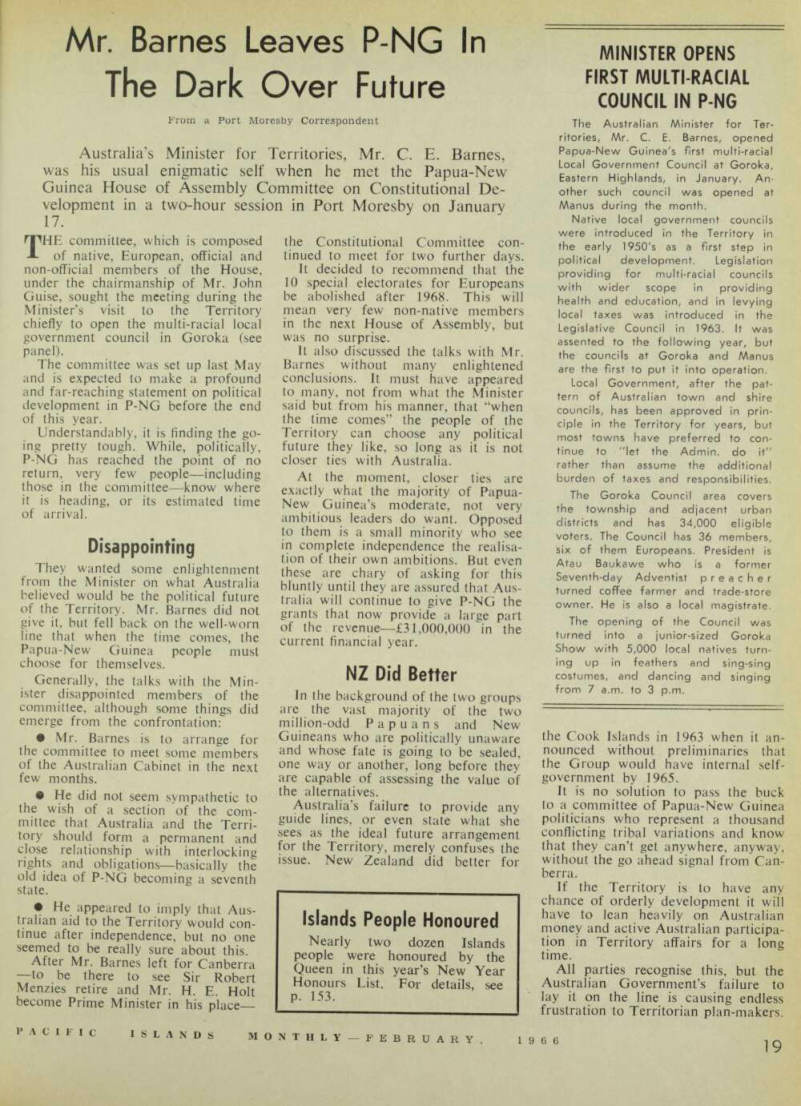
Mr. Barnes Leaves P-NG In The Dark Over Future
From a Port Moresby Correspondent
Australia’s Minister for Territories, Mr. C. E. Barnes, was his usual enigmatic self when he met the Papua-New Guinea House of Assembly Committee on Constitutional De velopment in a two-hour session in Port Moresby on January
THE committee, which is composed of native, European, official and non-official members of the House, under the chairmanship of Mr. John Guise, sought the meeting during the Minister’s visit to the Territory chiefly to open the multi-racial local government council in Goroka (see panel).
The committee was set up last May and is expected to make a profound and far-reaching statement on political development in P-NG before the end of this year.
Understandably, it is finding the go ing pretty tough. While, politically, P-NG has reached the point of no return, very few people—including those in the committee—know where it is heading, or its estimated time of arrival.
Disappointing
They wanted some enlightenment from the Minister on what Australia believed would be the political future of the Territory. Mr. Barnes did not give it, but fell back on the well-worn line that when the time comes, the Papua-New Guinea people must choose for themselves.
Generally, the talks with the Min ister disappointed members of the committee, although some things did emerge from the confrontation: • Mr. Barnes is to arrange for the committee to meet some members of the Australian Cabinet in the next few months. • He did not seem sympathetic to the wish of a section of the com mittee that Australia and the Terri tory should form a permanent and close relationship with interlocking rights and obligations—basically the old idea of P-NG becoming a seventh state. • He appeared to imply that Aus tralian aid to the Territory would con tinue after independence, but no one seemed to be really sure about this.
After Mr. Barnes left for Canberra —to be there to see Sir Robert Menzies retire and Mr. H. E. Holt become Prime Minister in his place—
the Constitutional Committee con tinued to meet for two further days.
It decided to recommend that the 10 special electorates for Europeans be abolished after 1968. This will mean very few non-native members in the next House of Assembly, but was no surprise.
It also discussed the talks with Mr.
Barnes without many enlightened conclusions. It must have appeared to many, not from what the Minister said but from his manner, that “when the time comes” the people of the Territory can choose any political future they like, so long as it is not closer ties with Australia.
At the moment, closer ties are exactly what the majority of Papua- New Guinea’s moderate, not very ambitious leaders do want. Opposed to them is a small minority who see in complete independence the realisa tion of their own ambitions. But even these are chary of asking for this bluntly until they are assured that Aus tralia will continue to give P-NG the grants that now provide a large part of the revenue—£3l,ooo,ooo in the current financial year.
NZ Did Better
In the background of the two groups are the vast majority of the two million-odd Papuans and New Guineans who are politically unaware and whose fate is going to be sealed, one way or another, long before they are capable of assessing the value of the alternatives.
Australia’s failure to provide any guide lines, or even state what she sees as the ideal future arrangement for the Territory, merely confuses the issue. New Zealand did better for
the Cook Islands in 1963 when it an nounced without preliminaries that the Group would have internal self government by 1965.
It is no solution to pass the buck to a committee of Papua-New Guinea politicians who represent a thousand conflicting tribal variations and know that they can’t get anywhere, anyway, without the go ahead signal from Can berra.
If the Territory is to have any chance of orderly development it will have to lean heavily on Australian money and active Australian participa tion in Territory affairs for a long time.
All parties recognise this, but the Australian Government’s failure to lay it on the line is causing endless frustration to Territorian plan-makers.