South Pacific
pp. 15-16 · Read in the full issue
Severe Drought Hits South Pacific
The exceptionally dry weather, in what is generally the wettest period of the year, has been one of the main talking points in the South Pacific in recent months.
IN some places the lack of rain has reached drought proportions, with water and food shortages, poor crops, dying stock and concern over the adequacy of water storage facilities.
The Pacific’s dry weather has coincided with severe droughts in other parts of the Southern Hemi sphere, including Australia and the southern part of Africa.
One of the few territories that has escaped the dry spell is the drought-prone Gilbert and Ellice Islands Colony, where the rainfall has been well above average and the outlook for copra, the colony’s only crop, is the best for some years.
Tarawa, with 120.11 in., had its wettest year since 1953.
Fiji Losses
In Fiji, on the other hand, little or no rain fell in any of the islands from November until January 10 (when the skies opened up), and the drought is expected to have caused almost as much damage to the Colony’s economy as the hurricane and floods last February.
People in the cane areas talk in terms of a couple of million pounds when assessing the damage to the sugar crop. Rice, copra and root crops have also suffered a setback.
“Much of the sugar cane crop will have withered and there is sure to be a shortage of seed cane for planting in 1967,” PlM’s Suva cor respondent says.
Another Fiji industry that has been hit by the drought is the banana industry, which has been recovering from the havoc wrought by last year’s floods. Now, the drought is expected to affect growth and post pone full recovery.
Fiji’s outer islands, such as the Yasawas, were the first to feel the effects of the drought, and by early December, relief food and water supplies had to be shipped to them.
Some villages were limited to so much water per head per day.
On the two main islands of Viti Levu and Vanua Levu the position was looking serious by the beginning of the year and even Suva had to tighten the watercocks.
A couple of weeks before relief came in the shape of two days’ heavy rain beginning on January 10, an announcement in the Royal Gazette made water wasting in Suva a punish able offence.
Although the city’s rainfall last year was 108.87 in. (15.48 in. below average), most of it (73 per cent.) fell in the first five months of the year.
December was the driest since records began in 1884—2.68 in. compared with the average of 12.34 in.
In Apia, Western Samoa, Christmas liquor sales reached an all time high, but in other respects the town had its driest Christmas in liv ing memory.
Rainfall in November and Decem ber was the lowest in the 70 years that records have been kept.
From the meteorological office, Talalelei Pauga reported that rainfall in November was one inch compared with an average of 10.40 in., while rainfall in December totalled 3.02 in. compared with an average of 14.68.
Rainfall for the whole of 1965 totalled 92.49 in. compared with a yearly average of 112.28.
There were no water restrictions in force in Apia during the dry spell and drought conditions did not really prevail as rain fell on various parts of the islands while it was fine in Apia.
In January, Apia’s rainfall ap peared back to normal.
Rain Brings Mosquitoes
In New Caledonia, beneficial rains in late December and early January after several months of drought have given the hills a welcome coating of green.
But the new herbage has proved an ideal breeding ground for mosquitoes, and in Noumea, they have been descending on the citizenry in plague proportions.
Another result of the long drought was a 40 per cent, cut in Noumea’s meat supply.
But the new-look greenness on New Caledonia’s hills did not seem likely to last in late January, as the New Year rains had been followed by boisterous Trade winds of great drying capacity.
On Niue, long spells of dry weather throughout 1965 have affec ted the growth of crops.
Final figures for the year are expected to show that exports were lower than in the previous year.
The weather in Rarotonga, the main island in the Cook Group, has
Clouds, But No Rain
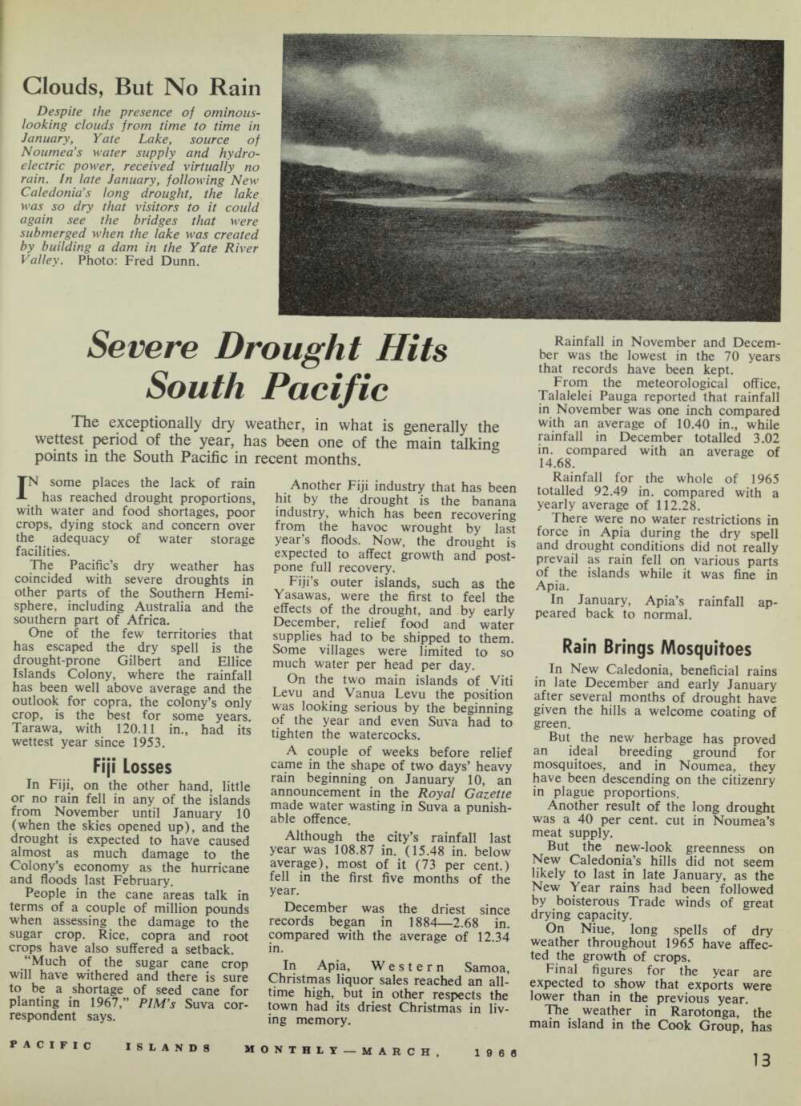
Despite the presence of ominous looking clouds from time to time in January, Yate Lake, source of Noumea’s water supply and hydro electric power, received virtually no rain. In late January, following New Caledonia’s long drought, the lake was so dry that visitors to it could again see the bridges that were submerged when the lake was created by building a dam in the Yate River Valley. Photo: Fred Dunn.
been similar to that experienced in the islands to the west.
Only 1.67 in. fell in November compared with 4.79 in. in the same month in 1964; December had 2.34 in. compared with 3.33 in. in 1964; and less than half an inch had fallen to January 11 compared with 10.90 in. for the whole of January last year.
In the New Hebrides, a drought following the 1964 hurricane has seriously affected the copra industry.
In 1965, only 28,725 tons of copra were exported, compared with 37,666 tons in 1964. However, 1966’s copra yield is expected to be better.
In Pago Pago, American Samoa— famous as the scene of Somerset Maugham’s short story Rain—night time water rationing was intro duced in the Bay area in mid- January, except to the Intercontinental Hotel. This meant that the water was cut off from 10 p.m. to 5 a.m.
Tonga’s weather pattern recently has been similar to that of the drier parts of Fiji.
Norfolk Island, with 32.11 in. in 1965, had its lowest annual rainfall for 70 years. But it got off to a good start in 1966 with 297 points in the first four days.
Parts of Papua-New Guinea have also suffered drought conditions in recent months, but by late December most affected areas had had good rains.
Footnote : As PIM went to press, a hurricane, with winds of more than 100 m.p.h., was reported to have caused millions of dollars worth of damage in American and Western Samoa on January 30. In American Samoa, a state of emergency was declared. A day or two earlier, 10 in. of rain fell in Papeete, Tahiti, and there was also torrential rain in Fiji.