P-Ng's Three Top Jobs
pp. 13-14 · Read in the full issue
Wide Open As Gunther
Takes New Uni. Post
By Stuart Inder
The big Australian territory of Papua-New Guinea (population two million) will soon have a complete change of top administrators. The old firm of Cleland, Gunther and Reeve is splitting up, after almost a de cade of close relationship during which the territory has undergone its greatest expansion.
Dr. John Gunther, 55, who has been Assistant Administrator ( Services ) since 1957, is to become Vice-Chancellor of the new University of Papua-New Guinea, and will almost certainly resign from his key Administration post within a month or two.
11/fR. HAROLD REEVE, formerly Treasurer, who has been Assis tant Administrator (Economic Affairs) since 1961, and who has been on sick leave since late October, left the territory on retirement at the end of January.
Sir Donald Cleland, Administrator since 1953, turns 65 in June, and al though he would prefer to stay until the end of the year he will leave some time after June if a replacement is found for him.
The Administrator’s post has al ready been offered to Sir John Craw ford, Director of the Research School of Pacific Studies, at the Australian National University, and a former secretary of the Commonwealth Department of Trade. He has declined it.
Mr. John Overall, chairman of the National Development Planning Com mittee, Canberra, holder of an MC and Bar, has also been considered re cently. Earlier last year the name of Mr. C. W. Falkinder, DSO, DEC and Bar, Liberal MHR for Franklin, Tasmania, was mentioned.
Dynamic, Efficient
The top job will certainly go to an outsider, and Dr. Gunther must have realised this in recent months.
For a long time he was hopeful that he would take Sir Donald’s place for he has in fact borne the burden of the Territory’s administration in recent years and Sir Donald has been content to let him do it.
There has been no decision of any importance taken that Dr. Gunther has not had a. hand in. He has been dynamic, efficient, a tireless worker, planner, worrier and manipulator.
He has been particularly happy in his political role as Government Leader in the House of Assembly, and his influence there has been vast.
Relations between Canberra and Port Moresby (i.e., Dr. Gunther) have not been the same since the departure of Mr. Paul Hasluck as Minister and Mr. C. R. Lambert as Secretary of the Department of Terri tories. The three seem to have had
an understanding.
Dr. Gunther’s views probably smack too much of socialism for Mr. C. E. Barnes, the new Minister, and there appears to be no love lost between Dr, Gunther and the new
secretary, Mr. G. Warwick Smith— two capable men with minds of their own who size each other up like a couple of sparring partners.
Dr. Gunther has thus been faced with a dilemma. With the Adminis trator’s post not open to him, with a glum prospect of having to show a new man the ropes and then stand in the shadows, with Canberra breath ing down his neck, it was a matter of what to do next.
Unless the university job had come up, Dr. Gunther would undoubtedly have been lost to P-NG. Probably he would have sought a post over seas—perhaps with an international health organisation. He was an imaginative Director of Health (his degree is in medicine) before his appointment as Assistant Admini strator.
He did not apply for the vice chancellor’s post, but his name was put forward by associates and it has been known for some time that he was in the running.
This fact in itself has caused controversy in the Territory, with one group advocating that the uni versity needed an academic and tha' Dr. Gunther’s appointment would be “tragic”.
Others supported his appointment on the grounds that he was a highly efficient administrator with local know-how and just the type of man needed to get a brand new university operating.
The selection committee, at a series of meetings, apparently was split the same way. Some took the view that
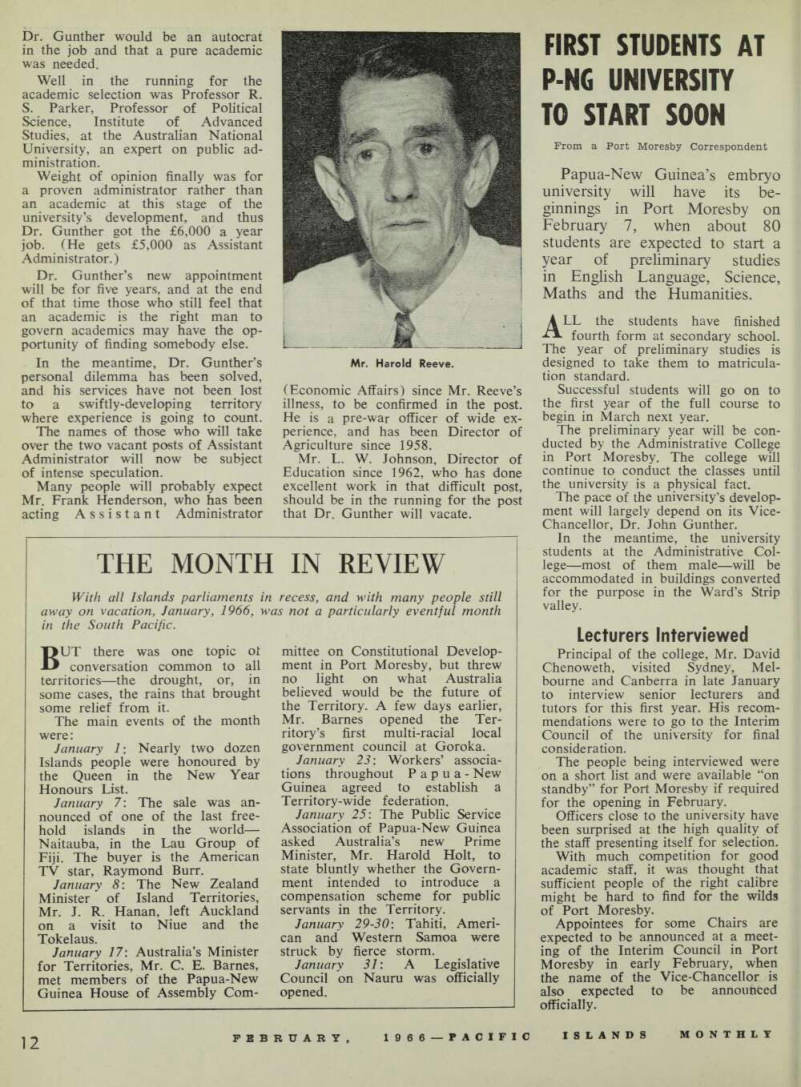
Sir Donald Cleland.
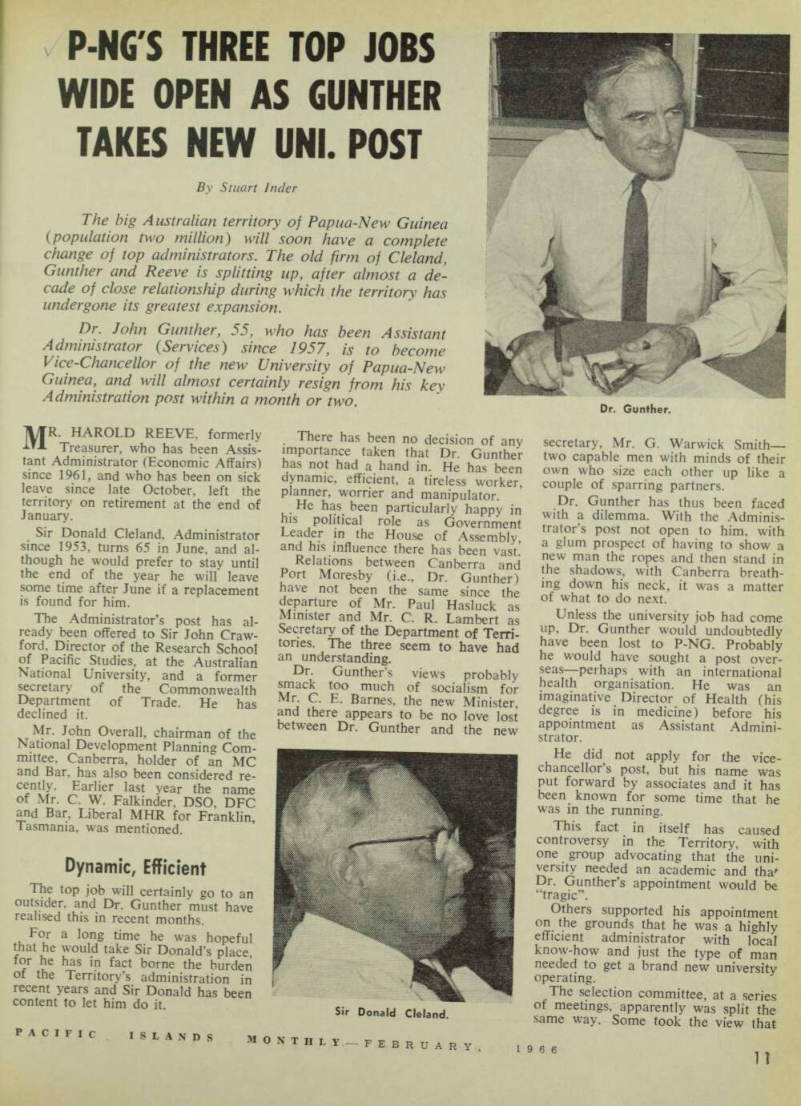
Dr. Gunther.
Dr. Gunther would be an autocrat in the job and that a pure academic was needed.
Well in the running for the academic selection was Professor R.
S. Parker, Professor of Political Science, Institute of Advanced Studies, at the Australian National University, an expert on public ad ministration.
Weight of opinion finally was for a proven administrator rather than an academic at this stage of the university’s development, and thus Dr. Gunther got the £6,000 a year job. (He gets £5,000 as Assistant Administrator.) Dr. Gunther’s new appointment will be for five years, and at the end of that time those who still feel that an academic is the right man to govern academics may have the op portunity of finding somebody else.
In the meantime, Dr. Gunther’s personal dilemma has been solved, and his services have not been lost to a swiftly-developing territory where experience is going to count.
The names of those who will take over the two vacant posts of Assistant Administrator will now be subject of intense speculation.
Many people will probably expect Mr. Frank Henderson, who has been acting Assistant Administrator
(Economic Affairs) since Mr. Reeve’s illness, to be confirmed in the post, He is a pre-war officer of wide ex perience, and has been Director of Agriculture since 1958.
Mr. L. W. Johnson, Director of Education since 1962, who has done excellent work in that difficult post, should be in the running for the post that Dr. Gunther will vacate.
Mr. Harold Reeve.