Pacific Commerce and Produce
pp. 141-142 · Read in the full issue
Much Of The South Seas Goes Decimal In February
February 14 is C-Day in a large slice of the South Pacific —and in a few islands north of it. February 14 is the day Australia converts to decimal currency after 178 years of £sd. The changeover will be followed by her territories and some other islands in her sphere of influence.
THOSE making the changeover on February 14 are the Australian territories of Papua-New Guinea, Nauru and Norfolk Island; together with the British Solomon Islands Pro tectorate, the Gilbert and Ellice Islands Colony (British) and the British-French Condominium of the New Hebrides. Australian currency is legal tender in all these islands.
By mid-1969, the entire South Pacific is expected to be on the decimal system.
New Zealand will change to decimals in July, 1967, and her changeover date will be accepted by the NZ territories of the Cook Islands, Niue and the Tokelaus, the British island of Pitcairn and the independent state of Western Samoa. All use NZ currency.
Tonga, Too
The British protected Kingdom of Tonga, whose currency is on a par with Australia’s, has also decided to make the change but has not fixed a date. It will probably be in 1967.
The British Crown Colony of Fiji, whose currency is midway in value between NZ and Australian, will be last to change. The date is likely to be June, 1969, but there has been no firm decision.
The new Australian dollar, to be come legal in February, will be equal to the present Australian 10/-. New notes will be issued in the denomina tions of $l, $2, $lO and s2o—which are the equivalent of 10/-, £l, £5 and £lO.
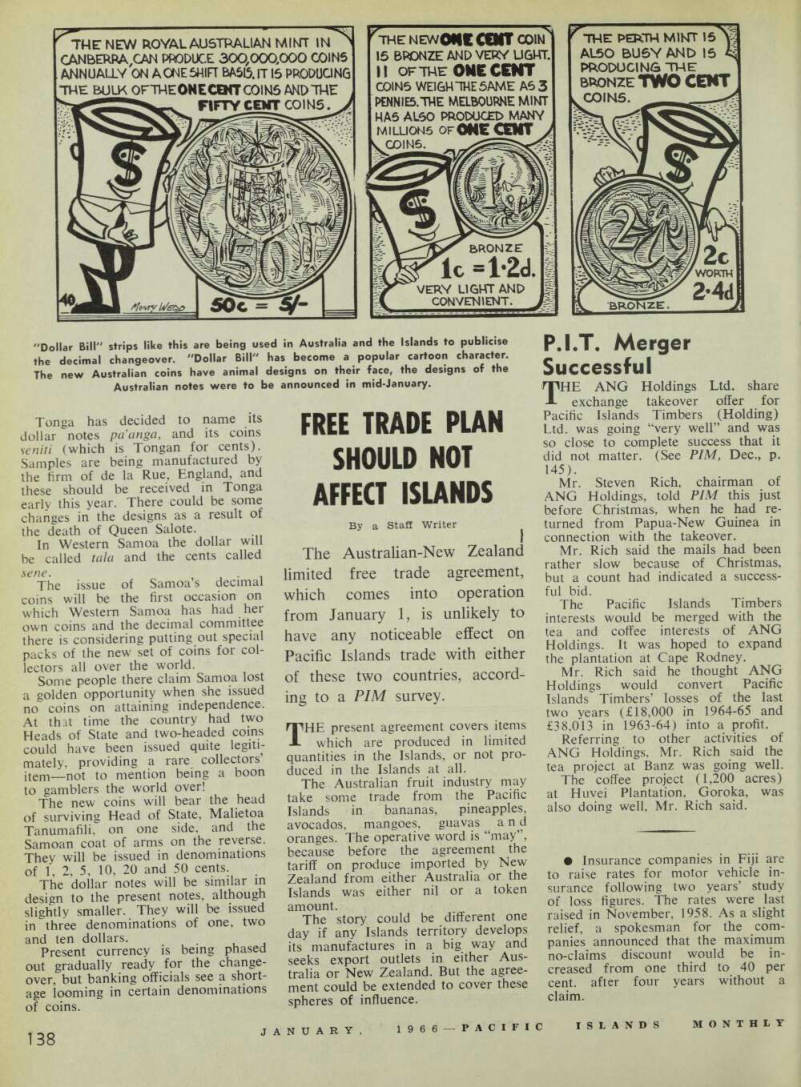
The coins will be 50 cents (silver), equal to 5/-; 20, 10 and 5 cent pieces (cupro nickel) equal to the 2/-, 1/and 6d pieces; and two cent and one cent bronze coins, which have a value of 2.4 d and 1.2 d respectively.
Both the new style money and the old style will be in use together after C-Day, until the £sd pass into history.
Nobody knows when that will be, but
the two currencies will be in opera tion for at least two years.
The territories making the change over in February have been mounting publicity campaigns in recent months, aimed at making the switch as smooth as possible. Most of their publicity material has been distributed through the Australian Decimal Currency Board, which has been campaigning in Australia for several years.
Press, radio, theatres and schools have all taken part in the Islands’ campaigns. Sets of plastic coins and paper money have been distributed in some areas to get the locals used to the look and feel of the new money.
Much of the Islands publicity has been directed at getting across the fact that both £sd and dollars will be legal and that there is no pos sibility that the old money will be revalued.
In Honiara, Mr. J. H. Cameron, the manager of the Commonwealth Banking Corporation, which controls the Protectorate’s only bank, says that if the fact that two currencies are
operating is not fully understood there could be an initial shortage of some denominations of the new coins because of a heavier-than-expected demand.
The amount of Australian coins which has “gone underground” in the Solomons in past years is unknown, he says, but it is thought to be sub stantial. He thinks it will be interest ing to find out how many locals want to convert their cash immediately.
The same problems apply in P-NG, where even the old German marks are still seen occasionally, although they ceased to be legal tender as far back as 1921. They were in regular circulation in some areas, particularly the Sepik, until the outbreak of World War 11. Traders continued to recog nise them, although the Treasury re called all that came into its hands.
Many New Guineans like to bury their silver, despite the growing appreciation of folding money and banks, and “old style” silver coins will probably turn up years hence.
Various Islands officials have been in Australia in recent months, obtain ing information on decimal pro cedures. These include a man from the Western Samoan Government, Mr. John Wendt, and two Tongan Government officials, T. Faha’ivalu Taumoepeau and T. Masiva ’Ofa. (Over)
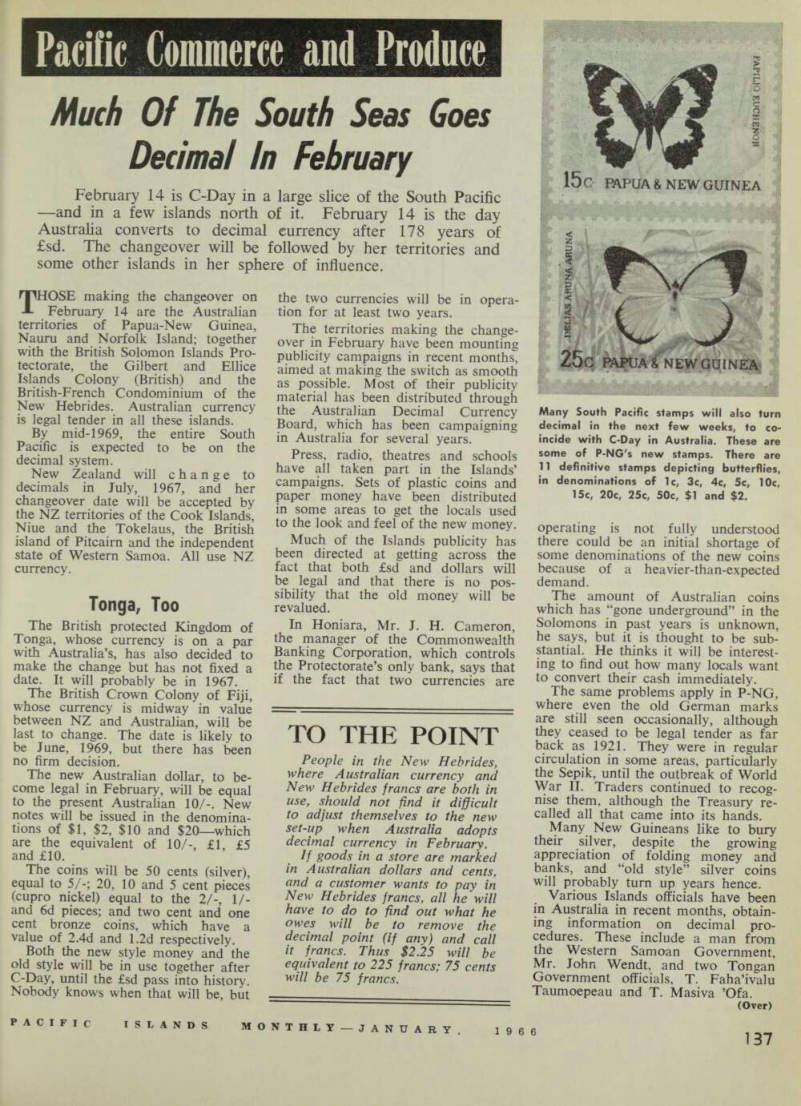
Many South Pacific stamps will also turn decimal in the next few weeks, to co incide with C-Day in Australia. These are some of P-NG's new stamps. There are 11 definitive stamps depicting butterflies, in denominations of 1c, 3c, 4c, 5c, 10c, 15c, 20c, 25c, 50c, $1 and $2.
Tonga has decided to name its dollar notes pa’anga, and its coins seniti (which is Tongan for cents).
Samples are being manufactured by the firm of de la Rue, England, and these should be received in Tonga early this year. There could be some changes in the designs as a result of the death of Queen Salote.
In Western Samoa the dollar will be called tala and the cents called sene.
The issue of Samoa s decimal coins will be the first occasion on which Western Samoa has had her own coins and the decimal committee there is considering putting out special packs of the new set of coins for col lectors all over the world.
Some people there claim Samoa lost a golden opportunity when she issued no coins on attaining independence.
At that time the country had two Heads of State and two-headed coins could have been issued quite legiti mately. providing a rare collectors i tem —not to mention being a boon to gamblers the world over!
The new coins will bear the head of surviving Head of State, Malietoa Tanumafili, on one side, and the Samoan coat of arms on the reverse.
They will be issued in denominations of 1, 2, 5, 10, 20 and 50 cents.
The dollar notes will be similar in design to the present notes, although slightly smaller. They will be issued in three denominations of one, two and ten dollars.
Present currency is being phased out gradually ready for the change over, but banking officials see a short age looming in certain denominations of coins.
"Dollar Bill" strips like this are being used in Australia and the Islands to publicise the decimal changeover. "Dollar Bill" has become a popular cartoon character.
The new Australian coins have animal designs on their face, the designs of the Australian notes were to be announced in mid-January.