new history of Pitcairn
pp. 96-97 · Read in the full issue
Nobbs mystery unsolved in new history of Pitcairn
Since 1808, when Captain Mayhew Folger, of the Ameri can sealer Topaz, discovered the hideout of the Bounty mutineers on Pitcairn Island, a bountiful literature has grown up about what has happened on that island since January, 1790, when the mutineers landed there with their Polynesian wives.
THE latest literary effort on Pitcairn is a history by Robert B.
Nicholson, a New Zealander living in Sydney. He became interested in the island in the 1950’s when he met a descendant of the Bounty mutineers and traced his family tree.
Nicholson’s book, The Pitcairners, claims that although much has been written about Pitcairn, a lot of it has been romance, and that, in an effort to tell the truth, The Pitcairners has been compiled from original material —printed work only being used where it is substantiated by diaries, letters, Admiralty reports and suchlike material.
Although Nicholson has certainly not excluded uncorroborated “printed work” as source material as rigidly as he claims, a glance at his voluminous five-page bibliography shows that he has gone to consider able pains to make his book an ac curate and valuable reference work.
His first chapters, recounting the story of the Bounty mutiny, the mutineers’ subsequent search for a home, and their early, murderous days on Pitcairn, contain no material that previous writers have not thoroughly combed over.
But the author begins to tap some little known and little exploited sources when he gets on to Pitcairn’s early visitors, although experts will notice a few omissions in his account of these.
Not mentioned
The author has not mentioned, for example, the intriguing story of the ship’s boat crew which landed on Pitcairn long before Mayhew Folger’s arrival in the Topaz and collected coconuts while the Pitcairners remain ed in hiding. Nor has he described how, in 1819, Captain James Hender son, of the Hercules, raised a sub scription of 3,500 rupees for the Pitcairners in Calcuta with which he bought numerous necessities for them.
On the other hand, good use has been made of some valuable manu
script material concerning Captain Thomas Raine’s visit to Pitcairn in the Surry in 1821. This is in the possession of Mr. E, C. R. Raine, of Sydney.
Probably the best chapters in the book are those concerning George Hunn Nobbs, an Irish-born adventurer who settled on Pitcairn in 1828, and Joshua Hill, a mad Englishman, who ruled Pitcairn as a dictator from 1832 to 1837.
Nobbs’ story has elements of mystery that have never been plumbed. After a career in the British and Chilean Navies, he arrived at Pitcairn from Peru in a 20-ton boat with a single companion, Noah Bunker.
The two men told the Pitcairners that they had come from Peru with the express intention of settling on Pitcairn, although their boat contained gear for catching seals. Both claimed to be the owner of the boat.
The Pitcairners were not keen to have the two men come among them, but finally consented. Soon after wards, Bunker, who had been sick on arrival, threatened to kill himself; and after two months, he threw him self over a 150 ft cliff, badly injuring himself.
Killed himself
A week later when Jacques Moerenhout, a visitor to Pitcairn, asked him why he had made the voyage from Peru in such a small boat, Bunker answered: “As you may imagine, the reasons were very power ful ones, but I cannot tell you what they were”.
When Moerenhout returned to Pitcairn a month or two after this, he found that Bunker had killed him self from an overdose of laudanum obtained from a passing ship, and that Nobbs had burned all of Bunker‘s papers except the ship’s licence, the bill of health, and the list of crew allegedly at Bunker’s request.
The crew list showed Bunker as captain and Nobbs as chief officer, but the name of the owner on both
the ship’s licence and the bill of health was not that of either man.
There was thus something ex tremely “fishy” about the circum stances surrounding the arrival at Pitcairn of Bunker and Nobbs, and as Nobbs later became an ordained pastor, was received by Queen Vic toria and was a leader of the Pit cairn community when it moved to Norfolk Island in 1856, no history of Pitcairn will really be complete until someone finds out what it was.
Nicholson gives a detailed account of the move to Norfolk and of the events leading up to it—and there, pretty well, his book comes to an end, for Pitcairn’s history over the last 109 years is dismissed in a bare eight pages.
Three invaluable appendices then follow—one listing the dates of birth, death, marriage, etc. of every Pitcairner from 1790 to 1856; one listing the Pitcairners who made an abortive attempt to settle on Tahiti in 1831; and one listing Pitcairn’s chief magistrates from 1838 to the present day.
One of the few clearly erroneous statements in the book is that the Pitcairners, who were seen surfboard riding in 1821, apparently invented that sport themselves, “as there ap pears to be no early record of the sport in Tahiti”.
Surfboard-riding was described by several of Tahiti’s early visitors—one of them being James Morrison, the Bounty's boatswain’s mate.—RL. (THE PITCAIRNERS. Angus and Robert son, Sydney. 47/6).
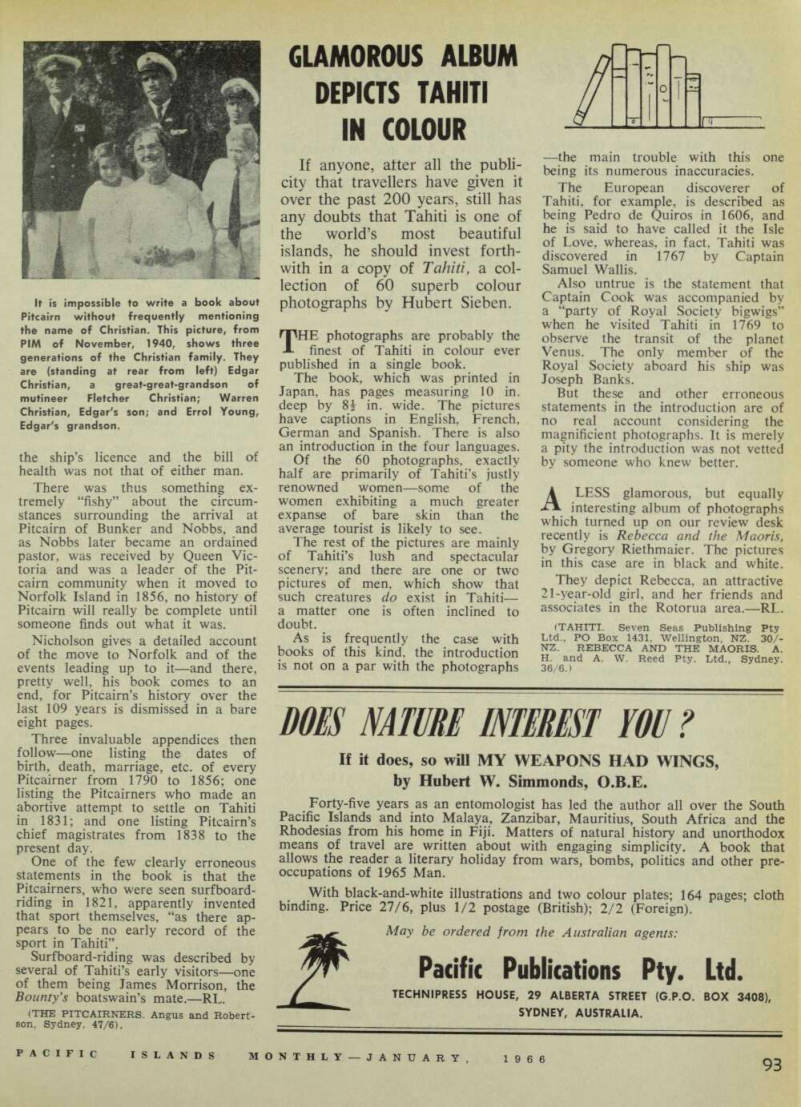
It is impossible to write a book about Pitcairn without frequently mentioning the name of Christian. This picture, from PIM of November, 1940, shows three generations of the Christian family. They are (standing at rear from left) Edgar Christian, a great-great-grandson of mutineer Fletcher Christian; Warren Christian, Edgar's son; and Errol Young, Edgar's grandson.