Charcoal From
pp. 73-76 · Read in the full issue

Tanna Tells An
Ancient Tale
Evidence that the island of Tanna, New Hebrides, was in habited by man more than 2,000 years ago was collected by two
American archaeologists during
excavations on that island in
February-April, 1964.
THE two Americans are Dr.
Richard Shutler, Jr., and his wife Mary Elizabeth, who also made surveys and excavations on the New Hebridean islands of Aneityum, Aniwa, Futuna, Erromanga and Efate between November, 1963, and June, 1964. Their archaeological in vestigations were the first ever made in the New Hebrides, Tn a preliminary report on their investigations, just issued, they say that a radiocarbon sample of char coal collected at a depth of 126 inches at the bottom of a midden on Tanna gave a date of 420 BC. The midden was in a rock shelter near the modern village of Bethel on the south coast.
Commenting generally on their discoveries on Tanna, the Shutlers said: “We were able to obtain per mission from the Tannese to work only in the southern part of the island. Along that coast we recorded five rock shelters, a large village site, and numerous small midden areas.
They represent, of course, only a small fraction of the probably very
great archaeological resources of the island. . . . The population, at least along the south coast, was evidently small and scattered. The villages appear to have been tiny hamlets which were frequently moved. Caves and rock shelters were used as fish ing camps and refuges, and occasion ally, as burial places”.
The Shutlers’ general comments on their work on other islands were: ANEITYUM: “As on almost all of the islands of the New Hebrides, the extremely dense vegetation makes
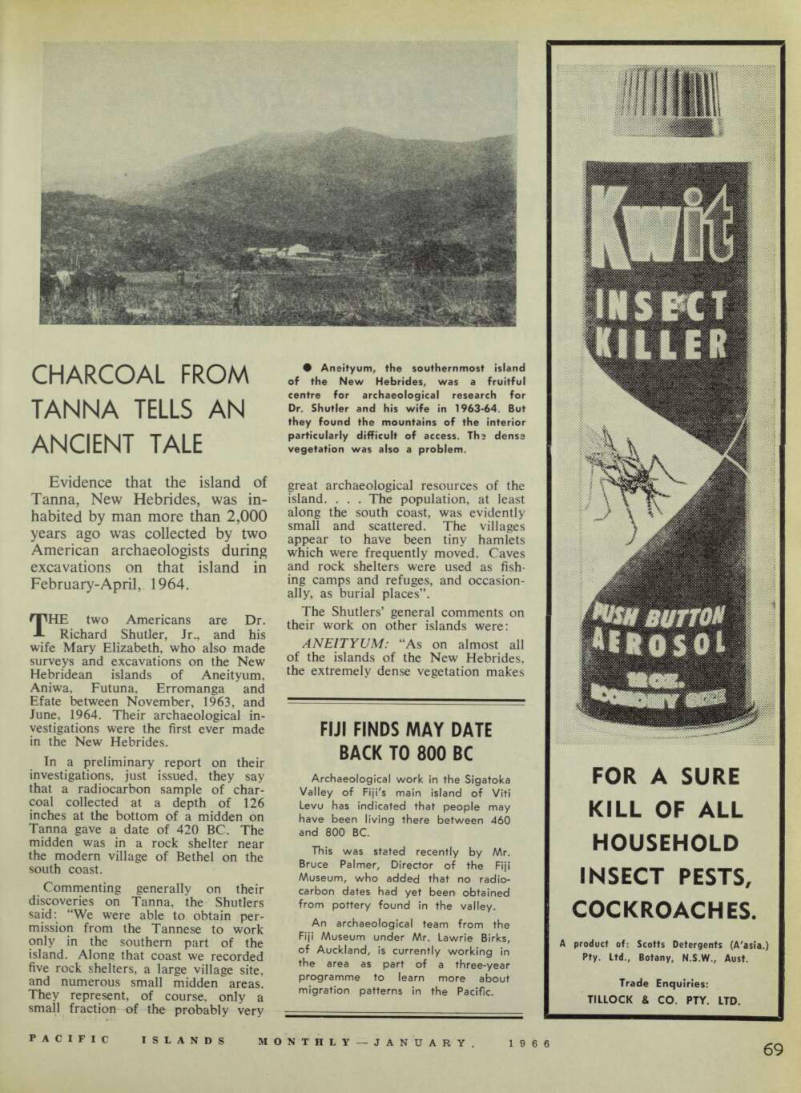
Aneityum, the southernmost island of the New Hebrides, was a fruitful centre for archaeological research for Dr. Shutter and his wife in 1963-64. But they found the mountains of the interior particularly difficult of access. The dense vegetation was also a problem.
travel on the island and the location of archaeological sites difficult. . . .
We recorded 20 archaeological sites on Aneityum, 17 of them on the coastal plain and three in the interior. Eleven of the sites are caves or rock shelters and seven are old village sites. In addition there are two areas of basaltic boulders covered with petroglyphs. These represent probably only a part of the sites yet to be recorded on Aneityum”.
The Shutlers said that radiocarbon samples of charcoal taken from the bottom of middens at two sites on the west coast of Aneityum gave dates of 1480 AD and 1100 AD.
Aneityum, the southernmost island in the New Hebrides, is about 17 miles long by 10 miles wide, and roughly rectangular in shape. The interior is mountainous.
ANIWA: “Sixteen archaeological sites were recorded on Aniwa, 15 village sites and one cave. . . . The list probably represents the greater part of the archaeological remains on the island. The Aniwans knew the locations of old villages, knew their names, and were able to re
count traditions concerning the sequence and circumstances of their founding.
“Aniwa, like Futuna its neighbour, is a Polynesian outlier. The inhabitants of these two islands speak closely related varieties of the same Polynesian language.” (Aniwa is a small flat coral island off the east coast of Tanna. It is about four miles long and threequarters to H miles wide.) FUTUNA: “Futuna is a small volcanic island about two miles square lying directly east of Tanna.
Its mountainous central plateau rises 2,000 feet abruptly from the sea.
Suitable lands for villages and fields are severely limited so that the modern population and the archaeo logical sites are concentrated in a few areas. . . . The inhabitants knew the names and locations of old villages, “We recorded 38 sites on the island, 19 rock shelters and 19 open middens. This probably represents pretty nearly the total inventory of archaeological sites on Futuna,”
The Shutlers added that a radio
carbon date of 1045 AD was derived from a sample of charred leaves from an earth oven on Futuna.
ERROMANGA: “Erromanga is a very large volcanic island situated between Tanna and Efate. Bad weather prevented us from making more than a brief visit to the island.
Six caves bearing cultural deposit were noted. . . . The only artifact we have from the island is a large ‘boat’ shaped ground piece of tridacna shell. ... It was said to be shell money and is very similar to a piece of shell money collected on Yap”.
EFATE: “Efate is a large volcanic island north of Erromanga. We
worked . . . only in the area around Vila Harbour. Four village sites and eight rock shelters were found in this area”, The Shutlers said that a consider able collection of pot sherds was made on Fila, a small, sandy island in Vila Harbour. The design element of this was similar to that found on modern pottery from Santo and on archaeological sherds from Fiji and New Caledonia.
Radiocarbon dates obtained from material on Fila Island ranged from 860 AD to 1135 AD. A radio carbon sample of charcoal from the mainland gave a date of 725 AD.