Territories TALK-TALK
pp. 57-61 · Read in the full issue

With Tolala
JFz7/z t/zls month we enter another Elevenses Year. It is 1966. There is a good game called Elevenses (nothing to do with the office morning tea-break), and I started it back in February, 1922.
808 CROFT, an accountant, and I had arrived at the New Guinea Club in Rabaul after the usual work day at the Expropriation Board office had ceased. The drinks had arrived and I was signing the chit. Writing the date, I remarked: “Two, two, twenty-two. The second of February, 1922. I wonder, Bob, where we’ll be on three, three, thirty-three”. “God knows”, Bob replied. It was then I suggested that wherever we might be we would try and get in touch with each other “just for fun”. Bob agreed.
On March 3, 1933, I had returned to Sydney from a trip to New Zealand and was walking up Martin Place towards Castlereagh Street.
Coming towards me was Bob Croft, whom I had not seen for years.
Naturally we toasted the coincidental rendezvous, expressed hopes for 1944 and exchanged addresses and departed.
There was no mail service where I was on April 4, 1944. I could not write to Bob for I was in the Jap boob in Rabaul. The air blitz was too intense for comfort; not a house was standing in the town. The last building to go was Government House up on Namanula Hill. Our boob was a cave near the quarry up from the Malaquna Road.
The rendezvous I did make in ’44 for ’55 (with somebody else) did not eventuate, for my friend had gone to his Long Rest, and that has also happened to my “date” for ’66. But its a good game if you can last the distance. . . . On 6/6/66 (if I am here) I shall turn down an empty glass, but am making no rendezvous for 7/7/77.
Chips Off
Old Blocks
The seventh meeting of the P-NG House of Assembly, which began on November 23, did not receive much publicity from the Sydney Press, but there was an interesting story in the Sydney Morning Herald by David
White, who attended the opening and managed to get on the beam better than many.
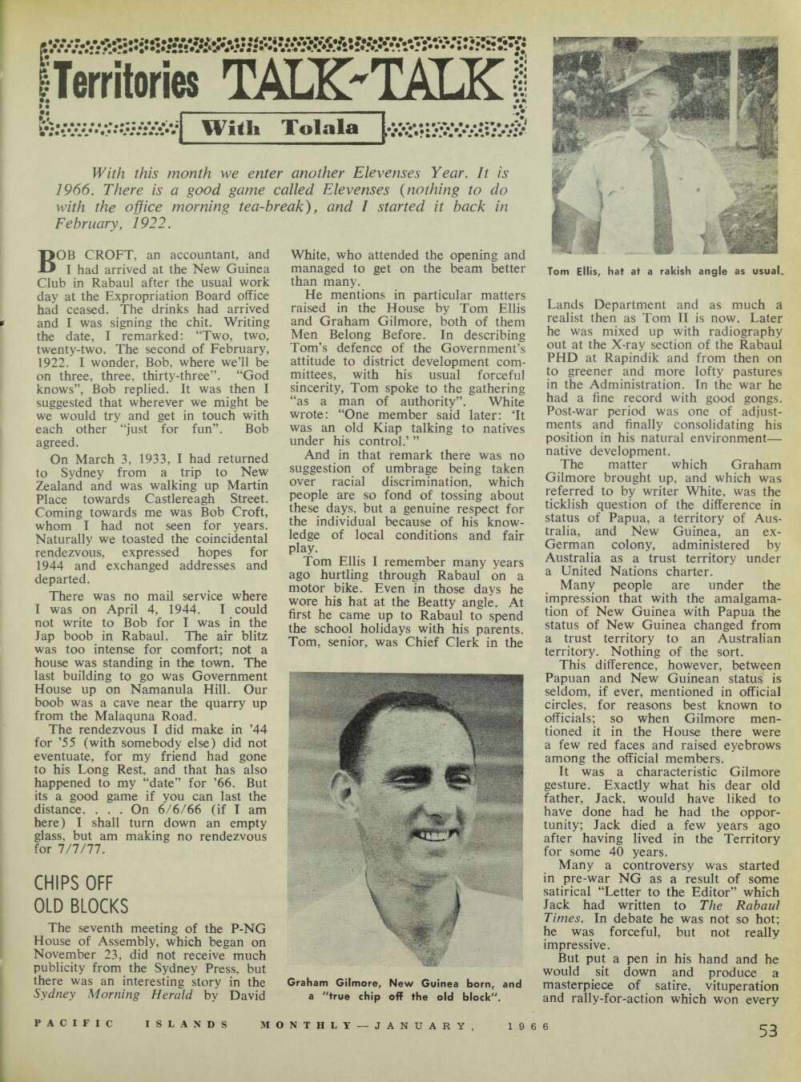
He mentions in particular matters raised in the House by Tom Ellis and Graham Gilmore, both of them Men Belong Before. In describing Tom’s defence of the Government’s attitude to district development com mittees, with his usual forceful sincerity, Tom spoke to the gathering “as a man of authority”. White wrote: “One member said later: ‘lt was an old Kiap talking to natives under his control.’ ”
And in that remark there was no suggestion of umbrage being taken over racial discrimination, which people are so fond of tossing about these days, but a genuine respect for the individual because of his know ledge of local conditions and fair play.
Tom Ellis I remember many years ago hurtling through Rabaul on a motor bike. Even in those days he wore his hat at the Beatty angle. At first he came up to Rabaul to spend the school holidays with his parents, Tom, senior, was Chief Clerk in the
Lands Department and as much a realist then as Tom II is now. Later he was mixed up with radiography out at the X-ray section of the Rabaul PHD at Rapindik and from then on to greener and more lofty pastures in the Administration. In the war he had a fine record with good gongs.
Post-war period was one of adjust ments and finally consolidating his position in his natural environment— native development.
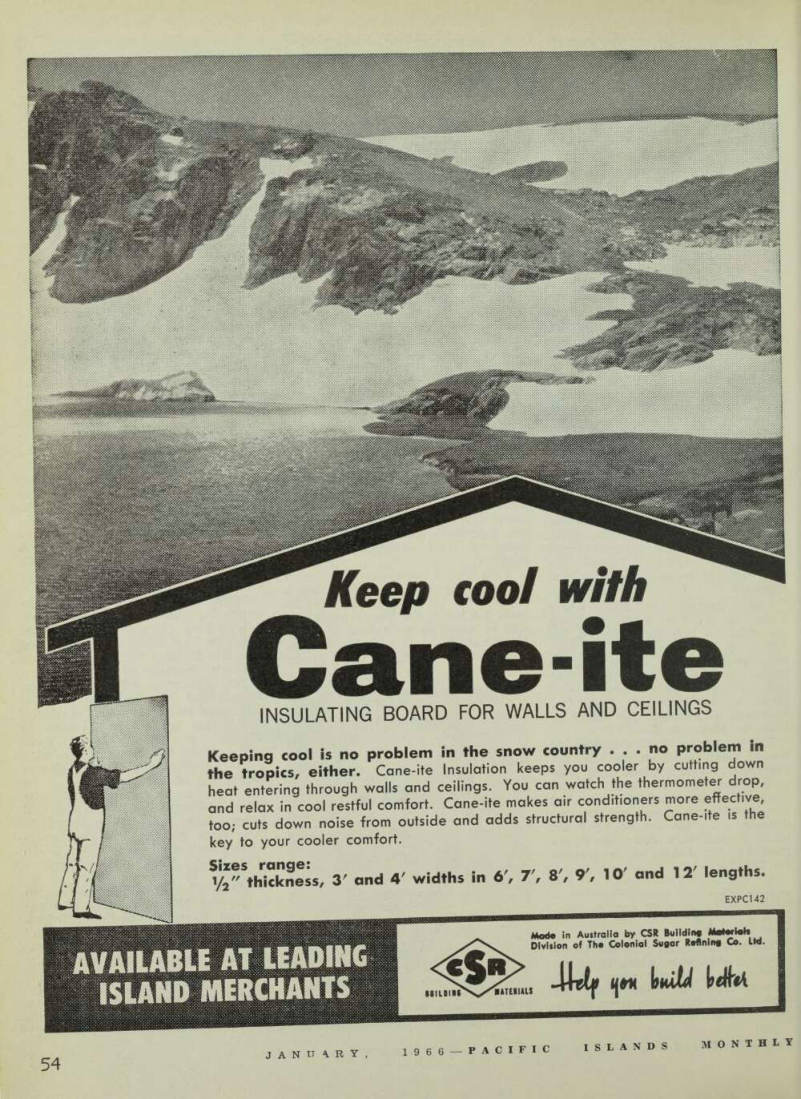
The matter which Graham Gilmore brought up, and which was referred to by writer White, was the ticklish question of the difference in status of Papua, a territory of Aus tralia, and New Guinea, an ex- German colony, administered by Australia as a trust territory under a United Nations charter.
Many people are under the impression that with the amalgama tion of New Guinea with Papua the status of New Guinea changed from a trust territory to an Australian territory. Nothing of the sort.
This difference, however, between Papuan and New Guinean status is seldom, if ever, mentioned in official circles, for reasons best known to officials; so when Gilmore men tioned it in the House there were a few red faces and raised eyebrows among the official members.
It was a characteristic Gilmore gesture. Exactly what his dear old father, Jack, would have liked to have done had he had the oppor tunity; Jack died a few years ago after having lived in the Territory for some 40 years.
Many a controversy was started in pre-war NG as a result of some satirical “Letter to the Editor” which Jack had written to The Rabaul Times. In debate he was not so hot; he was forceful, but not really impressive.
But put a pen in his hand and he would sit down and produce a masterpiece of satire, vituperation and rally-for-action which won every
Graham Gilmore, New Guinea born, and a "true chip off the old block".
Tom Ellis, hat at a rakish angle as usuah.
reader’s attention. And now son Graham charges in, undeterred, a true chip off the old block: fear less, resolute and realistic.
A factor which could (anyway, should ) have brought about an Appreciation of Varied Status is the amazing amount of capital expendi ture in the Papuan territory, while the trust territory must content itself with a little more than maintenance costs.
It reminds me of the days when in the early twenties the Expropria tion Board had a routine answer to all the worrying managers on old German plantations who wrote in asking for material to construct new kilns, bungalows, bridges, wharves and ships.
The answer was: “The policy of the board is, as trustees of the properties, to maintain the asset as taken over as at the date of pre scription. There is no provision for capital expenditure”.
From observations over the past decade or so it would appear that very much the same policy is being pursued now with the trust terri tory.
Where do all the big, substantial buildings go? Where the halls of culture, the schools of learning? In the trust territory? . . . Eliza Doolittle had an answer to that.
And, since the amalgamation of the two territories, it is noteworthy that oil drilling has been confined to the Australian, not the trust terri tory.
Gilmore didn’t get very far with his motion in the House; but he did bring the status question out of moth balls, in which it has been hidden so securely all these years.
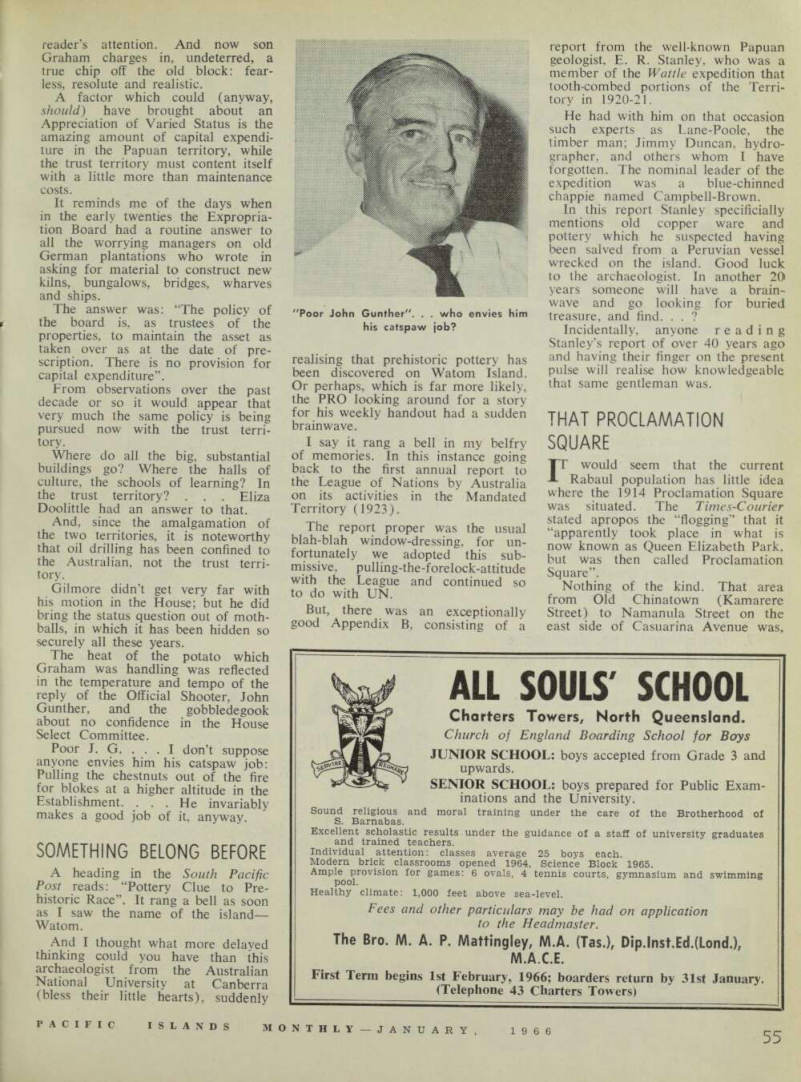
The heat of the potato which Graham was handling was reflected in the temperature and tempo of the reply of the Official Shooter, John Gunther, and the gobbledegook about no confidence in the House Select Committee.
Poor J. G. . . . I don’t suppose anyone envies him his catspaw job; Pulling the chestnuts out of the fire for blokes at a higher altitude in the
Establishment. . . . He invariably
makes a good job of it, anyway.
Something Belong Before
A heading in the South Pacific Post reads: “Pottery Clue to Pre historic Race”. It rang a bell as soon as I saw the name of the island— Watom.
And I thought what more delayed thinking could you have than this archaeologist from the Australian National University at Canberra (bless their little hearts), suddenly
realising that prehistoric pottery has been discovered on Watom Island.
Or perhaps, which is far more likely, the PRO looking around for a story for his weekly handout had a sudden brainwave.
I say it rang a bell in my belfry of memories. In this instance going back to the first annual report to the League of Nations by Australia on its activities in the Mandated Territory (1923).
The report proper was the usual blah-blah window-dressing, for un fortunately we adopted this sub missive, pulling-the-forelock-attitude with the League and continued so to do with UN.
But, there was an exceptionally good Appendix B, consisting of a
report from the well-known Papuan geologist, E. R. Stanley, who was a member of the Wattle expedition that tooth-combed portions of the Terri tory in 1920-21.
He had with him on that occasion such experts as Lane-Poole, the timber man; Jimmy Duncan, hydro grapher, and others whom I have forgotten. The nominal leader of the expedition was a blue-chinned chappie named Campbell-Brown.
In this report Stanley specificially mentions old copper ware and pottery which he suspected having been salved from a Peruvian vessel wrecked on the island. Good luck to the archaeologist. In another 20> years someone will have a brain wave and go looking for buried treasure, and find, . . ?
Incidentally, anyone reading Stanley’s report of over 40 years ago and having their finger on the present pulse will realise how knowledgeable that same gentleman was.
That Proclamation
Square
r would seem that the current Rabaul population has little idea where the 1914 Proclamation Square was situated. The Times-Courier stated apropos the “flogging” that it “apparently took place in what is now known as Queen Elizabeth Park, but was then called Proclamation Square”.
Nothing of the kind. That area from Old Chinatown (Kamarere Street) to Namanula Street on the east side of Casuarina Avenue was.
"Poor John Gunther". . . who envies him his catspaw job?
at the the time of the incident, a "beautiful” field of kunai grass with, I think, only three buildings on the whole block. These were Mrs. Hoff’s small bungalow, Steve Whiteman’s pretentious domicile and a non descript two-storey shack on high posts at the corner of Namanula Street and Casuarina Avenue.
Mrs. Hoff, a personality-plus German woman who owned Kolube plantation over on New Ireland, could run to a town house. Steve Whiteman, who was once described by an itinerant journalist of the day as “the best-dressed man in the Pacific”, had a small store in Rabaul.
Whiteman was an ex-employee of Queen Emma and, as biographer R.
W. Robson tells us in his excellent Queen Emma, recently published, she was a lady discriminative in her choice of virile, presentable male retainers in her court. And so one naturally includes among the Aus tralian section Steve Whiteman, along with such handsome and/or lively characters as Fred Jolley, “Whiskey”
Miller, Bob Bunting (uncle of the current Bob) and some others who will remain nameless.
I will leave Steve Whiteman for another day. He was a colourful character, and his wife, Eileen, was no less colourful. But Steve was an individualist: he wore tussore silk suits in Rabaul when everyone else was wearing twill or drill!
It was not until the late twenties that any effort was made to start a recreation ground on the present Elizabeth Park area: a cricket pitch was laid out opposite the Rabaul Hotel in Park Street. Cricket had previously been played on a pitch near the police compound.
Later on a baseball diamond and a football ground were added and then a grandstand was erected at the Pacific Hotel end of the ground.
This grandstand was the site where white residents of Rabaul had their first experience of colour discrimina tion. This was in 1942, when all residents still remaining in Rabaul were marched to the oval by the Jap conquerors and the whites were made to stand in the sun while the Asians and natives were given seats in the stand. This was part of the Co- Prosperity Scheme.
As for the dinki-di Proclamation Square; It lay between the present Toma Street-Central Avenue-Mango Avenue-Tavur Street. It was always an open space in the pre-War II days. Toma Street was the last street from the town going south, the next landmark was the group of Hern sheim & Co.’s old buildings which became the property of Cyril Gascoigne, the local auctioneer.
This group included the double storey bulk store which, for many years, was used as the Masonic Temple for Rabaul Lodge 4468 EC, consecrated on Anzac Day, 1923.
In earlier days—around 1911— the double-storey building was a part of Furst Bismarck Hof hotel, the rendezvous for Rabaul drinkers, with discriminating tastes at the stipulated times.
I remember calling there on oc casions in 1911 and being impressed by the flopping hats of the ladies (the teenagers of that period being Dollie Parkinson, Lulu Hoepfel and Phoebe Horgren. Trust an old man’s memory for a pretty face).
Bits And Pieces
Suggestion : To Methodists looking for their land records as reported in Territory papers; Why not turn up the old Government Gazettes—the German Amtsblatt and our own. At one time, I remember, all land trans actions were recorded in them. They are still available in public libraries. . . . Passed on: H. G. (Tex) Marshall in Sydney late November.
A good soldier of two wars and a good comrade in peace. . . . Keith Johnson, one of the early NG cadet patrol officers who did an excellent job in the service and had a good war record.