Suwarrow's Hermit Stays
pp. 55-56 · Read in the full issue
Put In "Paradise"
• When the Cook Islands schooner "Akatere" sailed from Rarotonga on November 18 for Palmerston, Nassau, Pukapuka and Suwarrow Islands, she had on board Mr. John Tariau, the member for Pukapuka in the Cook Islands Legislative Assembly, who had been entrusted by the Government with a possibly difficult mission. His mission was to contact and, if possible, remove from Suwarrow the 27-year-old hermit Michael Swift, a Londoner, who was illegally landed on the island in September from the New Zealand trimaran "Highlight" (PIM, Nov. p. 39).
Here is a report on the outcome of Mr. Tariau's mission, written on December 8 by Mr. T. Nena, a radio operator at Rarotonga's radio station.
From T. Nena on Rarotonga Everyone in these Islands and, for that matter, millions of people all over the world have been eagerly awaiting news about Michael Swift on Suwarrow Island.
SWIFT is very much alive and well, on Anchorage Islet.
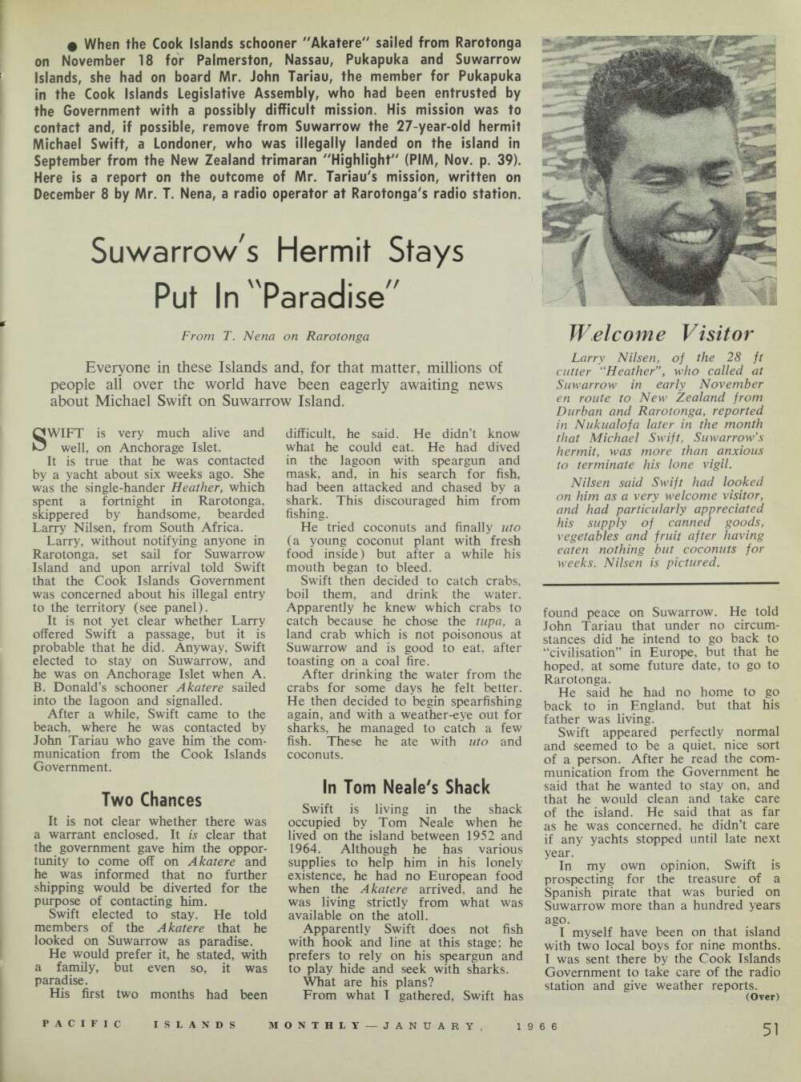
It is true that he was contacted by a yacht about six weeks ago. She was the single-hander Heather, which spent a fortnight in Rarotonga, skippered by handsome, bearded Larry Nilsen, from South Africa.
Larry, without notifying anyone in Rarotonga, set sail for Suwarrow Island and upon arrival told Swift that the Cook Islands Government was concerned about his illegal entry to the territory (see panel).
It is not yet clear whether Larry offered Swift a passage, but it is probable that he did. Anyway, Swift elected to stay on Suwarrow, and he was on Anchorage Islet when A.
B. Donald’s schooner Akatere sailed into the lagoon and signalled.
After a while, Swift came to the beach, where he was contacted by John Tariau who gave him the com munication from the Cook Islands Government.
Two Chances
It is not clear whether there was a warrant enclosed. It is clear that the government gave him the oppor tunity to come off on Akatere and he was informed that no further shipping would be diverted for the purpose of contacting him.
Swift elected to stay. He told members of the Akatere that he looked on Suwarrow as paradise.
He would prefer it, he stated, with a family, but even so, it was paradise.
His first two months had been
difficult, he said. He didn’t know what he could eat. He had dived in the lagoon with speargun and mask, and, in his search for fish, had been attacked and chased by a shark. This discouraged him from fishing.
He tried coconuts and finally uto (a young coconut plant with fresh food inside) but after a while his mouth began to bleed.
Swift then decided to catch crabs, boil them, and drink the water.
Apparently he knew which crabs to catch because he chose the tupa, a land crab which is not poisonous at Suwarrow and is good to eat. after toasting on a coal fire.
After drinking the water from the crabs for some days he felt better.
He then decided to begin spearfishing again, and with a weather-eye out for sharks, he managed to catch a few fish. These he ate with uto and coconuts.
In Tom Neale's Shack
Swift is living in the shack occupied by Tom Neale when he lived on the island between 1952 and 1964. Although he has various supplies to help him in his lonely existence, he had no European food when the Akatere arrived, and he was living strictly from what was available on the atoll.
Apparently Swift does not fish with hook and line at this stage; he prefers to rely on his speargun and to play hide and seek with sharks.
What are his plans?
From what I gathered, Swift has
found peace on Suwarrow. He told John Tariau that under no circum stances did he intend to go back to “civilisation” in Europe, but that he hoped, at some future date, to go to Rarotonga.
He said he had no home to go back to in England, but that his father was living.
Swift appeared perfectly normal and seemed to be a quiet, nice sort of a person. After he read the com munication from the Government he said that he wanted to stay on, and that he would clean and take care of the island. He said that as far as he was concerned, he didn’t care if any yachts stopped until late next year.
In my own opinion, Swift is prospecting for the treasure of a Spanish pirate that was buried on Suwarrow more than a hundred years ago.
I myself have been on that island with two local boys for nine months.
I was sent there by the Cook Islands Government to take care of the radio station and give weather reports. (Over)
After two months I started to look for the treasure, but, unfortunately, I found nothing.
Well, I hope you are interested in this bit of news about Suwarrow’s hermit.
As the kerosene of my lamp is getting low. I must say goodnight.
Mr. W. H. Percival, of Rarotonga, reports that when John Tariau and the Akatere’s master, Captain Archie Pickering, went ashore at Suwarrow to contact Swift, they found him look ing the part of a hermit, with his dark brown hair falling to his shoulders and his beard grown long and bushy. Mr. Percival goes on: “Mr. Tariau gave Swift a message from the Cook Islands Government which offered him the choice of re maining on Suwarrow at his own risk, or of travelling to Rarotonga, port of entry and seat of Govern ment of the Cooks, where he might have to face charges of being an illegal immigrant.
“It was made clear to Swift that he had broken the law by landing on Suwarrow without official per mission, and that no other vessels could be diverted to take him off.
“He elected to stay on Suwarrow and wrote a letter to that effect, exonerating the Government from all responsibility.
“Swift told his visitors that he was completely happy on Suwarrow and did not wish to leave. He was un afraid of possible ill-effects from the French nuclear tests to be held in the Tuamotus this year.
“Captain Pickering and a friend gave Swift a rooster and a hen. John Tariau handed him an armful of Aus tralian illustrated magazines, and others gave him coffee, tea and sugar,”
EDITORS’ NOTE: The notion that there is a Spanish pirate’s treasure on Suwarrow seems to have originated in 1855 when John Lavington Evans, supercargo of the Caroline Hort, a ship from Tahiti, is said to have dug up a box of specie on the island containing about 15,000 dollars, with dates “co-incident with the era of Commodore Anson” (about 1740). Later, another man is said to have found 2,400 dollars at the foot of an old iron wood tree. And in 1876, a young New Zealander, Henry Abbott Mair, is said to have found an iron box containing coins and rings set in precious stones.
Mair’s discovery—if not the others — seems to have been authentic. Since Mair’s time, many people have searched for treasure on Suwarrow, but no one, as far as we know, has found any.