Brigand Bus-Operators -
pp. 49-51 · Read in the full issue

They're A Dying Race
In Fiji Nowadays
From a Suva Correspondent Fiji’s buses, all 430 of them, brightly coloured, mostly windowless, but all certified fit for service, passed a milestone in November.
rwas the end of the first decade of control of the bus industry by the Government under the Transport Control Board, and no doubt all 65 registered operators, including one woman, celebrated, in their hearts at any rate, the occasion.
But there were no celebrations when the Transport Control Board came into being in November, 1955, following a commission of inquiry into the industry.
It was just the reverse. One opera tor even hired an assassin to remove the Senior Certifying Officer, Mr.
Fred Goodrum, because he saw in him a menace to the fat living he was making out of risking lives in his ramshackle outfits.
Touting
The industry was in a serious mess when the Government decided to try to bring law and order to the bus industry, which had more than its share of hi-jackers and brigands.
In those days, although it was an offence to tout for passengers, it was a familiar sight to see a bus leave the bus station and tour Suva before setting off for, say, Nausori, with the driver shouting at the top of his voice, “Any more for Nausori” or its Fijian or Hindi equivalent.
Buses jockeyed for position on the roads, racing each other to spots where passengers congregated. When competition was extra hot, there were cut-price rides. When business was brisk, the fares went up.
Most of that finished in 1955 when the Transport Control Board, under the present chairman, Mr. C. S.
Reay, laid down a formidable set of regulations.
Proper timetables were established.
Operators were licensed for every route. Fares were regulated.
Wasteful competition was elimina ted. Bad, very bad operators, were forced out of business. And a strict check began on the fitness of buses, many of which were banned from the roads.
Murder Attempt
Mr, Goodrum, now the Chief Technical Officer, and Mr. Ray Clendenning, now Senior Certifying Officer, along with Mr. Mike Laird, who is now in Australia, bore the brunt of the fight to establish the new order.
The board and its officers had been in being only a few months, harrying the operators and civilising the industry when the attempt was made on Mr. Goodrum’s life.
A man crept up on his house one night and hurled an iron bar, sharpened into a spear, through the window. It grazed Mr. Goodrum’s throat, but otherwise he was un scathed.
The assailant was arrested, con fessed to the crime, and was given nine years in gaol. He revealed the name of the bus operator, who had hired him for the crime, but the bus operator escaped the law by dying.
On the night of the murder attempt, when he was informed of its failure, he had a stroke and died soon after wards.
No other bus operator went to such an extreme to register his protest. But Mr. Clendenning got a big collection of threatening letters, and Mr. Laird was beaten up on the bus station.
"Civil War"
Meanwhile—in fact, right up to 1962—the operators engaged in “civil war”. Some of the more un scrupulous used to leave bananas filled with large nails on the road for their rivals’ tyres, or nail-studded palm fronds. They also slashed their rivals’ tyres and coils, or stole their spark plugs.
There were even one or two at tempts at arson, but they were half hearted.
Gradually, however, the operators realised the value of control, of pro tection of their routes, of the re moval of bad and unfair competition.
Today, most of the operators are steady-going responsible men.
There is the occasional bad hat, of course. All buses are examined periodically and if they are not fit, their certificate of fitness is with drawn and the bus is taken off the road.
Various ruses have been used to obtain certificates for unroadworthy
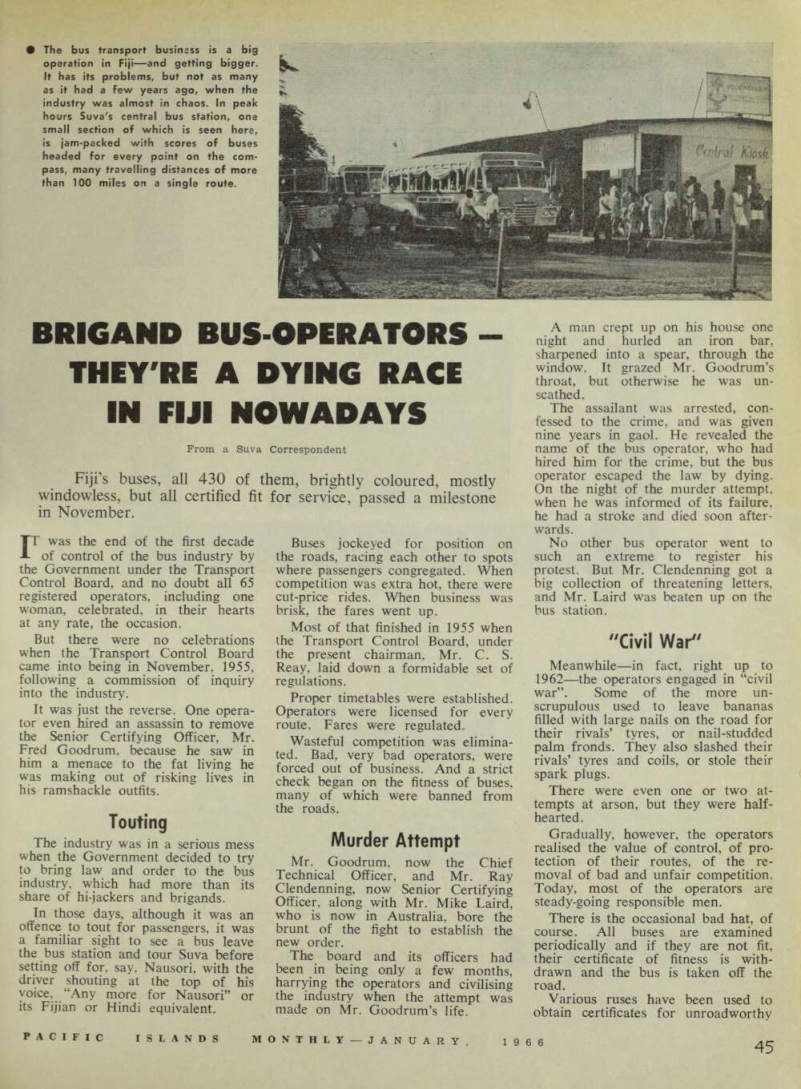
The bus transport business is a big operation in Fiji—and getting bigger.
It has its problems, but not as many as it had a few years ago, when the industry was almost in chaos. In peak hours Suva's central bus station, one small section of which is seen here, is jam-packed with scores of buses headed for every point on the com pass, many travelling distances of more than 100 miles on a single route.
buses. One operator, with two buses, but only one gearbox, got a certificate for his first bus, then put the gearbox in the other bus and brought that one in to be certified.
But a hawk-eyed inspector found him out.
Another operator was caught the same way. He had been switching engines.
At one time, an enterprising Suva man made a lucrative living by hiring new tyres to bus operators—the tyres being returned when the board’s examiners had given their buses a clean bill. He went bankrupt in the end because the bus operators re fused to return the tyres, and he could not complain to the police.
Fiji can be proud of its bus in dustry now, and of its Transport Control Board which holds all its meetings in public so that justice can both be done and be seen to be done.
The board issues a precis of pro ceedings at each meeting, plus copies of all applications for amended services and such like.
Metal Bodies
Some of this literature makes humorous reading. There was a woman operator, for instance, who wrote that she would be able to handle a certain service because she was shortly “to be delivered of a new bus”.
The board is now planning to insist on metal bodies for the Colony’s buses instead of wooden bodies, and already such buses are coming on the roads.
Of the 430 registered buses now operating, only five were not locally built.
Three of the importations are luxury jobs operated by the biggest and most efficient company, Pacific
Transport Company, which owns 30 buses.
What about prices? At present, Fiji’s bus fares are among the cheapest in the world. The first mile costs threepence, but after three miles the fare shrinks to just over a penny a mile and stays like that. The longest journey one can make by bus —l6O miles—costs 16/6.
But bus fares are expected to go up soon. The main reason for this is that too many buses stand idle for too many hours.
“We get tremendous peak hour loadings,” Mr. Goodrum says: “We get the workers and school children all at the same time and the bus
companies must cater for them.
Consequently, they have to have enough buses for peak hours and then they have most of their buses standing idle and earning nothing for most of the day.”
Apart from the low fares, the bus operators have only one real com plaint at the moment. There’s too much “piracy” by taxi-drivers, they say.
"Body-Snatching"
The worst “pirates”, the bus operators claim, are the owner drivers who are buying taxis on the never-never and must find their in stalments by the end of each month or lose their taxis.
With more than 1,200 operators in the overcrowded taxi industry— about 700 or them in Suva —there is hardly a living for the little man.
So he has to resort to “body snatch ing” from the buses.
Although it is against the law to tout for passengers and, indeed, to allow a shared fare, the taxi drivers openly compete for passengers with the buses.
Driving ahead of a bus, they draw up at a bus stop and collect seven or eight passengers, all of whom pay no more than the bus fare.
Three miles for sixpence in a com fortable taxi—and most Fiji taxis are comfortable—isn’t to be sneezed at, particularly if a passenger has had a long wait in the hot sunshine or the drenching rain for a bus which is running late.
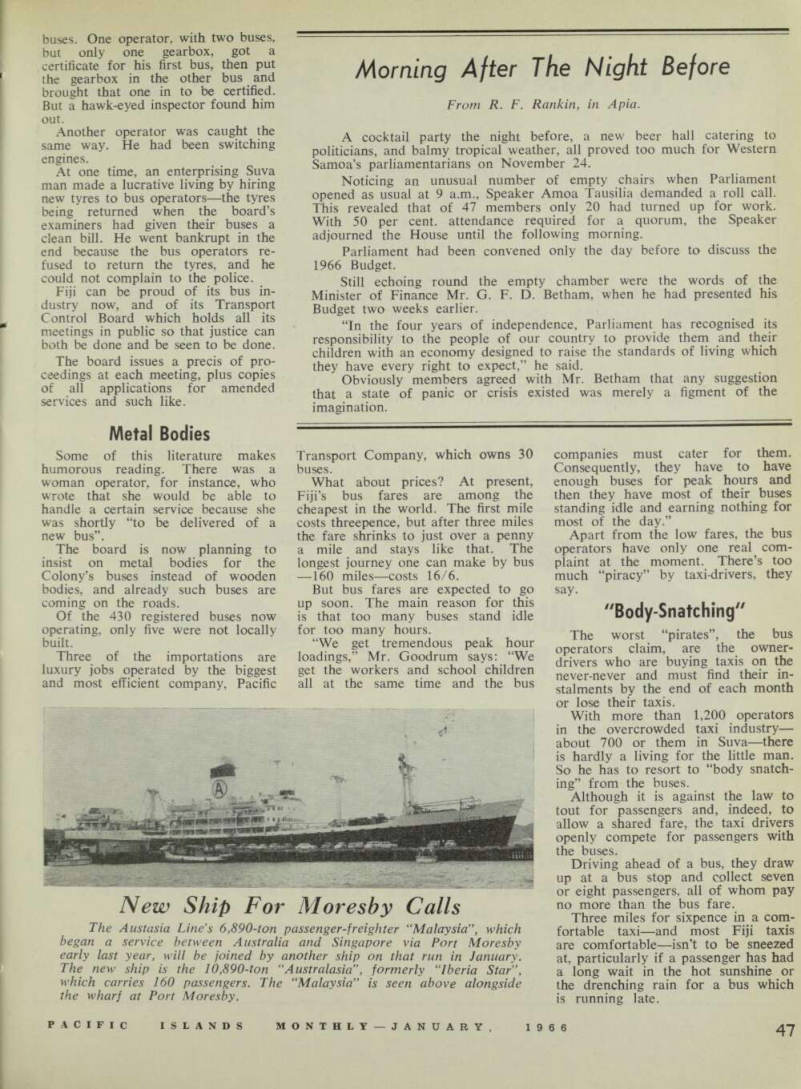
New Ship For Moresby Calls
The Austasia Line's 6,890-ton passenger-freighter “Malaysia”, which began a service between Australia and Singapore via Port Moresby early last year, will be joined by another ship on that run in January.
The new ship is the 10,890-ton “Australasia”, formerly “Iberia Star”, which carries 160 passengers. The “Malaysia” is seen above alongside the wharf at Port Moresby.