Puzzling Economics
pp. 37-39 · Read in the full issue

Of New Guinea's
Economic Affairs
From a Port Moresby Correspondent
Papua-New Guinea, which
now is in the position of having advisers to advise advisers, has digested another expert. The ap pointment of Mr. A. W.
McCasker as Economic Adviser to the Administration, on the recommendation of the World Bank Mission, has been accepted without a murmur. Or almost.
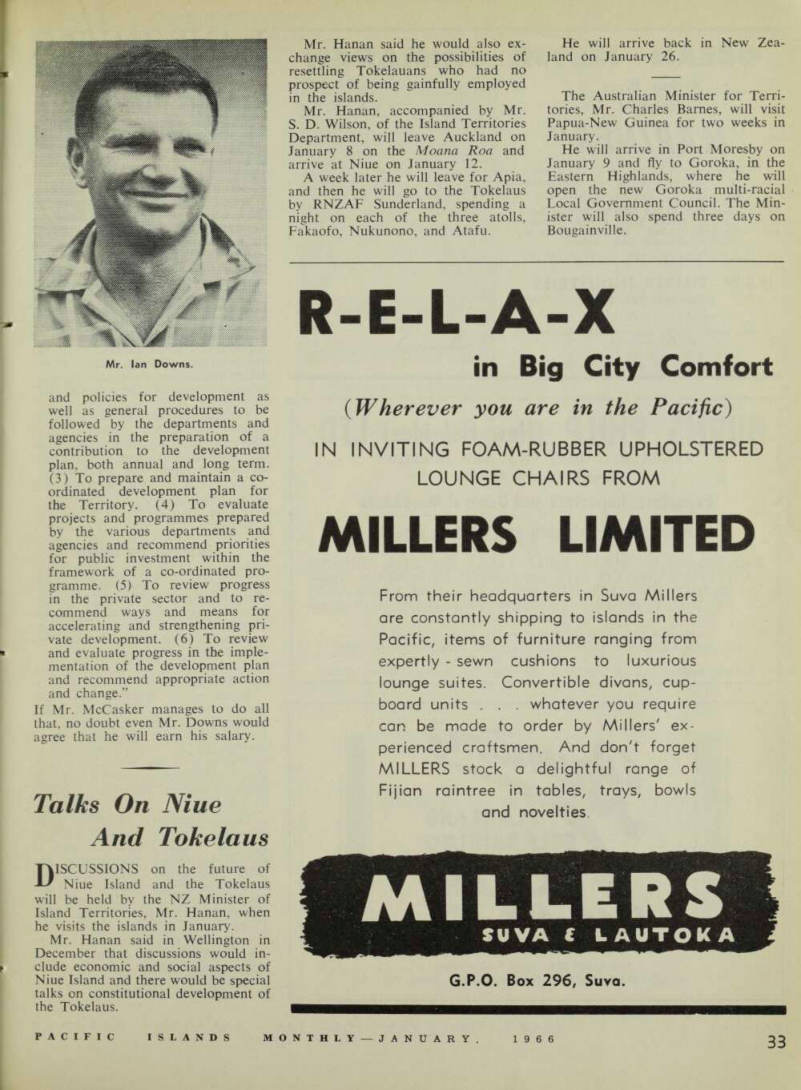
MR. lAN DOWNS, who keeps a censorious eye on such matters for the good of his constituents, had a few words to say on the subject in the House of Assembly in No vember. It could be, he thought, just another classic example of the public services solving another public ser vice problem by appointing another public servant.
The whole set-up of economic ad vice in the Territory seemed confused to him, he said. He felt that Mr.
McCasker might be confused also and that some people within the Administration itself might be con fused.
All Very Confused
“The Treasurer”, Mr. Downs went on, “is an officer who has something to do with economic affairs. Within the Treasurer’s own department there is a Director of Finance (Mr. Ritchie) who has something to do with economic affairs.
“And then we have an Assistant Administrator (Economic Affairs) — —he has something to do with economic affairs—plus the Central Policy and Planning Committee which no doubt has something to do with economic affairs.
“On top of these people—and capable of putting them in their re spective places—we have, in Can berra, a First Assistant Secretary (Economics).
“. . . I do not think [the new appointment] makes a great deal of sense unless the powers and duties of these people are defined and I hope that in this session someone on the Government side can tell us where the Central Policy and Plan ning Committee begins and ends; whether or not the Economic Adviser
will join this committee; whether the Assistant Administrator (Economic Affairs) and Economic Adviser will separate their functions and how these two gentlemen will liaise with the Director of Finance in the De partment of Treasury.
“Also, on top of that, can we also be told how the First Assistant Secretary of Territories in Canberra will fit into this picture? Unless these needs are made clear the public, the officers concerned will be in grave doubt as to what it is all about.”
Mr. Downs got an answer from Dr.
John Gunther, Assistant Adminis trator (Services) the following day.
It ran into three foolscap pages but set out the new Economic Adviser’s main duties thus: (1) To assist, in conjunction with the departments and agencies the availability of resources, both physical and financial for develop ment. (2) To co-ordinate and stimulate the planning activities of the departments and agencies in cluding the preparation of criteria
and policies for development as well as general procedures to be followed by the departments and agencies in the preparation of a contribution to the development plan, both annual and long term. (3) To prepare and maintain a co ordinated development plan for the Territory. (4) To evaluate projects and programmes prepared by the various departments and agencies and recommend priorities for public investment within the framework of a co-ordinated pro gramme. (5) To review progress in the private sector and to re commend ways and means for accelerating and strengthening pri vate development. (6) To review and evaluate progress in the imple mentation of the development plan and recommend appropriate action and change.”
If Mr. McCasker manages to do all that, no doubt even Mr. Downs would agree that he will earn his salary.
Mr. lan Downs.