Playing Cards,
pp. 29-31 · Read in the full issue
No Casino, Or Playing Cards, For Keith
From a Port Moresby Correspondent Off-course betting—SP, to give it its Australian name—got the green light, or seemed to, in the Papua-New Guinea House of Assembly in November. It
was agreed by usually disagree
ing members that it was better to let it go on under the lap than legalise it and thus permit bookmakers to advertise them selves.
IN coming to this conclusion (in order to save the natives from themselves) the Treasury gave up the idea of collecting what the proposer of the bill, Mr. Keith Tetley, of Gulf, calculated would be £200,000 a year in tax.
One of the chief opponents of the proposed legislation was Mr, Percy Chatterton, a LMS missionary and the member for the Central electorate.
He seemed to think that the licens ing of betting shops in the Territory would turn it into some sort of Pacific Las Vegas. It would be, he said, “the first step down a very slippery slope.
The next thing will probably take the form of a banner across Ela Beach Road saying ‘Come to Keith’s Casino.’ ”
Native members, he pointed out, had tried to introduce legislation against gambling at the last Assembly meeting.
Mr. W. Watkins, Secretary for Law,
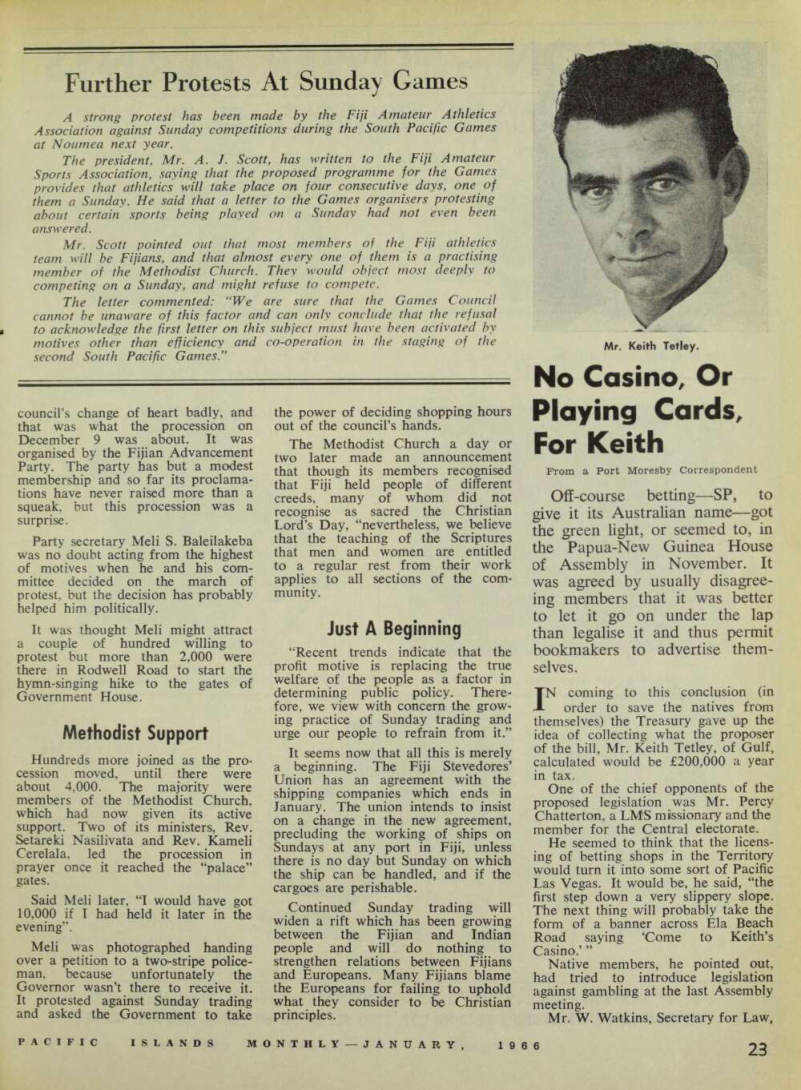
Mr. Keith Tetley.
said that although he did not often agree with Mr. Chatterton he did on this occasion. A few natives patronised SP bookies now but if such betting were legalised it would attract a great many more—to the detriment of the people of the Territory.
The bill was defeated before it reached the second reading stage.
Mr. Tetley had no better luck with his Gaming (Playing Cards) Ordin ance Repeal Bill which he introduced first at the September meeting of the House a few days after the famous Gaming (Playing Cards) Bill had been pushed through by New Guinean members who supported it.
The original ordinance seeks to pro hibit gambling in the Territory by the extraordinary procedure of licensing playing cards which are to be hired from gaming houses but returned thereto as soon as a game is com pleted. It also seeks to prohibit the import or local manufacture of cards.
The reason behind it was that some Highlands members believed that native gambling was ruining the country.
This first bill was introduced by Sinake Giregire of Goroka, and at that stage, endless time was spent in the House while it merits were gone over ad infinitum by most other New Guinean members. More endless time was spent recently when the same speakers said the same things in speaking against Mr. Tetley’s effort to have the ordinance repealed. In the end Mr. Tetley’s efforts were de feated and the original Sinake Giregire legislation stands—awaiting the assent or dissent of the Admin istrator. (See PIM, Dec., p. 19).
In the division only five people sup ported Tetley but it is safe to say that not one European really believes in the Giregire legislation—it is, for
one thing, virtually unworkable-—but nearly all have lent themselves to dangling it before the eyes of bemused New Guinean members as some sort of diversionary sugar-plum.
Quite frequently commonsense ideas from native members are turned down for policy reasons. But in this case there has been smug agreement that “we’ll let you have this one— then you can’t be too annoyed if we turn you down on something im portant.”
In the meantime, while those higher up the line are deciding the ultimate fate of the Gaming (Playing Cards) Ordinance, there has been a reported boom in playing card sales in the Territory.
A GROUP of Fiji businessmen visit ing Auckland in December said many Indian traders were confused over the details of new Customs regulations for New Zealand which were to be applied from January 1 ( PIM, Dec., p. 135), but the regula tions would probably seriously affect trade. The regulations are designed to crack down on New Zealanders returning from overseas with duty free articles. The amendments will reduce the number of duty free cameras the New Zealanders can bring back from two to one, and portable TV sets will be dutiable. The businessmen said they would like to see a New Zealand Customs officer visit Fiji to explain the regulations.