Fiji's Sunday
pp. 27-29 · Read in the full issue

Trading War Brings Deeper Issues Into The Open
From John Carter, in Suva
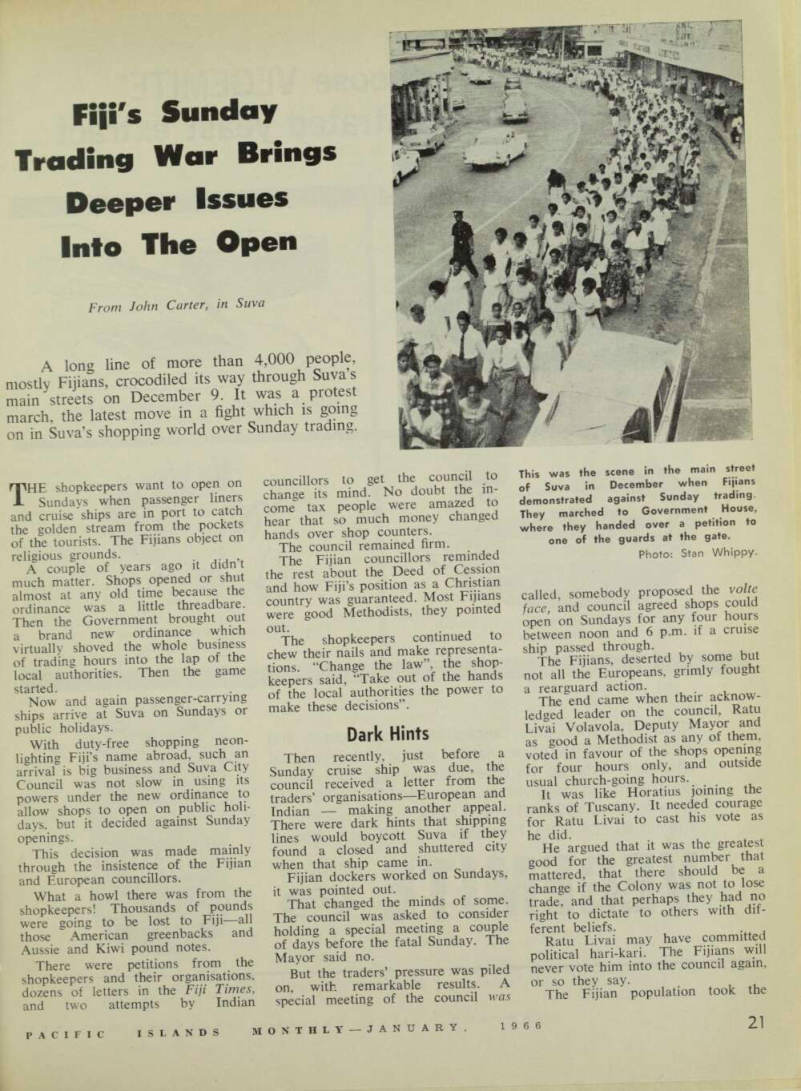
A long line of more than 4,000 people, mostly Fijians, crocodiled its way through Suyas main streets on December 9. It was a protest march, the latest move in a fight which is going on in Suva’s shopping world over Sunday trading.
fpHE shopkeepers want to open on 1 Sundays when passenger liners and cruise ships are in port to catch the solden stream from the pockets of t£°fourists The Fijians object on
religious grounds.
A couple of years ago it didn t much matter. Shops opened or shut almost at any old time because the ordinance was a little threadbare.
Then the Government brought out a brand new ordinance which virtually shoved the whole business of trading hours into the lap of the local authorities. Then the game started. .
Now and again passenger-carrying ships arrive at Suva on Sundays or public holidays.
With duty-free shopping neonlighting Fiji’s name abroad, such an arrival is big business and Suva City Council was not slow in using its powers under the new ordinance to allow shops to open on public hobdays, but it decided against Sunday openings.
This decision was made mainly through the insistence of the Fijian and European councillors. sho T pte e perTand^eh n or g a r nration h s, an? nS tw f o' et a,tempts the by '' Man
councillors to nd Bet N^ in° change its No double m come tax changed hear mat mnnters hands The pi : ian councillors reminded rest about the Dee( i G f Cession position as a Christian a W J guaranteed. Most Fijians cou y Me tbo di sts they pointed were good Methodists, tney poi out. choD keepers continued to , tb eir nads and m ake representachew them 1 hands f fu local’authorities the power to ° f £ e Lions”. make these aecisio r\ L Mintc UarK mmS Then reC ently, just before a s unday cruise ship was due, the counc ii received a letter from the trad ers’ organisations—European and x n di a n making another appeal.
There were dark hints that shipping lines would boycott Suva if they found a closed and shuttered city when that ship came in.
Fijian dockers worked on Sundays, But the P-ure tvas piled speciaf meedng of the council was
, , called, somebody proposed the volte face, and council agreed shops could Qn Sundays for any four hours between noon and 6 p.m. if a cruise ship passed through, The FijianSs deserte d by some but not all the Europeans, grimly fought a rearguard action. , The end came when their acknow ledged leader on the council, Ratu Livai Volavola, Deputy Mayor an as good a Methodist as any of them voted in favour of the shops open g f or four hours only, and outside usual church-going hours, it was like Horatms joining me ran ks of Tuscany. It needed courage f or Ratu Livai to cast his vote as he did. , orcatest He argued that it was Jhe greatest good for the greatest number that mattered that here should be never vote him into the council again, The Fijian population took the
This was the scene in the main street of Suva in December when Fijians demonstrated against Sunday trading.
They marched to Government House, where they handed over a petition to one of the guards at the gate.
Photo: Stan Whippy.
council’s change of heart badly, and that was what the procession on December 9 was about. It was organised by the Fijian Advancement Party. The party has but a modest membership and so far its proclama tions have never raised more than a squeak, but this procession was a surprise.
Party secretary Meli S. Baleilakeba was no doubt acting from the highest of motives when he and his com mittee decided on the march of protest, but the decision has probably helped him politically.
It was thought Meli might attract a couple of hundred willing to protest but more than 2,000 were there in Rodwell Road to start the hymn-singing hike to the gates of Government House.
Methodist Support
Hundreds more joined as the pro cession moved, until there were about 4,000. The majority were members of the Methodist Church, which had now given its active support. Two of its ministers, Rev.
Setareki Nasilivata and Rev. Kameli Cerelala, led the procession in prayer once it reached the “palace” gates.
Said Meli later, “I would have got 10,000 if I had held it later in the evening”.
Meli was photographed handing over a petition to a two-stripe police man, because unfortunately the Governor wasn’t there to receive it.
It protested against Sunday trading and asked the Government to take
the power of deciding shopping hours out of the council’s hands.
The Methodist Church a day or two later made an announcement that though its members recognised that Fiji held people of different creeds, many of whom did not recognise as sacred the Christian Lord’s Day, “nevertheless, we believe that the teaching of the Scriptures that men and women are entitled to a regular rest from their work applies to all sections of the com munity.
Just A Beginning
“Recent trends indicate that the profit motive is replacing the true welfare of the people as a factor in determining public policy. There fore, we view with concern the grow ing practice of Sunday trading and urge our people to refrain from it.”
It seems now that all this is merely a beginning. The Fiji Stevedores’
Union has an agreement with the shipping companies which ends in January. The union intends to insist on a change in the new agreement, precluding the working of ships on Sundays at any port in Fiji, unless there is no day but Sunday on which the ship can be handled, and if the cargoes are perishable.
Continued Sunday trading will widen a rift which has been growing between the Fijian and Indian people and will do nothing to strengthen relations between Fijians and Europeans. Many Fijians blame the Europeans for failing to uphold what they consider to be Christian principles.