Tropicalities
pp. 19-23 · Read in the full issue
NG Wants An Eye For An Eye
Although most Western nations have scrubbed the death penalty from their statute books, the same abhorrence to it is not felt in places like Papua-New Guinea. There, even amongst the members of the local parliament, the good old Biblical philosophy of an eye for an eye still holds good.
Fa man kills another man, should he be allowed just to sit around in a gaol sipping tea and having a good time? According to Tei Abal, a short Highlander who represents Wabag in the Western Highlands, he shouldn’t. He and his people would much prefer to see the man strung up.
Tei Abal had plenty of support from other native members of the P-NG House of Assembly at its session in late November. Most of the members seemed to regard the European view of the situation as namby-pamby and unrealistic. It is obvious that despite all the civilising influences that have been at work in the Territory of late, being “strong”—in all the implications that word has in its Melanesian Pidgin context—is still very much a desir able thing in the eyes of New Guineans, even when it extends to hanging someone for his crimes.
All the hanging talk stemmed from the new Criminal Code Bill, intro duced by the Secretary of Law. The legislation deals with the crime of “wilful murder” and the method of passing and executing sentence.
Automatic Commutation
It does not abolish the death penalty, though its effect is to make this contingency even less likely than at present. What it is striving to do is not merely to do justice but to make it abundantly clear to appear to be done, even to the local popu lace.
Under the present system, when a person is found guilty of wilful murder, the court—meaning the judge—may pronounce sentence of death or “record the death penalty”.
In either case the final decision on whether the penalty is to be carried out or commuted is one for the Governor-General of Australia, but “recording” has come to mean automatic commutation.
Under the new legislation, if the circumstances are bad enough the
judge can Still pass the death sentence, but if there are extenuating circumstances he can pronounce a gaol sentence at once. In other words, in the latter case, he does not have to go through the process of “recording the death penalty”, and then have the whole thing held up fer some months while it is considered in Australia.
In introducing the new legislation, the Secretary of Law, Mr. Wally Watkins, described an incident that had taken place at Mt. Hagen in 1947 when a former Chief Justice had held a trial for wilful murder and he (Watkins) had conducted the prosecution.
At the end of the trial the accused was found guilty, and the Chief Justice had “recorded the death penalty”; but he then went on to try to explain to the murderer and the gallery the processes that had to be gone through before the sentence could actually be carried out.
When the Chief Justice and Watkins tried to leave the Court, however, they were mobbed by the local people demanding that the death penalty be carried out immediately and for a while it seemed that they were going to take things into their own hands and stage a lynching.
Eventually, they were persuaded to await the decision of the Government, but the affair did not end there. The man’s sentence was eventually commuted to a term in gaol—which was served elsewhere in the territory.
For years afterwards, whenever the Chief Justice or Mr. Watkins visited Mt. Hagen, they were be-
sieged by local leaders demanding to know whether the sentence had been actually carried out—and, con eluded Mr. Watkins, no amount of explaining as to why it hadn’t seemed to satisfy them, [Hanging of natives in P-NG has been rare since the war. The last was eight to 10 years ago when a murderer was hanged in Lae. Besides his original victim, he had separately murdered two others while in gaol.] TL fl Af 1 ne 1 ■“OSUre
Govern mpnt' HniiQP
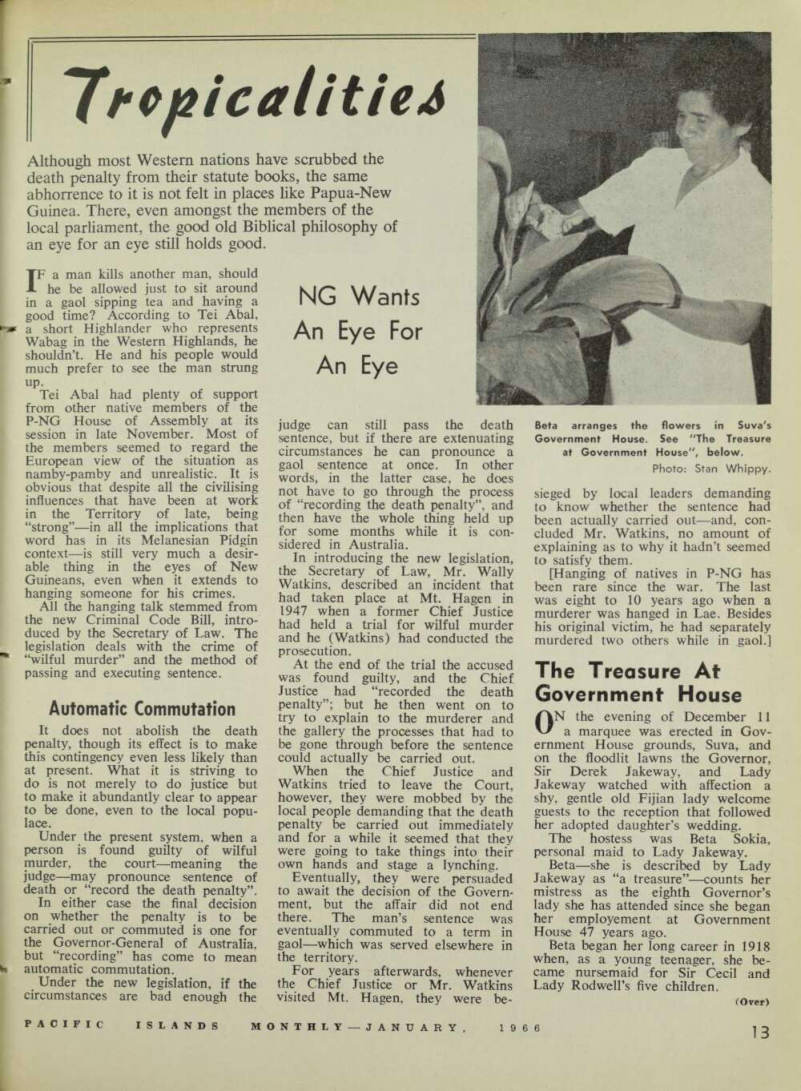
VJOYernmenT nouse fkN the evening of December 11 ” a marquee was erected in Gov emment House grounds, Suva, and on the floodlit lawns the Governor, Sir Derek Jakeway, and Lady Jake way watched with affection a shy, gentle old Fijian lady welcome guests to the reception that followed her adopted daughter’s wedding, The hostess was Beta Sokia, personal maid to Lady Jakeway.
Beta—she is described by Lady Jakeway as “a treasure”—counts her mistress as the eighth Governor’s lady she has attended since she began her employement at Government House 47 years ago.
Beta began her long career in 1918 when, as a young teenager, she be came nursemaid for Sir Cecil and Lady Rodwell’s five children, (Over)
Beta arranges the flowers in Suva's Government House. See "The Treasure at Government House", below.
Photo: Stan Whippy.
She clearly remembers the occasion in March, 1921, when the first Gov ernment House was burned down.
Beta assisted in getting her young charges to safety and then rescued all Lady Rodwell’s jewellery and clothes. Beta lost all her own possessions in the fire and these were replaced by her employers.
So fond of the young nursemaid were the Governor and his wife, and so much did they value her efficiency, they took her with them twice to England on leave and then later to British Guiana, when Sir Cecil was appointed to that country.
In 1928 Beta returned to Govern ment House and resumed work, this time as a lady’s maid to Lady Hudson. In the years that followed she attended Lady Fletcher and Lady Richards before returning to her birthplace, Kadavu, in 1938 for a rest.
In 1945 Beta returned to Govern ment House to attend Lady Gran tham. followed in turn by Lady Freeston, Lady Garvey and Lady Maddocks.
She began working for Lady Jakeway when Sir Derek began his term of office and it is clear she holds in special regard her present em ployer.
"Very Good Lady"
“She is a very good lady,” she says with deep sincerity. “She is always kind. I am very happy work ing for her.”
As well as attending Lady Jakeway Beta does all the floral arrangements in Government House with the skill of one with a flair for floral art.
She takes care of lady guests’ clothes and also is responsible for the linen cupboard.
Her adopted daughter, known everywhere as “young” Beta, she took under her care when the latter was a little girl.
“I wanted someone to be company to me, and to look after me and be kind to me when I get very old. It is not nice to be all alone when you are old,” she explained.
Now “young” Beta has taken her self a schoolmaster husband.
For her bridal outfit “young” Beta wore traditional masi, as did also the six little Fijian girls who attended her- . .
Old Beta had no plans at all for a special outfit for herself for the wedding until Lady Jakeway got to hear of it. Beta was then whisked to the shops at Lady Jakeway’s insistence and materials were chosen for a frock which became Lady Jakeway’s present to the bride’s mother.
Problems Of
Islands Education
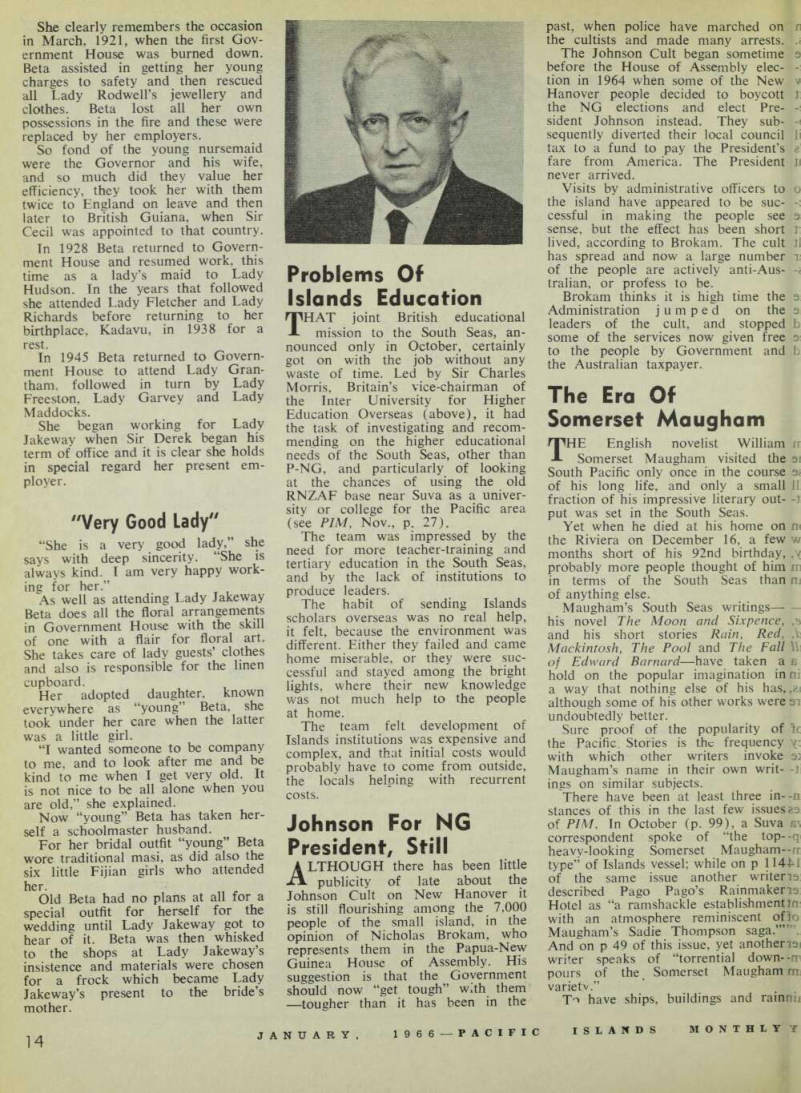
THAT joint British educational mission to the South Seas, an nounced only in October, certainly got on with the job without any waste of time. Led by Sir Charles Morris, Britain’s vice-chairman of the Inter University for Higher Education Overseas (above), it had the task of investigating and recom mending on the higher educational needs of the South Seas, other than P-NG, and particularly of looking at the chances of using the old RNZAF base near Suva as a univer sity or college for the Pacific area (see PIM, Nov,, p. 27).
The team was impressed by the need for more teacher-training and tertiary education in the South Seas, and by the lack of institutions to produce leaders.
The habit of sending Islands scholars overseas was no real help, it felt, because the environment was different. Either they failed and came home miserable, or they were suc cessful and stayed among the bright lights, where their new knowledge was not much help to the people at home.
The team felt development of Islands institutions was expensive and complex, and that initial costs would probably have to come from outside, the locals helping with recurrent costs.
Johnson For NG
President, Still
ALTHOUGH there has been little publicity of late about the Johnson Cult on New Hanover it is still flourishing among the 7,000 people of the small island, in the opinion of Nicholas Brokam, who represents them in the Papua-New Guinea House of Assembly. His suggestion is that the Government should now “get tough” with them —tougher than it has been in the
past, when police have marched on the cultists and made many arrests.
The Johnson Cult began sometime before the House of Assembly elec tion in 1964 when some of the New Hanover people decided to boycott the NG elections and elect Pre sident Johnson instead. They sub sequently diverted their local council tax to a fund to pay the President’s fare from America. The President never arrived.
Visits by administrative officers to the island have appeared to be suc cessful in making the people see sense, but the effect has been short lived, according to Brokam. The cult has spread and now a large number of the people are actively anti-Aus tralian, or profess to be.
Brokam thinks it is high time the Administration jumped on the leaders of the cult, and stopped some of the services now given free to the people by Government and the Australian taxpayer.
The Era Of
Somerset Maugham
THE English novelist William Somerset Maugham visited the South Pacific only once in the course of his long life, and only a small fraction of his impressive literary out put was set in the South Seas.
Yet when he died at his home on the Riviera on December 16, a few months short of his 92nd birthday, probably more people thought of him in terms of the South Seas than of anything else, Maugham’s South Seas writings— his novel The Moon and Sixpence, and his short stories Rain, Red, Mackintosh, The Pool and The Fall of Edward Barnard —have taken a hold on the popular imagination in a way that nothing else of his has, although some of his other works were undoubtedly better.
Sure proof of the popularity of the Pacific Stories is the frequency with which other writers invoke Maugham’s name in their own writ ings on similar subjects.
There have been at least three in stances of this in the last few issues of PIM. In October (p. 99), a Suva correspondent spoke of “the top heavy-looking Somerset Maugham type” of Islands vessel; while on p 114 of the same issue another writer described Pago Pago’s Rainmaker Hotel as “a ramshackle establishment: with an atmosphere reminiscent of: Maugham’s Sadie Thompson saga.’”' And on p 49 of this issue, yet another writer speaks of “torrential down pours of the Somerset Maugham j varietv.”
To have ships, buildings and rainr
linked with your name in one journal in a matter of months is a tribute to your universality; and in Maugham’s case it is all the more remarkable considering that it is now nearly 50 years since he visited the South Seas, and almost that long since his South Seas writings were first pub lished.
Much of the Pacific, of course, has changed out of all recognition since Maugham was here. American Samoa is no longer run by the US Navy.
Western Samoa is independent. And the Hotel Tiare in Tahiti, where Maugham stayed, has long ago come down.
But there is still at least one memento of Maugham for tourists to see. This is the Sadie Thompson Inn in Pago Pago. When last we heard, it was owned by Pago busi nessman Max Haleck.
The Fellows You
Meet In Brisbane
AT a Brisbane function, recently we met a professional man who asked after a Suva resident whose name he had forgotten.
“I visited the museum in Suva some years ago,” he said, “and, as I was leaving, I got into conversa tion with a friendly lad who insisted on taking me home, and showering me with hospitality.
“I said to him, ‘Aren’t you taking a risk in treating a perfect stranger in this way?’ The lad just laughed and remarked that there was little
risk in making friends with a man who could spend a couple of hours studying the exhibits in a national museum.
“He was a darned nice fellow. I wish I could remember his name.
It began with S, I think, and he seemed to be interested in the City Council.”
“Would that be Charlie Stinson?” we said. “He’s now regarded as the best mayor Suva ever had.”
Yes, it was Charlie Stinson, and would we convey our warmest re gards to the mayor?
The man in Brisbane was Mr. lan Chester, now a leading Brisbane dentist. He is the great-grandson of that famous H. M. Chester who nearly caused an international in cident in 1883 when—to forestall the Germans—he ran up the Union Jack in Port Moresby.
The Chesters are closely related to the Champion family, who have left their indelible mark upon Papua and New Guinea. Mr. H. W.
Champion, CBE, was Government Secretary in Papua from 1916 to 1942; and his three sons, Ivan, Allan and Claude, were top Administration executives before and after World War 11. All four now are retired and living in Australia. H. W. Champion is still going strong at 85. There are also two daughters.
Ivan Champion gained fame through his leadership of exploring expeditions, and by taking the old Laurahada into very dangerous places during the Jap occupation.
The Laurahada was sold, after the
war, and eventually rebuilt for com mercial jobs. Now and again, to break retirement boredom, Ivan takes command of the Laurahada on charter work.
A few weeks ago, he carried a party of (Papuan) missionaries to a Catholic mission station in West New Guinea, up a river near Merauke.
There, he encountered a number of Indonesian Administration officials, and he reports that they were courteous, helpful and very friendly.
He had no difficulty in carrying out his charter job and returning to Aus tralian waters.
Exciting Moment
For Geologist
WHEN news reached Honiara in December that Tinakula Volcano, in the Santa Cruz Group, had blown its top on the night of November 23, the BSIP’s Chief Geologist, John Grover, was so elated that he told friends it was the “most exciting thing that had happened in his life.” And for John Grover that is real excite ment indeed, for he’s a man who even on ordinary, grey old days is filled with enthusiasm for the little things of life.
The reason for his special excite ment was that he had predicted the eruption about a month earlier, and had issued an official warning to islanders in the Tinakula area to keep clear of the volcano.
A great billowing cloud of ash was
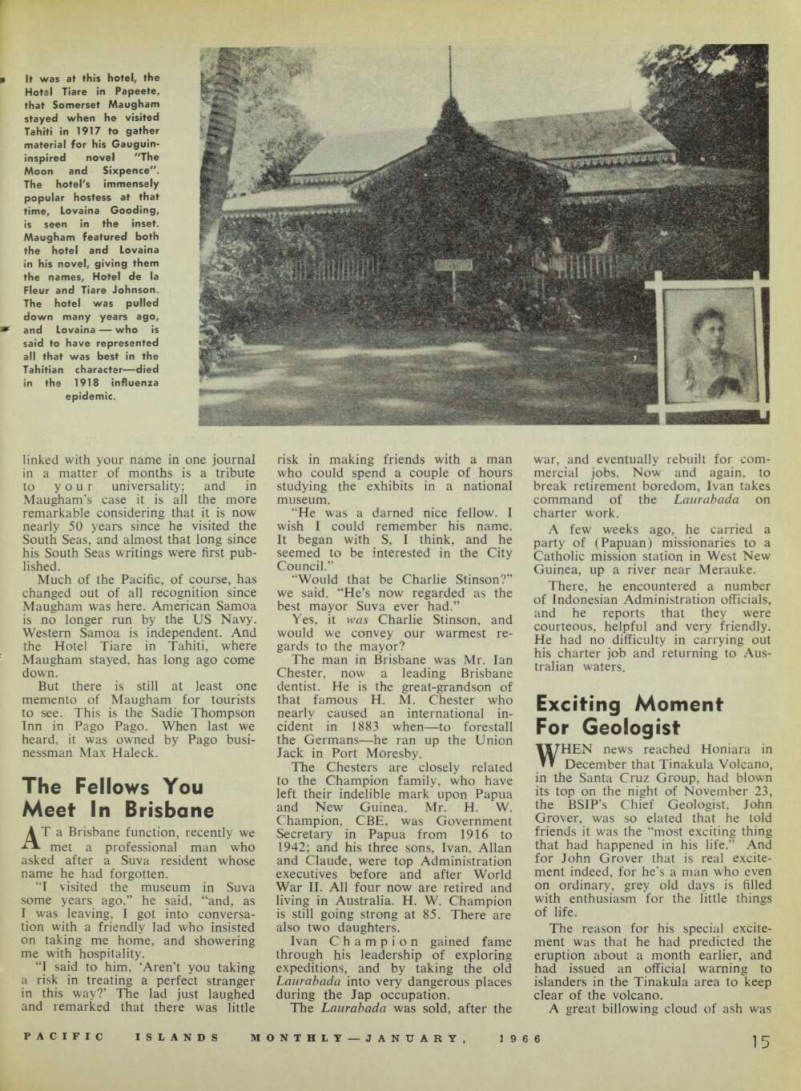
It was at this hotel, the Hotel Tiare in Papeete, that Somerset Maugham stayed when he visited Tahiti in 1917 to gather material for his Gauguin inspired novel "The Moon and Sixpence".
The hotel's immensely popular hostess at that time, Lovaina Gooding, is seen in the inset.
Maugham featured both the hotel and Lovaina in his novel, giving them the names, Hotel de la Fleur and Tiare Johnson.
The hotel was pulled down many years ago, and Lovaina who is said to have represented all that was best in the Tahitian character—died in the 1918 influenza epidemic.
emitted during the eruption. Until then, Tinakula had been quiescent for about 14 years.
In an official report issued on De cember 7, John Grover could scarcely conceal his enthusiasm at this piece of eruption forecasting. He gave credit to Dr. Claude Blot, of Noumea: “Although the prediction of vol canic eruptions ahead of the event is something not yet accepted as possible, this is in fact the second occasion that this has been done officially in the Protectorate,” his report said.
“On October 29, a telegram from the Department of Geological Surveys was sent to the District Commissioner who w T as visiting Santa Cruz, advising of an impending eruption and warn ing people to keep away. The DC replied that the warning had been duly issued. ‘The forecasting has been due to the concepts of Dr. Claude Blot, Chief of Research at the French Oceanic Institute in Noumea, who visited the Solomons in October for 10 days of discussions on his research, and a study of Solomons local structural conditions.
“Monsieur Blot has maintained a close research liaison with the Solomons Chief Geologist for several years.
“On the occasion of this meeting a set of international conventional signs was decided on, and the method of documentation for volcanic and earth quake studies was standardised, en abling the Solomons and the New Hebrides regions of Melanesia to be regarded as one research unit.”
The report added that following the eruption, islanders in the Tin— akula area had seen the volcano flam ing and glowing at nights, but there had been little emission of ash.
This suggested that the volcano’s crater was filling with molten lava, with simultaneous emission of gas— probably sulphur dioxide.
This appeared to be the initial heat ing-up stage of a major eruption and increased activity could be expected during December.
Norfolk Find
Revives Old Mystery
AN unfinished Polynesian stone adze recently found on Norfolk Island has renewed speculation on whether that island was inhabited by Polynesians, or merely visited by them, in pre-European times.
The adze, which has been identified by the Auckland Museum ethnologist, was found in shallow water at the west end of Emily Bay, near the con vict-built Salt House.
It is four inches long and about H inches wide. It varies in thickness, but is not more than one inch through at the deepest part. It is shaped to fit the hand, and bears evidence of flaking, grinding and polishing.
The finder was Ann Hoare, a 13year-old schoolgirl, whose mother, Mrs. Merval Hoare, is an anthority on Norfolk Island history.
“Earlier finds of Polynesian arti facts,” Mrs. Hoare tells us, “were made on Norfolk Island by a Mr.
McPhail, who found an adze on the
sand dunes at Emily Bay in 1929, and by Mr. H. Rabone, who, in 1934, reported his discovery of a number of unfinished adzes and several hundred flakes in the Emily Bay area.
“Today a few Norfolk citizens possess shaped stones which might be artifacts, but they have not been sub mitted for identification.
“Norfolk was uninhabited when Lieutenant Philip Gidley King arrived in 1788 to establish the first penal settlement.
“King recorded later that he had found certain articles that pointed to the existence of previous inhabitants.
These included “a large cluster of plantain trees” found growing on the south side of the island and some stone implements dug up during culti vation in the interior. ‘Though previous occupation of the island by Polynesians may be dif ficult to establish, the occasional dis covery of artifacts points to the pos sibility of accidental Polynesian callers at Norfolk.”
New Hope, Perhaps,
For The Sepik
r’S expected that the appointment of District Commissioners to the three recently-created administrative districts in New Guinea will be an nounced in January.
The three new districts are Chimbu, which has been excised from the old Eastern Highlands District and. which will have its headquarters i station at Kundiawa; West New Britain which will have headquarters;
in the Cape Hoskins area and which will divide the present island of New Britain into two districts; and West Sepik which splits the present Sepik District in two, Wewak remaining the headquarters station of East Sepik, and Vanimo, near the West New Guinea border, becoming the station of the new district.
This is the third time since 1921 that the boundaries of the Sepik Dis trict have been changed. Originally it was much the same as the recent Sepik District except that it was called Aitape and headquarters were at Aitape. About 1924 or 1925, the Sepik River, the lakes at its mouth and the hinterland that ran back to where the borders of Papua, Dutch New Guinea, and the Mandated Terri tory met, were taken out of Aitape and called the Sepik District with HQ at Ambunti. But in 1934 they were all put together again, Aitape and Sepik Districts amalgamating as the Sepik and the headquarters station being placed at Wewak.
The changes, in the Sepik District at least, may mean some advance for the locals, who are a neglected 191 in a Cinderella area. The Sepik residents are hoping so, anyhow.
End Of Isolation
For The Shortlands
THREE Mono Islanders wanting to post airmail letters were among the entire population of Stirling Island, BSIP, to turn out one day recently to greet the first plane to land there in 20 years.
The airstrip on Stirling Island (one of the Shortland Group) was used by fighters during World War II but since 1945 had fallen into dis repair. It has recently been re habilitated by the local people with the help of their council, supported by the Colonial Development and Welfare Fund.
Aboard the Megapode Airways Dove that landed on the strip were the District Commissioner Western, Mr. John Field; the BSIP Comptroller of Posts and Telecommunications, Mr. Dudley Wright; and a well known local trader, Mr. Cyril Ashton.
Leading the 200 people who wel comed the plane was the president of the Local Government Council, Roy Kimisi.
The Shortlands, including Mono and Stirling, are closer to Bougain ville than to the rest of the BSIP, and as ships call there only at long intervals the population of about 1,100 has felt that it is cut off from the rest of the world.
Megapode Airways proposes to
inaugurate a scheduled monthly service to Stirling from Henderson (Honiara) via their existing services to Yandina, in the Russell Islands, and Munda, New Georgia. If this can be done, some of the isolation of the Shortlands will be a thing of the past.
Islanders In A
Spin Over Copra
WE’VE heard of sinking funds, special funds, United Nations Funds, charitable funds and Colonial Welfare and Development funds.
But what, can anyone tell us, is a revolving fund?
Whatever it is, the islanders on Penrhyn, in the Northern Cooks, want the Government to give them one so that they can buy motors and boats to collect copra from the far flung motus around their big lagoon.
Penrhyn, at the moment, is having a copra boom. After producing only 12 tons of copra in 1964, when pro duction went to pot because of a rat plague coupled with a drought, Penrhyn’s production for 1965 was a record 334 tons.
But now that everything is looking so rosy, there are not enough people on Penrhyn to handle production, as the islanders have been moving in droves to Rarotonga and New Zealand.
The result is that many piles of coconuts collected for opening and copra-making have been sprouting before the small labour force has been able to get to them.
Besides asking for a revolving fund to overcome this problem, Penrhyn’s Legislative Assembly representative, Mr. Tangaroa Tangaroa, has asked for a kiln to be built on the island to help with copra-making.