Fiji Extremists
pp. 13-161 · Read in the full issue
The Constitutional Issue
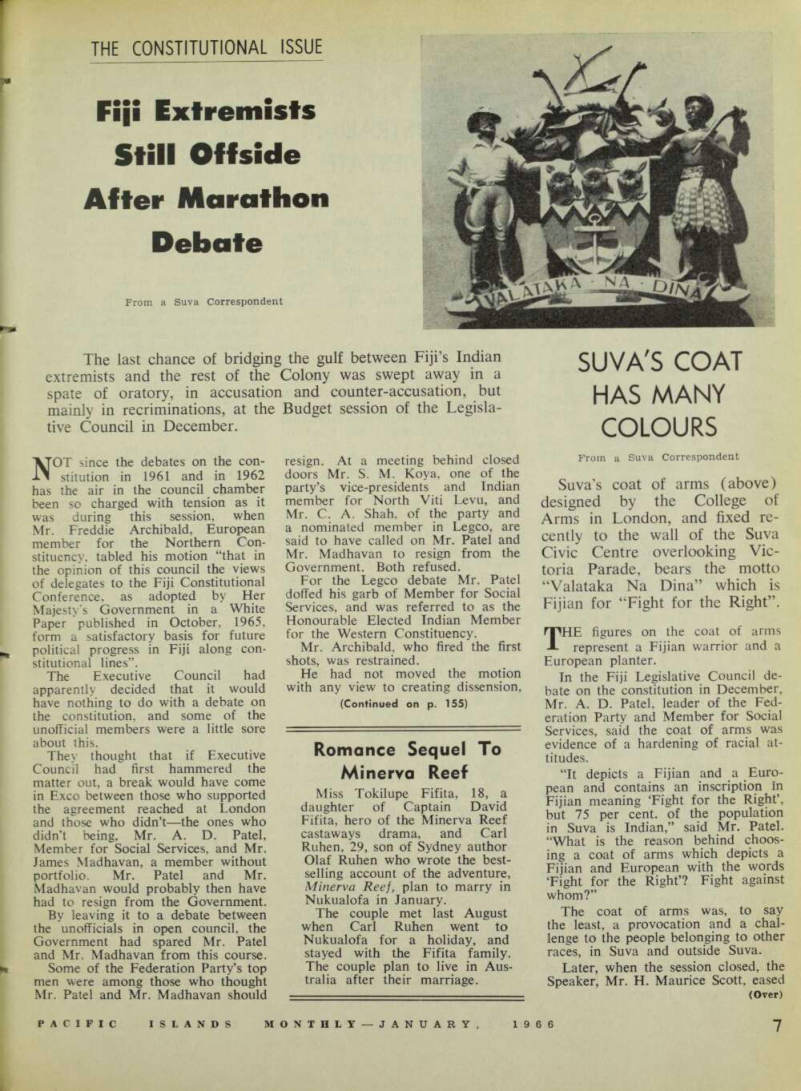
Fiji Extremists Still Offside After Marathon Debate
From a Suva Correspondent
The last chance of bridging the gulf between Fiji’s Indian extremists and the rest of the Colony was swept away in a spate of oratory, in accusation and counter-accusation, but mainly in recriminations, at the Budget session of the Legisla tive Council in December.
NOT since the debates on the con stitution in 1961 and in 1962 has the air in the council chamber been so charged with tension as it was during this session, when Mr. Freddie Archibald, European member for the Northern Con stituency, tabled his motion “that in the opinion of this council the views of delegates to the Fiji Constitutional Conference, as adopted by Her Majesty's Government in a White Paper published in October, 1965, form a satisfactory basis for future political progress in Fiji along con stitutional lines”.
The Executive Council had apparently decided that it would have nothing to do with a debate on the constitution, and some of the unofficial members were a little sore about this.
They thought that if Executive Council had first hammered the matter out, a break would have come in Exco between those who supported the agreement reached at London and those who didn’t—the ones who didn’t being, Mr. A. D. Patel, Member for Social Services, and Mr.
James Madhavan, a member without portfolio. Mr. Patel and Mr.
Madhavan would probably then have had to resign from the Government.
By leaving it to a debate between the unofficials in open council, the Government had spared Mr. Patel and Mr. Madhavan from this course.
Some of the Federation Party’s top men were among those who thought Mr. Patel and Mr. Madhavan should
resign. At a meeting behind closed doors Mr. S. M. Koya, one of the party’s vice-presidents and Indian member for North Viti Levu, and Mr. C. A. Shah, of the party and a nominated member in Legco, are said to have called on Mr. Patel and Mr. Madhavan to resign from the Government. Both refused.
For the Legco debate Mr. Patel doffed his garb of Member for Social Services, and was referred to as the Honourable Elected Indian Member for the Western Constituency.
Mr. Archibald, who fired the first shots, was restrained.
He had not moved the motion with any view to creating dissension, (Continued on p. 155)
he said. The motion would enable members to establish in the minds of the people as a whole that they did not waste public money (in going to London) and that they did strive to do their best.
Mr. R. A. Kearsley and Mr. Tony Moore were also sweetly reasonable.
When Mr. Patel got up he called for the common roll—the same rock on which he and his party’s craft had foundered in London.
He called for one man one vote.
He said cross voting (which had been agreed to in London by the Euro peans and Fijians in what they looked upon as a major concession to Patel’s party) was no use. It would accentuate racial division.
The European representation on the council was such, Mr. Patel argued, that each European vote was the equivalent of nine or 10 Indian votes.
Europeans Hold Power
Indians with 50 per cent, to 51 per cent, of the population would have 12 representatives, Fijians with 43 per cent, would have 14 representa tives and Europeans and others (in cluding Chinese) with 6 per cent, to 7 per cent, would have 10.
Even the Fijians with their 14 seats could not form a government on their own, nor could the Indians.
The Europeans would hold the balance of power.
Mr. Patel put up the United Kingdom’s constitutional set-up as a plank in his argument. It was a hotch-potch of all races, he said, and yet the UK had had for ages a system of representation by common franchise.
This was over-simplification on Mr. Paiel’s part. As any Englishman could tell Mr. Patel, they’d been at it for centuries; they’d been integrating for centuries, and still an English candidate would have little chance against a kilted Scot in an election for a Scottish Highlands seat.
Mr. Patel quoted the United States, Australia and New Zealand as examples of the common franchise system, but was shot down later by Mr. John Falvey, Member for Com munications and Works, who re minded the House that in New Zealand the Maoris have a separate roll.
Tension began to grow as Mr.
Patel. departing from political dialectics, began to take a stand from a racial position.
Perhaps he was needled by the
interjections from Mr. Falvey, Ratu K. K. T. Mara and Semesa Sikivou.
When he began to cite examples of political integration and common franchise he began with the words: u We have outstanding examples in our neighbouring dominions”, and was interrupted by Ratu Mara who asked: “India and Pakistan”?
When Mr. Patel went on to explain why the Federation Party members broke off discussions with the other unofficial members of the Legislative Council before the London con ference, the acid crept into the air.
He used the phrase, “European representatives, and the Fijian repre sentatives led by European members” which brought protests from the other side, Semesa Sikivou asking him whether he was “purposely try ing to be insulting”.
Mr. Patel replied that he was stating a fact.
On a point of explanation, Ratu Mara said that 80 per cent, of the papers for the pre-conference dis cussions were prepared by himself alone.
Mr. Patel told the council that the reason for not continuing the discussions in Fiji was that he and his colleagues were anxious to avoid tension. Because there seemed to be no chance of a compromise on the common roll they broke the talks off, hoping that the problem might be solved in London through the kind offices of the UK delegation. But the UK delegation did not try seriously to compromise. .Mr. Patel added, “The United Kingdom can still make a serious effort to bring about a compromise which would be acceptable to all”.
Mr. Patel’s arguments did not
impress the council, for most of it had been said before.
Mr. R. G. Kermode, a member without portfolio, said they were all agreed on one point—that common roll and racial integration were the ultimate goals. The disagreement was on the timing. The Patel party wanted the common roll now, the rest of Fiji when there had been more integration.
Mr. Patel, said Mr. Kermode, seemed to be impatient about the introduction of the common roll.
Why? he asked.
Mr. Kermode referred to the feel ing of distrust that the majority of people in Fiji had in relation to Mr.
Patel and his party and said: “We must be excused if we are not pre pared to jump straight into a common roll at this stage. I exhort the Federation Party to work towards creating the trust which is essential if we are to achieve the integration of the people and build what the honourable member himself wants, a single nation”.
Tribute
Mr. Kermode paid a tribute to the courage of Mr. Chandra Pal Singh, the nominated member who is a bitter opponent of the Federation Party and who moved over at the London conference to the anti- Federation group.
Mr. Singh, speaking in the council, attacked Mr. Patel and his party, describing them as “the ones who were responsible for mischief and strife that had done great harm to the country, economically, politically and socially”, Josua Rabukawaqa (Northern) was more forthright than most. He referred to the wartime years when Indians refused to join the Fiji defence forces, and exclaimed: “How dare these people come cry ing for equality now?”
Ratu Penaia Ganilau (Western),
Mr. A. D. Patel.
Mr. John Falvey.
who is also Secretary for Fijian Affairs, was more dramatic. He said the Indian political leaders had to change their attitude if Fiji’s people were to live together.
“I have heard threats,” he said, “that there would be moves to wreck or sabotage the implementation of the constitution. I hope those responsible will accept full respon sibility for what might happen if that plan is carried out.”
Some Indian speakers opposed the contention of non-Indians that the indigenous Fijians must have special status in their own country.
Mr. S. M, Koya said: “If every one accepts the proposition that Fijians have a special position, it follows they should have a special position for everything else”.
In future a move would come for “Fiji for the Fijians, Indians and others get out”.
Several members laughed when Mr. Koya alleged that during the constitutional conference period in July and August, “rumours were circulating that arms were being secretly landed to shoot Indians”.
He retorted: “It’s no use laugh ing”.
A Fijian member, Semesa Sikivou replied; “I think that is all it is worth”.
Mr. Koya’s speech lacked the clever dialectic touches of Mr.
Patel’s and consisted mainly of attacks.
Mr. Falvey's Views
Mr. Andrew Deoki, who went a good way with Mr. Patel and his supporters, being for the most part in agreement with them on such issues as the common roll, called for another try at reaching common ground, if not common roll. He said Mr. Patel did not belong to the Federation Party. The party belonged :o him.
It was left to Mr. Falvey to tear Mr. Patel’s case apart. Mr. Patel’s speech, said Mr. Falvey, “started in he gutter and ended in the gutter”
It was “naked racialism”.
There had been a hardening of acial differences, Mr. Falvey said, vholly, solely and grievously at nbutable to the fulminations of Mr. 3 atel and those associated with him He accused Mr. Patel of mis quoting the Governor’s speech, of vrongly defining the cross voting ;ystem, and he threw back at Mr. s atel his own speeches made in the legislative Council in the 1940’5.
At that time Mr. Patel had said hat Fijian interests must always re nain paramount.
Mr. Falvey was able to show that Tr. Patel’s latest reason for break ng off discussions before the London
conference contradicted one made at the time.
Then, he reminded the House, it was on a directive from the Federa tion Party that no good purpose would be served by continuing the discussions, because “vested interests”, including the Fiji Times, the Fiji Public Relations Office and the FBC, had deliberately published distorted news with the sole object of creating an atmosphere of tension, mistrust and misunderstanding.
Government officials took no part in the five-day debate, nor in the final vote, which resulted in 12 votes for and five against the motion expressing approval of the con stitution.
All the Fijian and European members of the council and one Indian (Mr. C. P. Singh) voted for.
The five Indian opponents Included four members of the Federation Party.
After this, what?
There were no predictions this Christmas.