South Pacific Mourns Death
pp. 10-12 · Read in the full issue
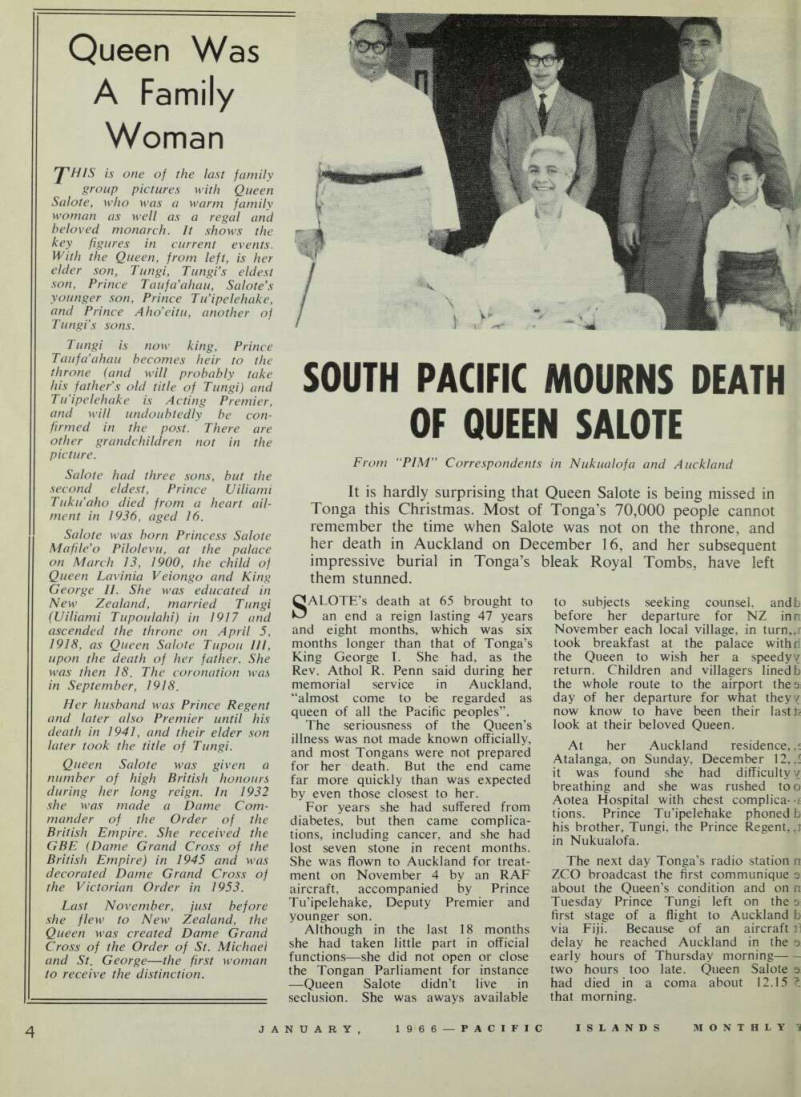
Of Queen Salote
From “PIM” Correspondents in Nukualofa and Auckland It is hardly surprising that Queen Salote is being missed in Tonga this Christmas. Most of Tonga’s 70,000 people cannot remember the time when Salote was not on the throne, and her death in Auckland on December 16, and her subsequent impressive burial in Tonga’s bleak Royal Tombs, have left them stunned.
SALOTE’s death at 65 brought to an end a reign lasting 47 years and eight months, which was six months longer than that of Tonga’s King George I. She had, as the Rev. Athol R. Penn said during her memorial service in Auckland, “almost come to be regarded as queen of all the Pacific peoples”.
The seriousness of the Queen’s illness was not made known officially, and most Tongans were not prepared for her death. But the end came far more quickly than was expected by even those closest to her.
For years she had suffered from diabetes, but then came complica tions, including cancer, and she had lost seven stone in recent months.
She was flown to Auckland for treat ment on November 4 by an RAF aircraft, accompanied by Prince Tu’ipelehake, Deputy Premier and younger son.
Although in the last 18 months she had taken little part in official functions—she did not open or close the Tongan Parliament for instance —Queen Salote didn’t live in seclusion. She was aways available
to subjects seeking counsel, andb before her departure for NZ inn November each local village, in turner took breakfast at the palace withd the Queen to wish her a speedyy return. Children and villagers linedb the whole route to the airport the si day of her departure for what theyy now know to have been their lastte look at their beloved Queen.
At her Auckland residence, .e Atalanga, on Sunday, December 12, ,S it was found she had difficulty y breathing and she was rushed to o Aotea Hospital with chest complica- -c tions. Prince Tu’ipelehake phoned b his brother, Tungi, the Prince Regent, J in Nukualofa.
The next day Tonga’s radio station n ZCO broadcast the first communique si about the Queen’s condition and on n Tuesday Prince Tungi left on the si first stage of a flight to Auckland b via Fiji, Because of an aircraft fii delay he reached Auckland in the si early hours of Thursday morning two hours too late. Queen Salote s: had died in a coma about 12.15 t that morning.
Tu’ipelehake was among those at her bedside.
Salote’s personal chaplain, Rev.
Lepa Kupu, told Tungi of his mother’s death in a car be tween the airport and the hospital.
In Nukualofa later that moraine Artinp Premier Mahe ’Uli’uli Tupouniua officially announced the Queen’s death and proclaimed that Prince Tungi had become “the only lawful and rightful heir to the throne. by the Grace of God, King of the Kingdom of Tonga” and beseeched God to bless King Taufa’ahau Tupou IV “with long and happy years to reign over us”.
D| ar L rlnth Fvprvwhprp DIdCK vJOin cverywnere Tonga plunged into official mourning for the Queen for six months, and soon the Kingdom had exhausted its supplies of black cloth and more was hurriedly brought from Fiji.
Black was even draped from coconut palms. People began to descend on Nukualofa from the outer islands.
Messages flooded in from all over the world.
In Auckland, where there is a large Tongan colony, the Queen’s body was removed to Government House, where it lay in state from December 17 to 20 as thousands of Aucklanders filed silently past.
On Saturday, December 18, King Taufa’ahau flew home by RNZAF Hercules to be greeted by his people for the first time as their ruler.
There was a gathering of officials
the* "played
National Anthem before King
Taufa’ahau and Queen Halaevalu Mata’aho entered their car.
Later at the old wooden palace (as Premier he had at one time wanted to replace it with a newer model, but Queen Salote wanted no change) King Taufa’ahau received individual declarations of allegiance from Tonga’s traditional group of nobles—men who still hold power m the Kingdom.
Following a State procession from Government House, Auckland, on December 20, Queen Salote’s body was flown to Nukualofa by the RNZAF, accompanied by Prince Tu’ipelehake and other members of the royal family, and nobles. They included the new heir to the throne, young Crown Prince Taufa’ahau, w ho had flown out from school in England. i t was a sa( j home-coming. The remarkable Queen Salote had been idolised in her life-time.
From the airport gates to the aircraft there was a 200-yd length 0 f tapa, with villagers seated each side of it. A colour party of members of the Tonga Defence Force, with distinctive hats turned up on the side, like the Australian Army slouch hat, carried the Queen’s coffin to a funeral car and the procession slowly moved off for the 14-mile drive to the palace.
The whole route was lined with
schoolchildren sitting with bowed heads. Most had waited for up to three hours yet they sat in silent respect in the sun without complaint —a remarkable demonstration, Villagers sat on the roadside behind the children, and as the pro cession reached Nukualofa there was nothing but a great sea of faces The utter silence during this 14 mde drive was an impressive, awe inspiring tribute to the dead Queen, A 21-gun salute was fired as the body was laid m state at th c Chapel, adjoining the g a^ ace . on the foreshores. That night flickering flames from a hundred fires outside the palace walls marked the great Tongan vigil before the funeral on December 23. ca aaa i„ MmLhiL^
50,000 In Nukudioid
Soon an estimated 50,000 people of Tonga’s total of 70,000 had come to Nukualofa to pay homage. The huge problem of logistics was over come the traditional way, with the people bringing food as gifts. The King technically accepts respon sibility for their welfare, but the people themselves arranged for their own shelter and for the distribution and coraect apportioning of the great quantities of food required for this great multitude.
Meanwhile, special aircraft and shipping brought in leaders from all
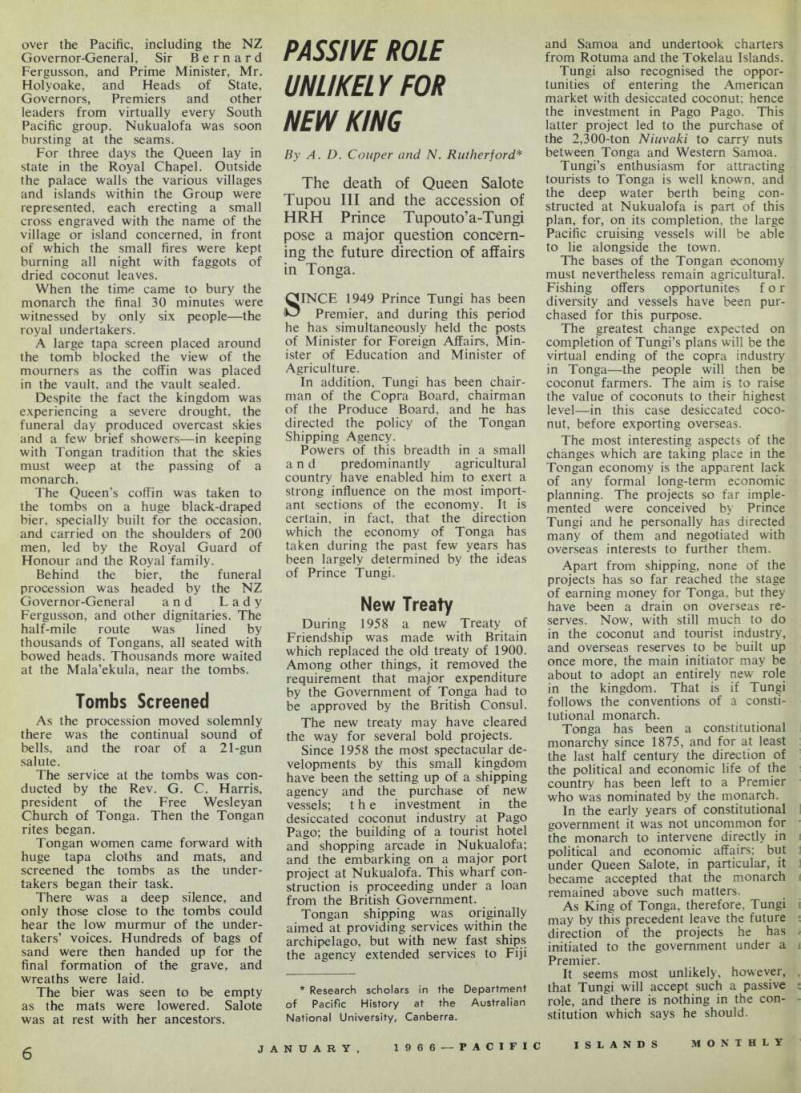
This was the impressive sight in Nukualofa in December as Queen Salote's body was taken to its resting place on the shoulders of 200 stalwart Tongan men. Also on the huge black-draped bier were two high chiefs. On the left are members of the Tonga Defence Force.
over the Pacific, including the NZ Governor-General, Sir Bernard Fergusson, and Prime Minister, Mr.
Holyoake, and Heads of State, Governors, Premiers and other leaders from virtually every South Pacific group. Nukualofa was soon bursting at the seams.
For three days the Queen lay in state in the Royal Chapel. Outside the palace walls the various villages and islands within the Group were represented, each erecting a small cross engraved with the name of the village or island concerned, in front of which the small fires were kept burning all night with faggots of dried coconut leaves.
When the time came to bury the monarch the final 30 minutes were witnessed by only six people—the royal undertakers.
A large tapa screen placed around the tomb blocked the view of the mourners as the coffin was placed in the vault, and the vault sealed.
Despite the fact the kingdom was experiencing a severe drought, the funeral day produced overcast skies and a few brief showers—in keeping with Tongan tradition that the skies must weep at the passing of a monarch.
The Queen’s coffin was taken to the tombs on a huge black-draped bier, specially built for the occasion, and carried on the shoulders of 200 men, led by the Royal Guard of Honour and the Royal family.
Behind the bier, the funeral procession was headed by the NZ Governor-General and Lady Fergusson, and other dignitaries. The half-mile route was lined by thousands of Tongans, all seated with bowed heads. Thousands more waited at the Mala’ekula, near the tombs.
Tombs Screened
As the procession moved solemnly there was the continual sound of bells, and the roar of a 21-gun salute.
The service at the tombs was con ducted by the Rev. G. C. Harris, president of the Free Wesleyan Church of Tonga. Then the Tongan rites began.
Tongan women came forward with huge tapa cloths and mats, and screened the tombs as the under takers began their task.
There was a deep silence, and only those close to the tombs could hear the low murmur of the under takers’ voices. Hundreds of bags of sand were then handed up for the final formation of the grave, and wreaths were laid.
The bier was seen to be empty as the mats were lowered. Salote was at rest with her ancestors.
* Research scholars in the Department of Pacific History at the Australian National University, Canberra.