Pacific Commerce and Produce
pp. 139-142 · Read in the full issue
South Pacific
Trade Reaches
£220 Million
Pacific Commerce and Produce
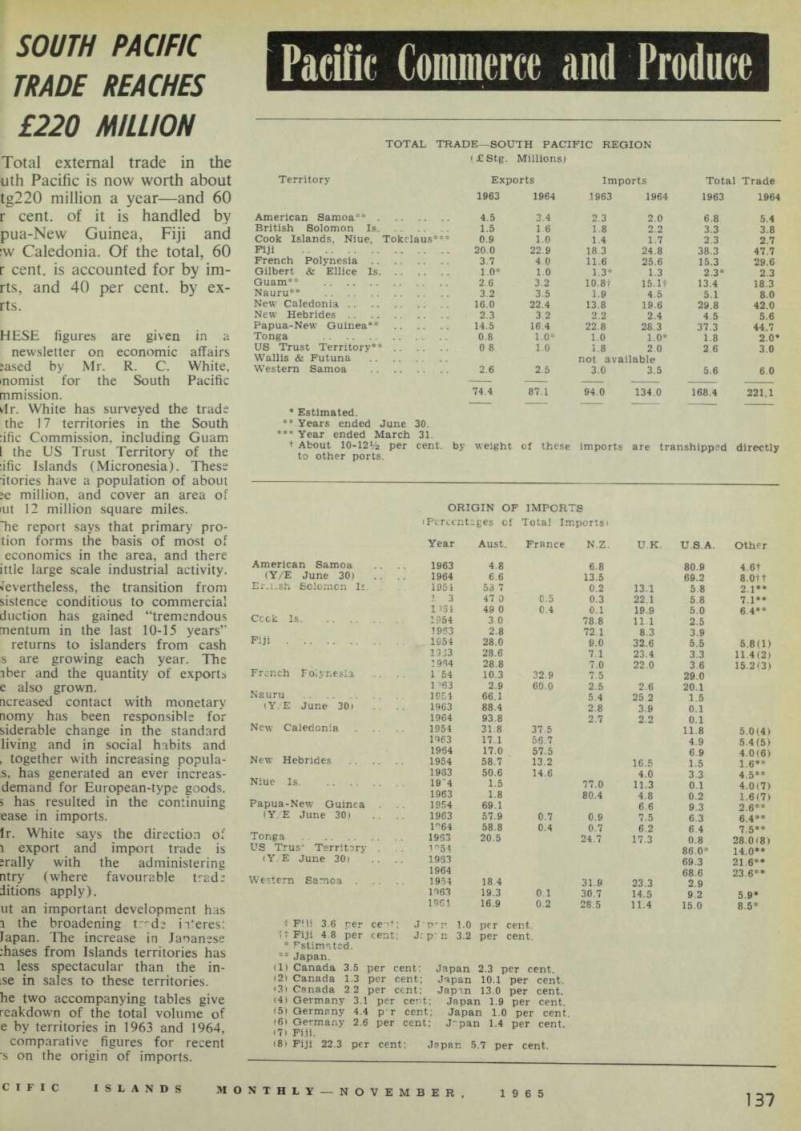
Total external trade in the uth Pacific is now worth about tg22o million a year—and 60 r cent, of it is handled by
pua-New Guinea, Fiji and
:w Caledonia. Of the total, 60 r cent, is accounted for by im rts, and 40 per cent, by ex rts.
HESE figures are given in a newsletter on economic affairs jased by Mr. R. C. White, »nomist for the South Pacific mmission. rir. White has surveyed the trade the 17 territories in the South :ific Commission, including Guam I the US Trust Territory of the :ific Islands (Micronesia). These itories have a population of about je million, and cover an area of iut 12 million square miles.
"he report says that primary pro tion forms the basis of most of economics in the area, and there ittle large scale industrial activity.
Nevertheless, the transition from sistence conditious to commercial duction has gained “tremendous mentum in the last 10-15 years” returns to islanders from cash s are growing each year. The iber and the quantity of exports e also grown. ncreased contact with monetary aomy has been responsible for siderable change in the standard living and in social habits and , together with increasing popula s, has generated an ever increas demand for European-type goods, s has resulted in the continuing ease in imports.
Ir. White says the direction of i export and import trade is orally with the administering ntry (where favourable trad itions apply), ut an important development has i the broadening tr-de interest Japan. The increase in Japanese phases from Islands territories has i less spectacular than the in ise in sales to these territories, he two accompanying tables give reakdown of the total volume of e by territories in 1963 and 1964, comparative figures for recent •s on the origin of imports.
Total Trade—South Pacific Region
( £ Stg. Millions!
Origin Of Imports
iPerccnt-ges cf Total Imports)
Territory Exports Imports Total Trade 1963 1964 1963 1964 1963 1964 American Samoa** 4.5 3.4 2.3 2.0 6.8 5.4 British Solomon Is 1.5 1.6 1.8 2.2 3.3 3.8 Cook Islands, Niue, Tokclaus*** 0.9 1.0 1.4 1.7 2.3 2.7 Fiji 20.0 22.9 18.3 24.8 38.3 47.7 French Polynesia 3.7 4.0 11.6 25.6 15.3 29.6 Gilbert & Ellice Is 1.0* 1.0 1.3* 1.3 2.3* 2.3 Guam** 2.6 3.2 10.8t 15.lt 13.4 18.3 Nauru** 3.2 3.5 1.9 4.5 5.1 8.0 New Caledonia 16.0 22.4 13.8 19.6 29.8 42.0 New Hebrides 2.3 3 2 2.2 2.4 4.5 5.6 Papua-New Guinea** 14.5 16.4 22.8 28.3 37.3 44.7 Tonga 0.8 1.0* 1.0 1.0* 1.8 2.0* US Trust Territory** 0 8 1.0 1.8 2.0 2.6 3.0 Wallis & Futuna Western Samoa 2.6 2.5 not available 3.0 3.5 5.6 6.0 74.4 87.1 94.0 134.0 168.4 221,1 * Estimated. ** Years ended June 30. *** Year ended March 31. + About 10-12y 2 per cent, by weight of these imports are transhipped directly to other ports.
Year Aust.
France N.Z.
U.K.
Usa.
Other American Samoa 1963 4.8 6.8 80.9 4.6t (Y/E June 30) 1964 6.6 13.5 69.2 8.0tt Er.t.sh Solomon Is. 1951 53 7 0.2 13.1 5.8 2.1** 1 3 47 0 0.5 0.3 22.1 5.8 7.1** H34 49 0 0.4 0.1 19.9 5.0 6.4** Ccck Is 1954 3 0 78.8 11.1 2.5 1953 2.8 72.1 8.3 3.9 Fiji 1954 28.0 9.0 32.6 5.5 5.8(1) 13J3 28.6 7.1 23.4 3.3 11.4(2) 1964 28.8 7.0 22.0 3.6 15.2(3) French Polynesia 154 10.3 32.9 7.5 29.0 1 1 63 2.9 60.0 2.5 2.6 20.1 Nauru 1951 66.1 5.4 25 2 1.5 (Y/E June 30) 1963 88.4 2.8 3.9 0.1 1964 93.8 2.7 2.2 0.1 New Caledonia 1954 31.8 37.5 11.8 5.0(4) 1963 17.1 56.7 4.9 5.4(5) 1954 17.0 57.5 6.9 4.0(6) New Hebrides 1954 58.7 13.2 16.5 1.5 1.6** 1963 50.6 14.6 4.0 3.3 4.5** Niue Is 19‘4 1.5 77.0 11.3 0.1 4.0(7) 1963 1.8 80.4 4.8 0.2 1.6(7) Papua-New Guinea 1954 69.1 6.6 9.3 2.6** (Y/E June 30) 1963 57.9 0.7 0.9 7.5 6.3 6.4** 1"64 58.8 0.4 0.7 6.2 6.4 7.5** Tonga 1963 20.5 24.7 17.3 0.8 28.0(8) US Trus 1 Territory 1^54 86.0* 14.0** (Y E June 30) 1963 69.3 21.6** 1964 68.6 23.6** Western Samoa 1954 18 4 31.9 23.3 2.9 1963 19.3 0.1 30.7 14.5 9.2 5.9* 196 4 16.9 0.2 28.5 11.4 15.0 8.5* t Piii 3.6 per ce' f ; J P'r. 1.0 per cent. it Fiji 4.8 per cen t; Jr P' n 3.2 per cent. * Estimated. ** Japan. (1) Canada 3.5 per cent; Japan 2.3 per cent. <2) Canada 1.3 ; per cent; Japan 10.1 per cent. (3) Canada 2 2 per cent: Japan 13.0 per cent. (4) Germany 3.1 per cent; Japan 1.9 per cent. 1 5 1 Germany 4.4 P‘ r cent; Japan 1.0 per cent. (6) Germany 2.6 per cent :; J"pan 1.4 per cent. (7) Fiji. • 8) Fiji 22.3 per cent: Japan 5.7 per cent.
The Copra Market
For October
THE Philippine FM copra price fixed by the London Cop Association fell to an average £Stg.73/15/- in September, but the first three weeks of October t market strengthened, and it seem likely that the October avera would be somewhere around £Stg. per ton.
Mr. Ian McDonald, chairman the P-NG Copra Marketing Boai reported: “There does not appear to be a clearcut reason for the prese market firmness, not only in cop] but in most other oilseeds as W€ Neither Vietnam nor the rece disturbance in Indonesia appear have had any effect, and thus it quite likely that it is merely t result of normal demand, a perhaps some gambling on the 01 come of this year’s soyabean cr in the US.
“It would not be surprising to s market prices slip back a little o\ the next few weeks, if only for t fact that Philippine copra expo: have been well up over the h couple of months and are expect to increase, as is the case wi Nigerian palm kernels and palm c “Another factor which will i doubt have considerable bearing ( prices is the currently large prodi; tion of Norwegian fish oil, whi this year will touch around 135,0* tons compared with only 83,600 h year and 54,700 in 1963.”
In Papua-New Guinea, continu dry weather in some areas is begi ning to affect production, but not any great extent. The estimate f the year is still for a record pr duction of around 118,000 tons.
Higher Profit 1 For
Fiji Industries
Fiji Industries Ltd., Ceme
manufacturer, had a net pro of £F55,275 for the year ended Jui 30, compared with £F40,518 1963-64.
Reporting this in October, tl directors said the company was nc studying possible avenues into whi* it might expand its activities.
Sales in the year were substantial! higher than those of 1963-64, chief because of increased local consumi tion of cement.
Export sales showed a slow b( steady increase, although they we; small compared with local sale
s growth was encouraging and ;cted the quality of the cement Juced in the face of keen foreign [petition. he dividend is 10 per cent., in ling a final of 5 per cent.
> Bonk Acquires
terest In P-NG
lASE International Investment Corporation (CIIC), a subsidiary the Chase National Bank has n up shares, representing a ority interest in the Australia r Guinea Corporation Limited. [r. David Rockefeller, chairman 2IIC and president of the Chase ihattan Bank, announced this in >ber. e said: “We are delighted to this effort to help promote the lomic development of the Ter y of Papua and New Guinea.
Ve hope it will supplement the rted plans of the Australian eminent to spend very sub ial sums in the development of Papua-New Guinea area in the five years.
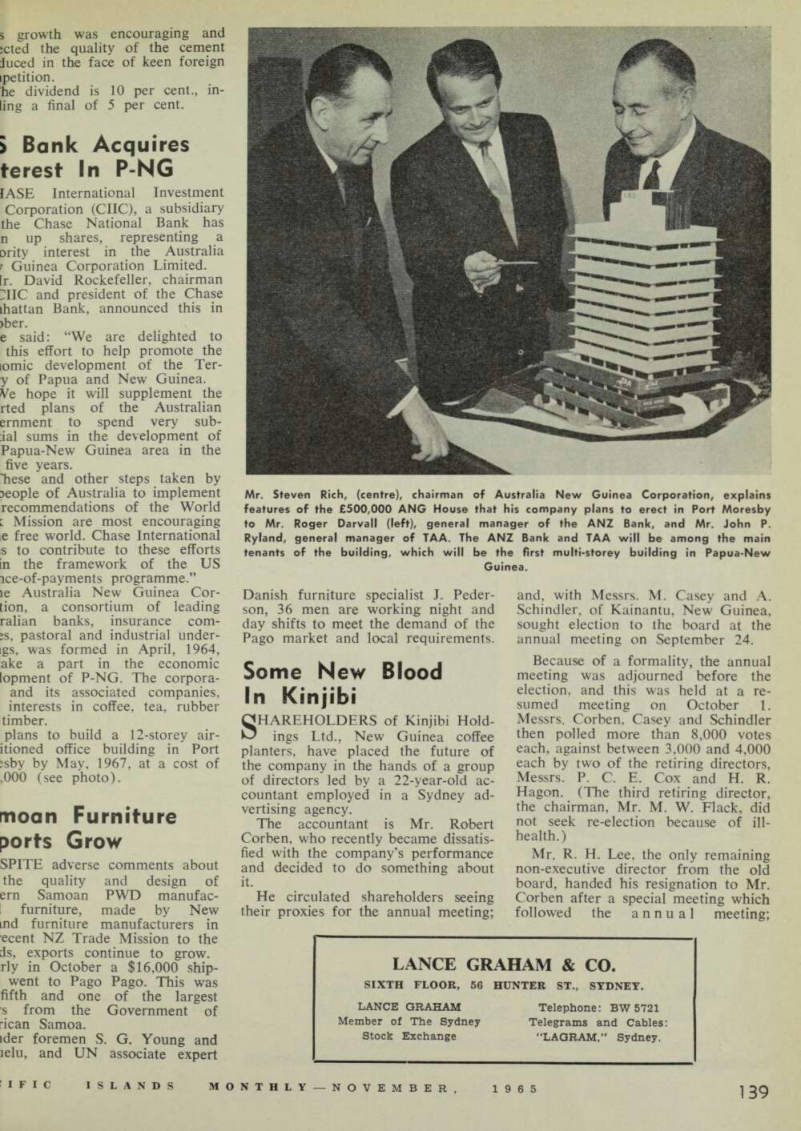
Tiese and other steps taken by people of Australia to implement recommendations of the World : Mission are most encouraging ie free world. Chase International s to contribute to these efforts in the framework of the US ice-of-payments programme.” le Australia New Guinea Cor tion, a consortium of leading ralian banks, insurance com js, pastoral and industrial under igs, was formed in April, 1964, ake a part in the economic lopment of P-NG. The corpora and its associated companies, interests in coffee, tea, rubber timber. plans to build a 12-storey air itioned office building in Port ishy by May, 1967, at a cost of ,000 (see photo).
moan Furniture
ports Grow
SPITE adverse comments about the quality and design of era Samoan PWD manufac fumiture, made by New md furniture manufacturers in ecent NZ Trade Mission to the ds, exports continue to grow, rly in October a $ 16,000 ship went to Pago Pago. This was fifth and one of the largest s from the Government of dean Samoa. ider foremen S. G, Young and idu, and UN associate expert
Danish furniture specialist J. Peder son, 36 men are working night and day shifts to meet the demand of the Pago market and local requirements.
Some New Blood
In Kinjibi
Shareholders of Kinjibi Hold ings Ltd., New Guinea coffee planters, have placed the future of the company in the hands of a group of directors led by a 22-year-old ac countant employed in a Sydney ad vertising agency.
The accountant is Mr. Robert Corben, who recently became dissatis fied with the company’s performance and decided to do something about it.
He circulated shareholders seeing their proxies for the annual meeting;
and, with Messrs. M. Casey and A.
Schindler, of Kainantu, New Guinea, sought election to the board at the annual meeting on September 24.
Because of a formality, the annual meeting was adjourned before the election, and this was held at a re sumed meeting on October 1, Messrs. Corben, Casey and Schindler then polled more than 8,000 votes each, against between 3,000 and 4,000 each by two of the retiring directors, Messrs. P. C. E. Cox and H. R.
Hagon, (The third retiring director, the chairman, Mr. M. W. Flack, did not seek re-election because of ill health.) Mr, R. H. Lee, the only remaining non-executive director from the old board, handed his resignation to Mr.
Corben after a special meeting which followed the annual meeting;
Mr. Steven Rich, (centre), chairman of Australia New Guinea Corporation, explains features of the £500,000 ANG House that his company plans to erect in Port Moresby to Mr. Roger Darvall (left), general manager of the ANZ Bank, and Mr. John P.
Ryland, general manager of TAA. The ANZ Bank and TAA will be among the main tenants of the building, which will be the first multi-storey building in Papua-New Guinea.
and another board member, Mr. R.
R. Bell, resigned before the annual meeting.
Mr. Corben has stated that the aim of the new board is to have a controlling board in Sydney to re ceive reports from directors in New Guinea.
Mr. Corben aims to cut costs by limiting directors’ fees to £l,OOO a year, and by abolishing the post of
managing director—having only a
chairman of directors in Sydney.
He added that, if run properly, the
company would be able to pay a dividend within 18 months.
This statement contrasts with what the managing director, Mr. C. W.
Ford said at the annual meeting —that there would be no dividend for five or six years from 1963.
Carpenter Profit Up
W. R. Carpenter Holdings
Ltd. has increased profit for the 22nd successive year, a prospect which was apparently considered remote by investors for they had
marked the shares below 2 several times before the net pr of £2,323,805 was announced.
The profit, a rise of 13.1 per ce came from operations in Papua-> Guinea, Fiji, Tonga, Western Sam New Zealand, Canada, the Uni Kingdom, the Bahamas and Austrc Higher prices for copra w reflected in the increased merchant turnovers by subsidiaries in sevt of the Island groups.
Australian-based industries yiel higher investment income and creased net profits.
The result represented an earn rate of 35.4 per cent, on aver capital employed of £6,562,C (Capital was increased during year from £6,250,000 to £7,500,( by a one-for-five bonus issue February. The bonus was the fi since 1951).
The dividend has been maintau at 15 per cent, and includes a fi of 7i per cent, payable on the bon increased capital.
Steamships' Too
Steamships Trading co. i had another good year to Ji 30, with the net profit rising £16,904 to £418,151. The divid< is again 13-1/3 per cent., includ a final of 6-2/3 per cent. Sha from the recent l-for-5 premi issue do not receive the fi dividend.
New Fiji Industries
TWO new products were adc in October to Fiji’s stead growing range of secondary dustries. An animal feed facto first of its kind in the Colony, v officially opened at Nausori by member of Legislative Coun Semesa Sikivou.
Canned tomato juice is the n product of a factory near Sigatc which is already producing passi fruit juice and guava puree.