Tourist Frontier
pp. 123-131 · Read in the full issue
Out, Round And About New Guinea's Wild Tourist Frontier
By Judy Tudor.
The state of Papua-New Guinea tourism at the end of 1965 can be summed up in half a dozen words: It is there in spite of, rather than because of.
riE increasing stream of visitors has been in spite of lack of ninistration support for tourism an industry. A change of policy this has now been indicated (see el), but because of a general ing of insecurity, and because of Administration’s attitude, banks e lent money to finance tourist jects only with tremendous ictance.
Tie increasing number of visitors ilso in spite of the Territorials litional antipathy to tourists. This tion that all “round-trippers” are le sort of freaks goes back as » as I can remember. It is re ted in the treatment of guests in le of the long-established hotels in the attitude of residents to a jected industry. lany are convinced that tourists Papua-New Guinea are neither essary nor desirable; and econo ally, of course, they are right, the time being. The Territory no need of this industry, in the r that Tahiti, American Samoa or a Fiji has needed it.
Money Only For BP's?
his general feeling was summed ay two public servants with whom e a meal recently at a Highlands i\. They were of the opinion that ourist industry was a waste of 5 because all the profits there n would “only go to Beeps or tmies”. . Burns Philp subsidiary owns hotels in Port Moresby; Steam s Trading Co. has one at Mt, ;en, one at Popondetta and has is for building one in Lae, but ;rwise there have been few in tions from either that they want lo more for tourism. lay be this is a pity. Failing ninistration assistance to the in ry, these two companies are )ably the only ones with the >ssary funds to do anything on a e scale.
But whether Territorians are apathetic or not, P-NG is getting many visitors each year, so many in fact that there is continual pres sure on all available accommodation.
Unless there is an economic re cession in Australia—where most of P-NG’s visitors originate—this trend will continue and facilities already building or in the planning stage in the favoured spots don’t even begin to look as though they will meet the demand.
Already “tourist New Guinea” seems to have been delineated. It includes Port Moresby, on the Papua side, and in New Guinea it takes in Lae, with its War Cemetery and Botanic Gardens, and the whole Highlands area from Goroka to Mt.
Hagen. Some tourists also include Madang; very few get as far as Rabaul.
The greatest enterprise in tourism is undoubtedly coming from the Highlands (see PIM, Sept., p. 121), where there is a special Highlands
chapter—or “Board” as it is called —of the P-NG Tourist and Travel Association. (The parent association formed about four years ago has. to date, been moribund). Mr. S. (Peter) Fox of Goroka is the chair-
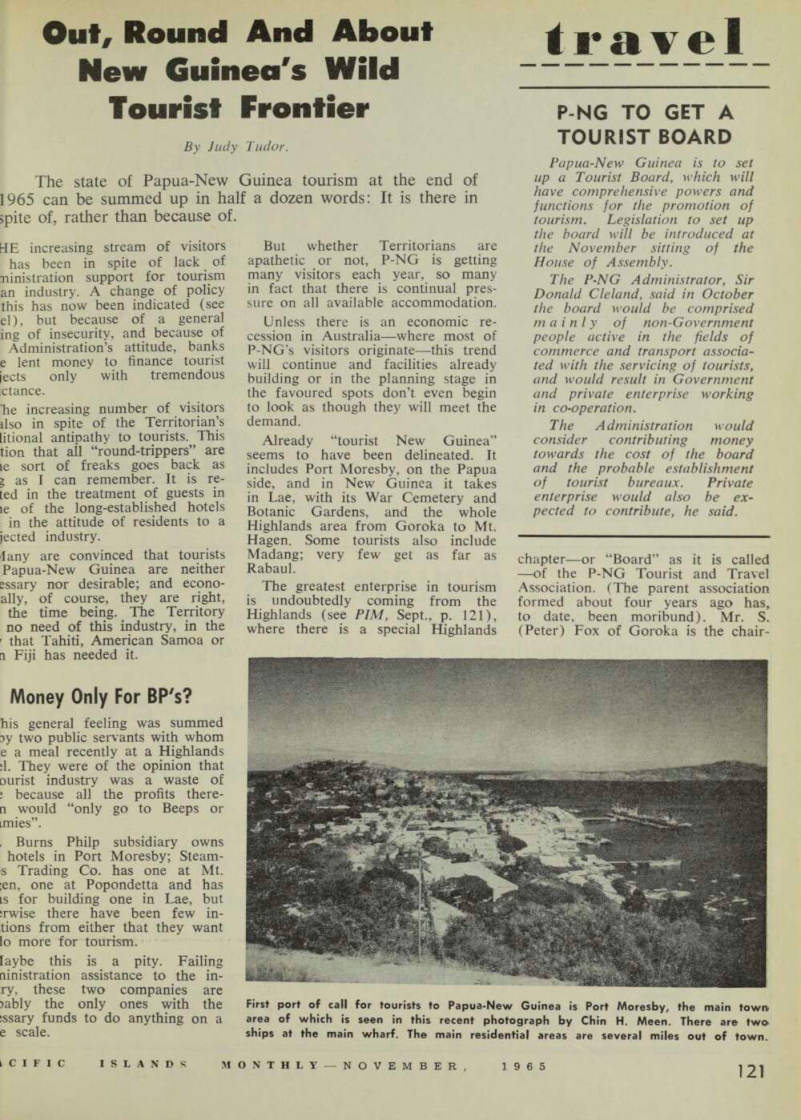
First port of call for tourists to Papua-New Guinea is Port Moresby, the main town area of which is seen in this recent photograph by Chin H. Meen. There are two ships at the main wharf. The main residential areas are several miles out of town.
an of the Highlands Board and he full of enthusiasm.
He sees the solution to the tourist ■oblem in the Highlands in Safari illages—that is, units built of native aterials but with modern con miences, financed and owned by e various Local Government ouncils, and run by European anagers. He visualises up to 40 of ese villages all over the Highlands, id the scheme certainly has many rtues —not the least of which, Erhaps, is that it would please my r o public servant friends who like see profits kept out of the hands Beeps and Steamies.
At the moment, of course, there not one of these villages, much is 40, and sceptical Territorians itside the Travel Association are lick to point this out.
Transport Problems
It is easy to get to the Highlands air from Lae or Port Moresby, d, for those in good physical con tion, increasingly easy to get there road. This road is the longest in ?w Guinea, stretching from Lae . the coast 340 miles inland to Mt. igen and even beyond.
In the course of its length it mbs, in one section of a dozen les, from the flat floor of the arkham Valley up the 5,000-odd ;t of the Kassam Pass to the ginning of the interlacing systems valleys and plateaus that are the ghlands; and again, on the western ie of Goroka, it climbs another )00 feet to cross Daulo Pass and scends a similar distance.
It is remarkable because most of 5 Highlands section was put in, in i early 1950’5, by amateur road ilders and it still remains much they left it—taking the ridges and iirs by frontal attack, climbing up d up, only to go down and down.
Those interested in New Guinea ■irism put a great deal of faith in j road for the future and can see ; day coming when an increasing mber of tourists hire cars and ive themselves through the High ids.
Some are already doing it and ire is, in fact, nothing to stop reasonably competent motorist dertaking this, so long as he has inty of time.
The great hazard is weather. Heavy in can cause washaways or slips;
even light rain in some sections can turn the slopes into skating rinks, impossible to negotiate.
None of these hazards are in themselves dangerous but when they happen it is necessary to stop until, in the first case, the road is repaired, or in the second, until the sun comes out and dries the surface. Either might take an hour or a week.
Who Drives You Back?
But the biggest draw-back to do it-yourself safaris at the moment is the fact that although at least one firm in Lae will hire out a car for the journey, few motorists having driven 340 miles to Mt. Hagen then relish the thought of having to drive the whole way back along the same heart-breaking route to Lae.
The alternative is an organised bus tour and these can be arranged by a couple of firms, if they are given sufficient notice; or hitching a ride in one of the dozens of big trucks that almost daily are plying along some section of the road between Lae and Hagen.
Recently, Hilliard and Rice, a trucking company of Lae, were good enough to give me a lift on two successive days, as far as Goroka, but obviously there is a limit to the generosity of trucking companies for this sort of thing, and the average tourist would probably find it a mixed blessing.
There is room for only one pas senger beside the driver; it is a pretty rough ride; it is hot; and it takes about twice as long to reach
anywhere as in a conventional vehicle.
The 120 miles between Lae and Kainantu, including the 90 dead level miles of the Markham Valley section, took us seven hours in a new Ley land truck; on the second day, in an older version of the same truck, it took seven hours on the 65 miles section between Kainantu and Goroka.
Apart from the Kassam Pass and the magnificient views from the top,
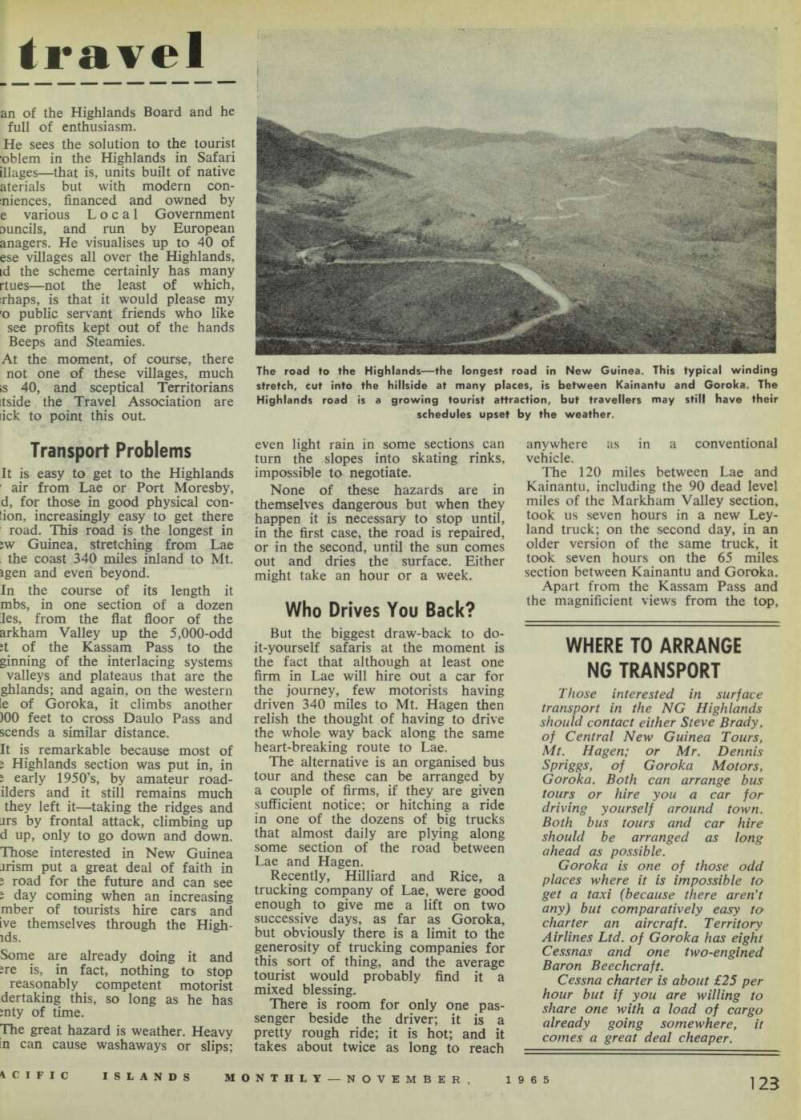
The road to the Highlands—the longest road in New Guinea. This typical winding stretch, cut into the hillside at many places, is between Kainantu and Goroka. The Highlands road is a growing tourist attraction, but travellers may still have their schedules upset by the weather.
road is monotonous, a never ling switchback through grass mtry. I kept myself entertained st of the way by trying to figure the economics of the trucking iness in New Guinea (without ning to any enlightened con don); but when I reached Goroka 1 found that some bridge was it” and that I couldn’t get further road, I can’t say I was very iappy. spent the next morning flying and down Highland valleys in ; of Territory Air Lines Cessnas; the following day in going on to Hagen in their Beechcraft Baron.
Comparing the two modes of isport, I can’t help but come to conclusion that for thrills, ctacular views, and off-the-beaten ;k places, the tourist would still better served expending £5O on isna charters than the same sum car hire. lowever, the road must inevitably 3 a bigger place in local travel.
Tie three lowland rivers that once ie the Markham Valley section the route difficult, the Erap, the on and the Umi, have all been Iged; in the last 18 months, the nmonwealth Works Department regraded and reconstructed the miles of the Kassam Pass and made a first-class job of it.
Tie department is now working the next section of road between top of the Pass and Kainantu. mderstand that tenders for the nantu-Goroka section are to be shortly.
iat Tourists Want To See
4ost tourists who go to Port resby want to see the Bomana r Cemetery, Rouna Falls, the koda Trail, look in at Koki rket or the shanty-town of tiuabada village. When they get the Highlands, 95 per cent, of
them have only one thing in mind —they want to see primitive New Guineans. And this, to me, seems to be where Highlands tourism could meet its Waterloo in the years ahead.
Highlanders, generally, have taken to planting and trading like ducks to water and as such are busy people— too busy often to be bothered about keeping up their reputation of being picturesque savages.
Along with this, they are in creasingly going for the coastal style of native dress or, worse, having a little each way, piling on an old Army jacket and a battered felt hat or, in the case of women, a grubby Mary’s blouse, over the usual bark girdle and traditional drapes of hand rolled twine.
The New Guineans that one sees in Goroka these days are little dif ferent from those at Lae; further out at Mt. Hagen it is probably still 50-50. There you still see the High lander, stalking majestically down the main street, wearing traditional undress and gazing into the shop windows of this rather Wild-Frontier town.
The urbanising of the Highlands is inevitable, but when complete a great deal of the present fresh charm of the area will go with it.
New Guinea Hotels
So many rude things have been said about Papua-New Guinea hotels by travellers in the past it would be difficult to say anything new.
Some of these blanket condemna tions are unwarranted—but not very often. For what it is worth, here are a few brief comments on hotels I visited while recently in the Ter ritory—to stay, to have a meal or sometimes only a drink.
PORT MORESBY. I daresay it is a toss-up whether the Boroko or the Papua is considered the best hotel here. The Papua has been longer in existence, is right in the down-town area and can scarcely be overlooked.
It is one of the popular drinking spots in the Territory (judged, any way, on the decibels of noise registered in the lounge-bar between noon and 2 p.m. and between 4,30 and 10 p.m.).
My overwhelming impression of this place, formed over many years, is its Presbyterian cleanliness. I’ve never known a place where the housekeeping was so obtrusive. From 6.30 a.m. when the boy comes and tries to remove the sheets from under you (they are then piled up in big white mountains in the guest’s lounge at the top of the stairs for most of the morning) until the lounge-bar is washed out at 11 p.m., a team of natives scrubs and polishes without cease.
Under this onslaught I’ve watched
section of the [?]fortable hotel at nantu, described "one of the re pleasant sur- Ses New Guinea has in store".
The road to the Highlands begins at Lae—an attractive New Guinea town with many new buildings, such as the modern Administration offices seen here. Lae is also the aviation hub of the Territory.
th interest the top layer disappear >m the rubber floor covering on irs and top floor between my last o visits. The place has been im aved in recent years by the ad ion of some air-conditioned rooms th private bathrooms. More agination and less remote control uld do more.
LAE. Most people go to the T.A.A. ansair Lodge, which was built by mtas in the early 1950’s as a stop p. Accommodation should be oked long in advance. It is in ttages, each with four bedrooms, bathroom, and a tiny lounge.
The rooms are austere but the >rst feature is the noise. The floors ; bare polished timber, the walls ►p short a foot from the top, so it the lights from one room shine every other room and what goes in one room is abundantly clear every other room.
The food here is simple, good d comes in portions suitable for ung, vigorous aircraft-engineers. :al-hours are restricted and early 12 o’clock lunch and 6 p.m. dinner. >u can get a drink by going into 5 club next door and asking a unber to sign you in. The ernative accommodation is the >tel Cecil down on the flat. This tel has had a lot of trouble, >stly financial, in recent years.
KAINANTU. The hotel is owned d run by Mr. Graham Gilmore, is one of the more pleasant sur ses New Guinea has in store. It is ilt of local stone and timber; the mge and dining room, with a lall cocktail bar in one corner, nelled walls, big stone fireplace d polished tables of local timber, ; very good indeed. Only that the >pard-skin rugs and mounted ;phant-tusks are missing, it could ve been lifted outright from part ly up Mt. Kilimanjaro or else tere in East Africa.
The sort of imagination shown in s hotel is rare in New Guinea and loever is responsible should go to j top of the class. However, the drooms could be improved by the dition of bedside lights—and the ;>vision of a box of matches to go th the candle. The electricity goes around 11 p.m. and this leaves non lokers in real trouble. If they want get up and wander about they ve to depend on an acute sense of •ection and touch.
Kainantu gets few tourists, as yet, cause of poor plane services but is must change with the current ogramme of road improvement. It only 120 miles from sweltering ie.
GOROKA. The hotel here is owned by the same organisation that owns the Cecil in Lae and it has had the same financial troubles. The Goroka, however, has never wanted for patrons and there is little excuse for the fact that a great deal less is done for guest comfort now than 10 years ago.
It has a cold, withdrawn air about it as though the owners had sworn an oath never to make things cosy for their customers. Some of the gloom of wet Goroka nights and cold Goroka morning fogs might be dispelled if they had followed other Highlands hotel owners by building a fireplace to brighten up the scene.
Most of the accommodation is in dongas—two roomed cabins —across the backyard and parking area. Here you invariably share one of the nine-by-ten rooms with a stranger, and the primitive bathroom with three others.
The shower in the bathroom at tached to No. 17, in September, kept the whole floor awash and guests flushed the lavatory by hauling a piece of sash-cord that someone had thoughtfully attached to the inner works.
There seems little reason for such sloppiness when, at the same time, they are building large extensions to the public bar.
Goroka also has a motel. I did not see it but reports are that it is quite good. [Morobe Hotels Ltd. which owns the Cecil at Lae, Goroka Hotel and Wau Hotel, recently came under new ownership and management. There therefore could be much improve ment in these establishments in the future].
KUNDIAWA. Kundiawa is head quarters for the Chimbu Sub-District, a pretty, almost totally Administra tion townlet spread around a basin in the mountains and sprinkled liberally all over with pine tress.
The hotel here was a rest-house until three years ago and, apart from the fact that it now has a public bar, it is still just that.
At present it is being run by three young ladies from the Land of Hope and Glory. It is all rather Youth Hostel, with liquor. Nonetheless this place, too, has had a phenomenal increase in tourist traffic during the last year—quite 400 per cent. The proprietor told me that they had one tourist stay last year; four this year, (Over)
MT. HAGEN. This town has >bably more to offer the tourist in any other in the Highlands. It s an air of get-up-and-go about it it Goroka has lost but at the ne time you see far more of the ;al wild-life. It has a motel and hotel.
Phe motel, owned by Messrs.
Ison and Gibbes, is not yet com te but what there is of it is first ss. Carpeted floors, good furniture, t lights, tiled bathrooms are rather s the pot of gold at the foot of rainbow after a trek through the ghlands. It is in a pleasant posi n, in a pine grove and has a nor licence.
Fhe hotel is about five years old. big lounge-bar is well-patronised local drinkers and looks as though las been created by someone who i seen too many Westerns. There a big fireplace; the seats are made of cow-hide with the hair tly worn off; the tables from thick t>s of local timber. You keep ex iting to see Davy Crockett and a iple of his mates, all wearing ;r-hide jerkins and coon-skin caps, ne in at any moment.
Nonetheless it has a friendly ntier air about it. The bedrooms on a par with those in the Hotel roka but the bathrooms (ladies’) isiderably better.
Food
tfost people like to eat. They will able to do this in the Territory not always with happy results, □king standards don’t vary so ch from hotel to hotel as from t to visit. Largely the quality of food depends on who is currently
doing the supervising of the local kitchen staff, and supervisors seem to move on pretty frequently.
Most of the big hotels can whip up special meals for dinner-parties, at special prices—given notice—but the general level of ordinary cooking is poor. Not much use is made of local foodstuffs and, in a way, this is understandable. These can come in flood or famine quantities and are not always dependable, while frozen supplies from Australia are.
For what it is worth, the best meal I had during two weeks in P-NG recently was at the Hibiscus Restaur ant, a tiny place hanging onto a cliff, up past the Hotel Papua in Port Moresby. I don’t know whether this was a happy accident or not but the place is very popular with younger Port Moresby people and doesn’t close till late.
All over the Territory there are places that provide snacks, but most of the serious eating is done in hotels.
Visitors to Port Moresby who want morning tea or light lunches, in pleasant surroundings, should try the Country Women’s Association club rooms which are open to the public.
FIJI STYLE.—Fiji, which already has a number of first-class hotels, with more being planned, will develop its tourism even more quickly if the principles of a new survey are accepted (see story at right). But South Seas travellers used to the standard of, say, the Reef Lodge Hotel, near Sigatoka, the lounge of which is seen above, will be disillusioned if they go to Papua-New Guinea expecting the same standard. But they will pay no less for what they get in New Guinea.
Photo: White's Aviation.