Staggering Seabirds, Dancing Crabs
pp. 87-89 · Read in the full issue
Tonga Can Produce Them Both
By Rob Wright
Of the hundreds of islands associated with the main Tongan groups of Tongatapu, Haapai, and Vavau, perhaps the least to attract attention would be the 15 or more islets entwined in a 36-mile maze of coral reefs near Nukualofa, capital of these Friendly Isles.
HEWED from the mainland, they are hull-down on the horizon d because of their remoteness, :ape closer scrutiny. Which is the ty the Tongans and the old-timers e it.
These are coral islets, built with mite patience by millions of tiny lyps which have dedicated their dies to these marine shrines.
With the help of the wind and > waves, and the flotsam which ds a resting place there, they have en transformed into things of sat beauty with stately palms rmounting beaches of shimmering nd and lush green carpets of >pical creepers and shrubs.
Where the ocean currents swirl d eddy round the coral foundations, s water is clear and deep and the me of the uotavake (crayfish), koma’u (giant clam), fonu (turtle), ohuafi (cod) and the giant lubo ick crevally), while the warm nd and the larger trees provide vens for a variety of seabirds.
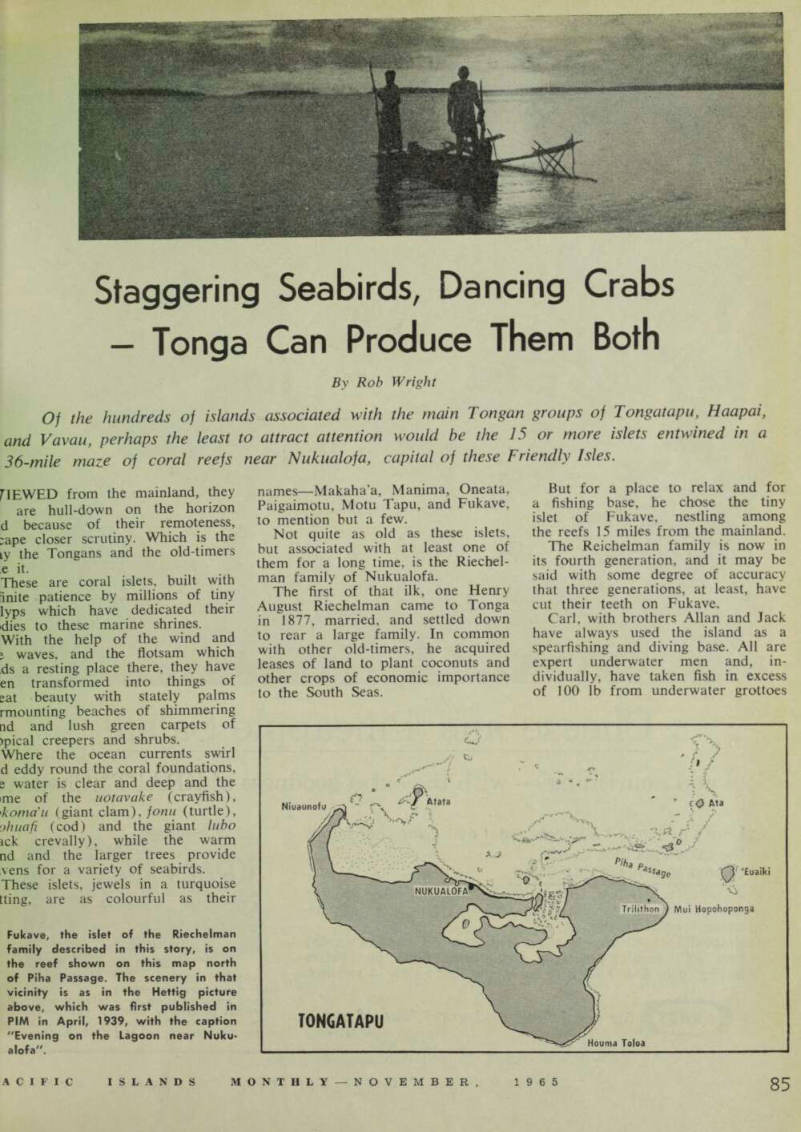
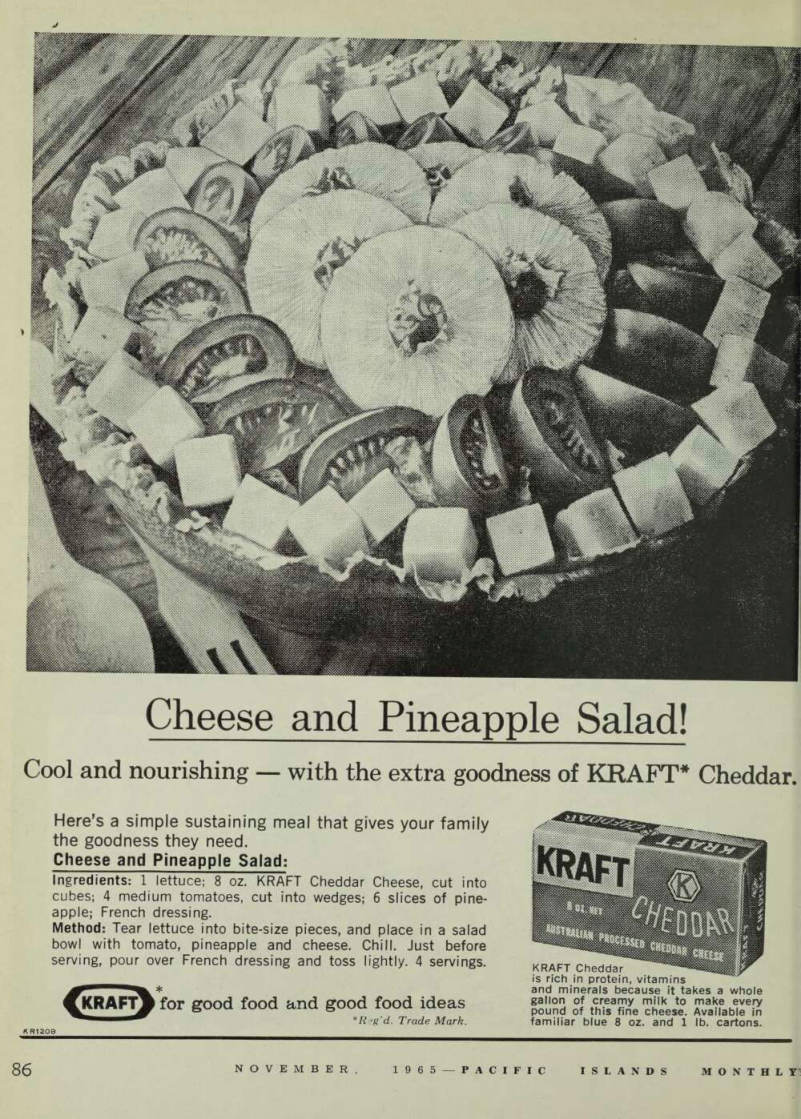
These islets, jewels in a turquoise tting, are as colourful as their Fukave, the islet of the Riechelman family described in this story, is on the reef shown on this map north of Piha Passage. The scenery in that vicinity is as in the Hettig picture above, which was first published in PIM in April, 1939, with the caption "Evening on the Lagoon near Nuku alofa".
names—Makaha’a, Manima, Oneata, Paigaimotu, Motu Tapu, and Fukave, to mention but a few.
Not quite as old as these islets, but associated with at least one of them for a long time, is the Riechelman family of Nukualofa.
The first of that ilk, one Henry August Riechelman came to Tonga in 1877, married, and settled down to rear a large family. In common with other old-timers, he acquired leases of land to plant coconuts and other crops of economic importance to the South Seas.
But for a place to relax and for a fishing base, he chose the tiny islet of Fukave, nestling among the reefs 15 miles from the mainland.
TTie Reichelman family is now in its fourth generation, and it may be said with some degree of accuracy that three generations, at least, have cut their teeth on Fukave.
Carl, with brothers Allan and Jack have always used the island as a spearfishmg and diving base. All are expert underwater men and, m dividually, have taken fish in excess of 100 lb from underwater grottoes
:ar the island, and have dived to cover giant clams from the sandy attorns.
But for them there is just as much easure during the cool evenings recounting their experiences of e day. It was during one such ening that Carl first became aware r the strange behaviour of the abird known to the Tongans as e lafu.
Sanctuary
The lafu is not an uncommon bird id it chooses the sandy beaches ’ the islets to burrow into and make 5 nest. The warm sand hatches the ;gs, and the young are favoured for eir succulence, much in the same anner as Maori’s relish mutton rds.
But the lafu has a strong pointed ;ak and even fledglings draw blood om the hands of anyone incautious lough to put his hands in a sand arrow.
Carl had forbidden anyone to take rds from Fukave, preferring to iep the island as a sanctuary, but 5 had never before seen adult birds iptured, and so, one evening, gave srmission to a Tongan friend to go aout the routine.
It was dusk and the party were daxing round a fire on the beach, here was little sound except for the vish of waves and the murmur of Dices.
Then the Tongan began an eerie ailing into the night. There were o words. It was a simple and lonotonous wailing sound—“oo-000-oo”. o-oo”.
Within a short while out of the [y appeared a lafu, and it began to rcle the group on the sand. As
the eerie call was kept up, more and more birds appeared until there were 20 or 30 circling overhead.
First one bird then another settled on the ground and began a drunken walk towards the source of the sound.
The birds rolled and staggered, and sometimes fell over and lay still.
Some, lifted into positions, perched swayingly on the fingers, hands, or shoulders of the people on the sand.
Even when the call ceased, the birds appeared to be under some form of hypnosis and made no at tempt to escape. They were left lying on the sand.
At daybreak on the following morning, they had disappeared.
Supernatural
Carl thought the whole thing smacked of the supernatural, and later when he saw Alfred Hitchcock’s picture The Birds, he was sure there was something sinister about it. He told the story to Ve’ehala, a Tongan noble who is Keeper of the Palace Records. Ve’ehala, in turn, repeated it to Queen Salote.
But Queen Salote knew already of the queer performances of the lafu.
She had also witnessed another strange event in the animal knigdom of Tonga—the dance of the kauki (ghost) crabs.
This took place at Lifuka, in Ha’apai, where the Queen had a residence adjoining the beach. Like the lafu performance, it took place at dusk, but this time at the instiga tion of a Fijian who used a small lali (wooden drum) which he beat with an insistent rhythm to attract the crabs.
Gradually the kauki crawled out of their burrows on the beach, first in twos and threes, then in greater numbers. Finally in their hundreds they danced in unison to the rhythm of the wooden drum.
The macabre dance began at dusk and, as the crabs became involved in their routine, light from torches was introduced to show the eerie and wondrous spectacle of thousands of crabs going through intricate patterns of movements to the rhythm of the lali.
It is not known where the Fijian learned the art of attracting kauki crabs to dance to his music, or whether he passed that knowledge to anyone else.
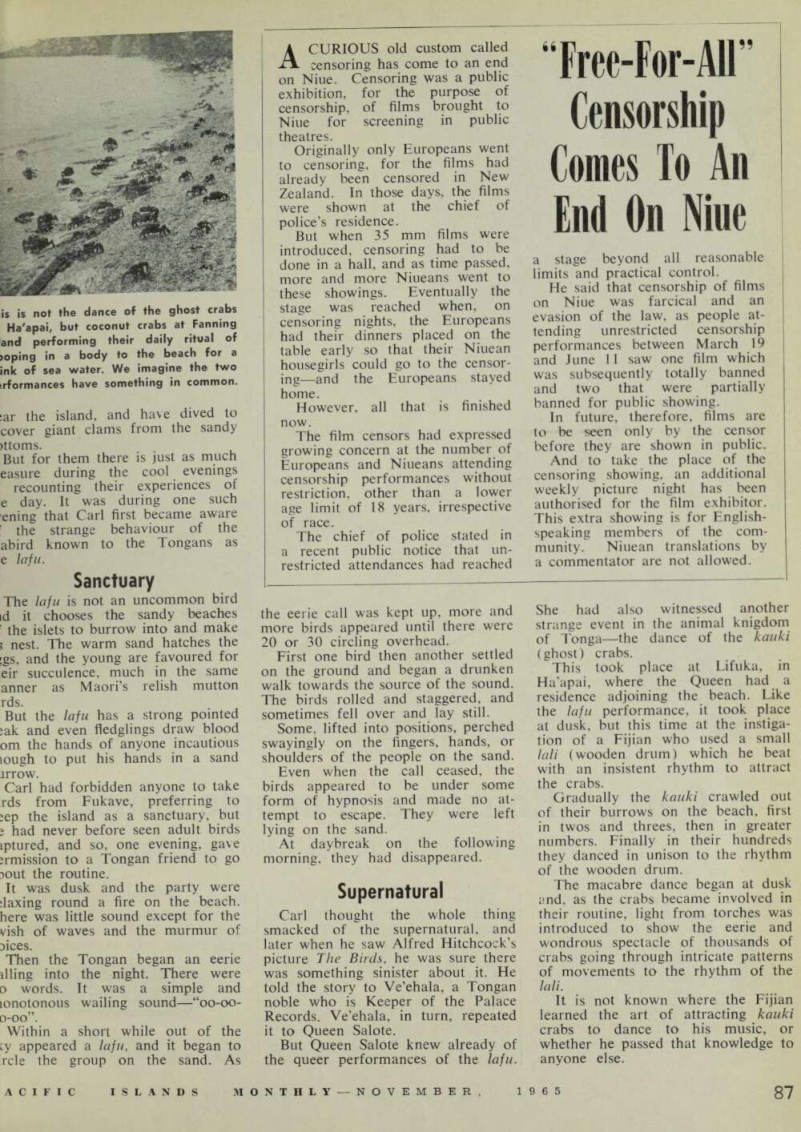
is is not the dance of the ghost crabs Ha'apai, but coconut crabs at Fanning and performing their daily ritual of [?]oping in a body to the beach for a ink of sea water. We imagine the two erformances have something in common.