Destiny
pp. 47-49 · Read in the full issue

New Guinea Man of Destiny
One day early in April, 1936, the late “Bill” Kyle, then ADO at New Guinea's recently opened Chimbu Gov ernment station, heard reports of serious fighting between the Gena and the Siku, two Chimbu tribes living by the Koronigl River near Kerowagi, some 20 miles west of Kyle’s station.
rYLE, a tough, energetic, forceful man (who died most gallantly a Coastwatcher in New Ireland 1942) had been in the area for couple of years.
He knew that the Gena and the ku had been warring against each her for years before the white man id penetrated the Chimbu in 1933, id he determined, as far as possible, put an end to it.
The fighting that he was immedi ;ly concerned with arose over the croachment by the Gena on land limed by the Siku. The land was ar where the present Government ition at Kerowagi is located.
Kyle assembled the entire Gena d Siku population near a Lutheran ission station that had been tablished at Kerowagi in 1934 by ; Rev. H. Hanneman, who is there Jay.
He confiscated all the weapons he uld find—spears, bows and arrows, d stone axes —and destroyed them.
In a forceful speech, he told the ople that their fighting must stop; d he resettled some of the Siku the land the Gena had taken from ;m.
Profound Impression
His prompt and vigorous action t a profound impression on the ?esmen. To this day, his name, J this particular action of his, are I remembered.
A.mong the thousands of tribes n who were present at the destruc n of the weapons was a youth of 3ut 15 named Siwi Kurondo, of na.
His father was a prominent fight der among the Gena and was also sorcerer of renown, for he was e to go and come with compara s ease anywhere in the Kerowagi :a, and indeed, further afield.
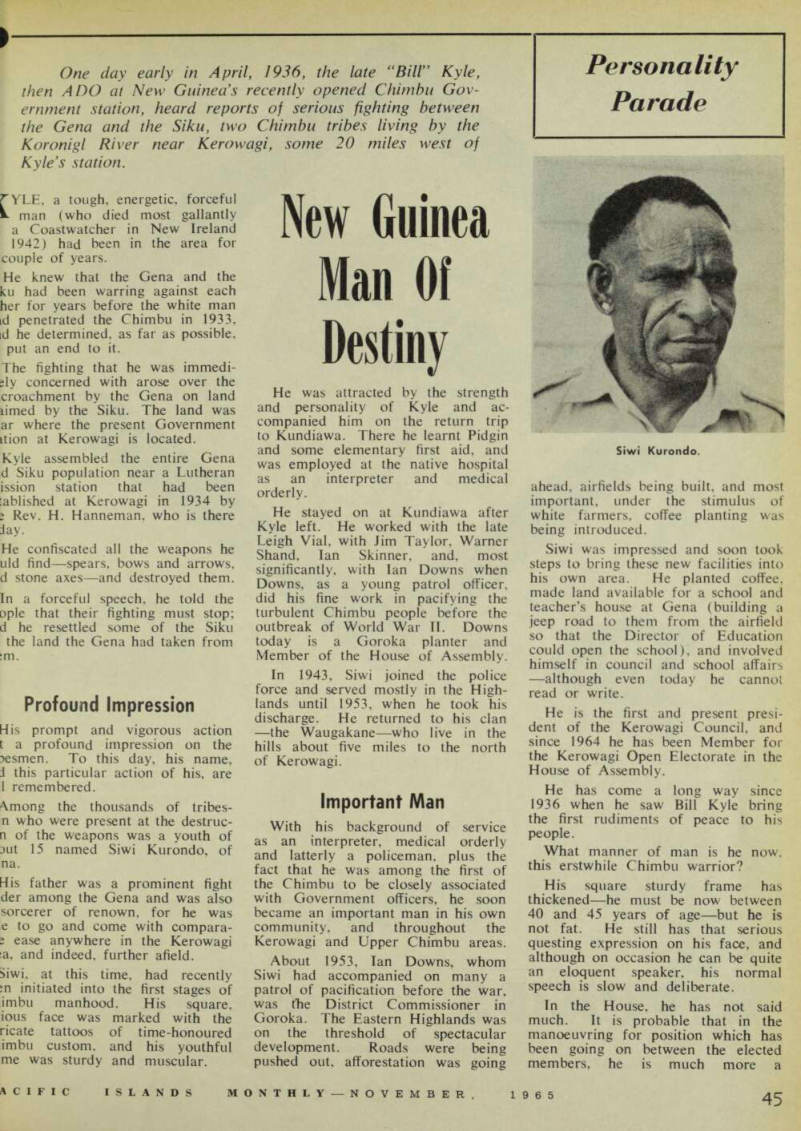
Siwi, at this time, had recently m initiated into the first stages of imbu manhood. His square, ious face was marked with the ricate tattoos of time-honoured imbu custom, and his youthful me was sturdy and muscular.
He was attracted by the strength and personality of Kyle and ac companied him on the return trip to Kundiawa. There he learnt Pidgin and some elementary first aid, and was employed at the native hospital as an interpreter and medical orderly.
He stayed on at Kundiawa after Kyle left. He worked with the late Leigh Vial, with Jim Taylor, Warner Shand, lan Skinner, and, most significantly, with lan Downs when Downs, as a young patrol officer, did his fine work in pacifying the turbulent Chimbu people before the outbreak of World War 11. Downs today is a Goroka planter and Member of the House of Assembly.
In 1943, Siwi joined the police force and served mostly in the High lands until 1953, when he took his discharge. He returned to his clan —the Waugakane—who live in the hills about five miles to the north of Kerowagi.
Important AAan
With his background of service as an interpreter, medical orderly and latterly a policeman, plus the fact that he was among the first of the Chimbu to be closely associated with Government officers, he soon became an important man in his own community, and throughout the Kerowagi and Upper Chimbu areas.
About 1953, lan Downs, whom Siwi had accompanied on many a patrol of pacification before the war, was the District Commissioner in Goroka. The Eastern Highlands was on the threshold of spectacular development. Roads were being pushed out, afforestation was going
Personality Parade
ahead, airfields being built, and most important, under the stimulus of white farmers, coffee planting was being introduced.
Siwi was impressed and soon took steps to bring these new facilities into his own area. He planted coffee, made land available for a school and teacher’s house at Gena (building a jeep road to them from the airfield so that the Director of Education could open the school), and involved himself in council and school affairs —although even today he cannot read or write.
He is the first and present presi dent of the Kerowagi Council, and since 1964 he has been Member for the Kerowagi Open Electorate in the House of Assembly.
He has come a long way since 1936 when he saw Bill Kyle bring the first rudiments of peace to his people.
What manner of man is he now, this erstwhile Chimbu warrior?
His square sturdy frame has thickened—he must be now between 40 and 45 years of age—but he is not fat. He still has that serious questing expression on his face, and although on occasion he can be quite an eloquent speaker, his normal speech is slow and deliberate.
In the House, he has not said much. It is probable that in the manoeuvring for position which has been going on between the elected members, he is much more a
Siwi Kurondo.
ipporter of lan Downs than he is ' John Guise or Matthias Toliman.
But he is no Yes man. On several Ejects, such as maintenance of >ads and the price paid, for native own coffee, he has opposed the dministration and interested com ercial enterprises. He can be very itical of certain European traders.
He told the recent UN Trustee ip Council Mission which visited e Territory that Australia had ought big improvements, that he is sure his people were not ready t for self-government and that he inted the Australian Administration stay.
But as against this, there were ports a year or so ago that Siwi is not satisfied with the Australian hievement and that he was vocating the assumption by the nited States of the responsibility r developing the Territory to timate independence.
He is one of two Highlands native smbers representing more than 0,000 Chimbu people. His people e vigorous, volatile and voluble out their increasing population and sir shrinking land resources.
Despite old clan and tribal dif rences, there is more solidarity and nse of unity within the Chimbu ople than there is in any other oup in the Territory (the Tolais :luded).
Importance Of Money
They also have an innate realisa >n of the importance of money, ley have seen progress come to sir region and they want it to con me.
In Siwi’s case, certain things stand it. He is first and foremost a limbu. His loyalties are, in order, his family, his clan, his group d his Chimbu people. The minant outside influences on him ve been his youthful contacts with de and Downs, and in the last 10 12 years, his renewed association th Downs.
If Downs himself maintains his m valuable role in the political here as adviser, legislator and itic of the Administration, then vi in his own independent Chimbu ly will most likely be found sociated with orderly progressive aves towards a form of self vemment and independence which 11 maintain the link with Australia.
If, however, the struggle and trigue for position and power in e House (which some people be ve is being deliberately cultivated certain interests) results in 3wns’ withdrawal from the political here, then Siwi could well emerge
as the focal point for Chimbu intransigence and parochialism.
Siwi, therefore, whether he realises it or not, is one of New Guinea’s men of destiny.
Those competent to judge are con vinced that he is becoming aware of the role which he has been called upon to play, and that beneath his phlegmatic and stolid exterior, con flicts are raging between his Chimbu inheritance of turbulent, tribal
concepts, which could lead him along a narrow path to sectional interests, and his acquired appreciation of what orderly, steady political progress can mean for a unified New Guinea.
By 1975, there will be at least 200,000 people in the Chimbu, and their active co-operation is essential to the creation of a viable new nation.
Gorohauve