Tropicalities
pp. 20-23 · Read in the full issue
When news reached us from Tarawa in mid-October that a political party, the Gilbertese National Party, had been formed in the Gilbert and Ellice Islands Colony, we were inclined to think at first that, despite its name, the party was designed to cater for both Gilbert and Ellice Islanders.
BUT later reports made it clear that the Gilbertese National Party was just what its name said it was, and that (as explained on p. 7) part-Gilbertese and Ellice Is landers would only be accepted in the party in special circumstances.
This news reminded us that, al though the Gilbert and Ellice Islands are widely scattered and just about as far off the beaten track, as you can get nowadays, they, too, are afflicted by that much-heard-of bugaboo, racial ism.
The root of the trouble is that the Gilbert Islands, which comprise 16 atolls straddling the Equator, are peopled by some 40,000 Micro nesians; while the nine atolls of the more southerly Ellice Islands are peopled by about 6,000 Polynesians; and both groups are administered as a single entity by the British Crown.
The people of the two groups have different languages, customs and habits, and there is occasionally friction between them.
A Gilbertese member of the GEIC Advisory Council, Tebaau Tiba, who raised the question of this friction at the last meeting of the council in June, was curious to know what the British Government had gained by forming the two groups into a single colony in 1892.
An Ellice Islander, new to the Gilberts, he said, could not under stand a word of Gilbertese; and the same was true of a Gilbertese visiting the Ellice Islands.
Although some had overcome this problem, there was still tension be tween the two peoples.
He claimed that the Ellice Islands population in the Gilberts created a bad impression because they con sidered themselves cleverer and superior to the Gilbertese as a race; that they showed favouritism towards their own kind; and that they behaved as if they owned the whole Colony.
Tebaau Tiba quoted the case of an Ellice foreman in the Public Works Department who had been
asked to recruit 40 casual labourers.
He had sent notices to all the Ellice community first, and then made up the numbers still needed with Gilbertese.
When it came to putting men off when a job was finished, the Gil bertese were the first to go, perhaps with a few Ellice Islanders for ap pearance’s sake.
Tebaau Tiba claimed that a Gil bertese parent had asked to enter his child in a primary school where the headmaster was an Ellice Islander.
He was told there was no vacancy, yet the following week an Ellice boy was admitted to the school.
The member added that the Gov ernment should actively work towards a lessening of tension in the Colony so that it could have a united people going forward together.
The Assistant Resident Commis sioner, Mr. R. Angeloni, took up the racial issue when he wound up the Advisory Council debate.
He said that the British Govern ment had nothing to gain by keeping the two groups in the Colony to
gether, and that although it might no have been sound to link them up, thi had happened, and he felt it wouh be wrong to further fragment ai already small group of islands.
The resentment which the Gil bertese felt because of the attitude of the Ellice people on Tarawa wa something which arose when an; minority mixed in a larger group.
It happened with the Scots whei they went to England, Mr. Angelon said, and it was worth mentionin; that one of the criticisms that ha< been directed against the Gilbertes* who had been resettled in the Britisl Solomon Islands Protectorate wai that they regarded themselves as j superior race.
However, he agreed that such ai attitude was dangerous and one whicl he hoped the Ellice Islanders wouh guard against.
He added that the people must bt made to realise that much would bf
lost if the Colony were broken up; that the need for unity was a matter 3n which all must agree; and that ;he leaders of public opinion must irmly resolve to eliminate racial iifferences.
Now, it seems, the Gilbertese National Party is moving in exactly he opposite direction!
The Changing
Face Of Noumea
CALEDONIANS returning to Ll Noumea by ship recently after l week or two away would have been orgiven for rubbing their eyes and hinking that someone in Noumea lad made a major breakthrough in gricultural science.
Greeting them on their return /ere two 20 ft high coconut trees n front of the quay-side Customs louse —growing where only a short ime before there had been nothing ut a concrete landing.
But there was no new Jack-and he beanstalk character at large. The alms had been transplanted from Isewhere in a programme undertaken y the New Caledonian Tourist iureau, a semi-government body, to eautify Noumea’s approaches.
The palms are more than 20 years Id and seem to be doing well.
However, the job of beautification i this area is only half-completed, ecause the traveller, after being reeted by the swaying palms, passes irough the Customs House to what nr Noumea correspondent calls “a ideous collection of sheet iron and ooden shanties, probably there for hundred years”.
“Transplanting mature coconut ees,” our Noumea man goes on, s not new here. A few months >o, a number of palms, on the te of a new luxury tourist hotel at nse Vata Beach, were moved to take way for the buildings—and ansplanted on another part of the •operty to form part of the land aped grounds.”
: or Sir Guy, A
)nce-A-Year Day
[Ir Guy Powles, Nz High Com
* missioner in Western Samoa in e days before independence, is still laranteed at least one good burst ; publicity each year in New Zea nd. This is at the time he lodges s annual report to Parliament on s work as New Zealand official mbudsman, a job he has held since ctober, 1962.
In this year’s report just released.
Sir Guy notes that the number of complaints against Government departments which he has found to be justified have been dropping in recent years, and he thinks the most important reason for this is that the departments are improving their practices because they are aware the Ombudsman, as public watchdog, is ever ready to breathe down their necks.
More than 700 complaints were received during the year from the public and only 55 were found to be justified. There was no case of actual malpractice by Government depart ments.
Orchids For A
Trade Fair idea
SIX Australian coffee firms com bined to give New Guinea’s coffee a real boost at the Sydney Trade Fair in October. The six firms, which use a high content of
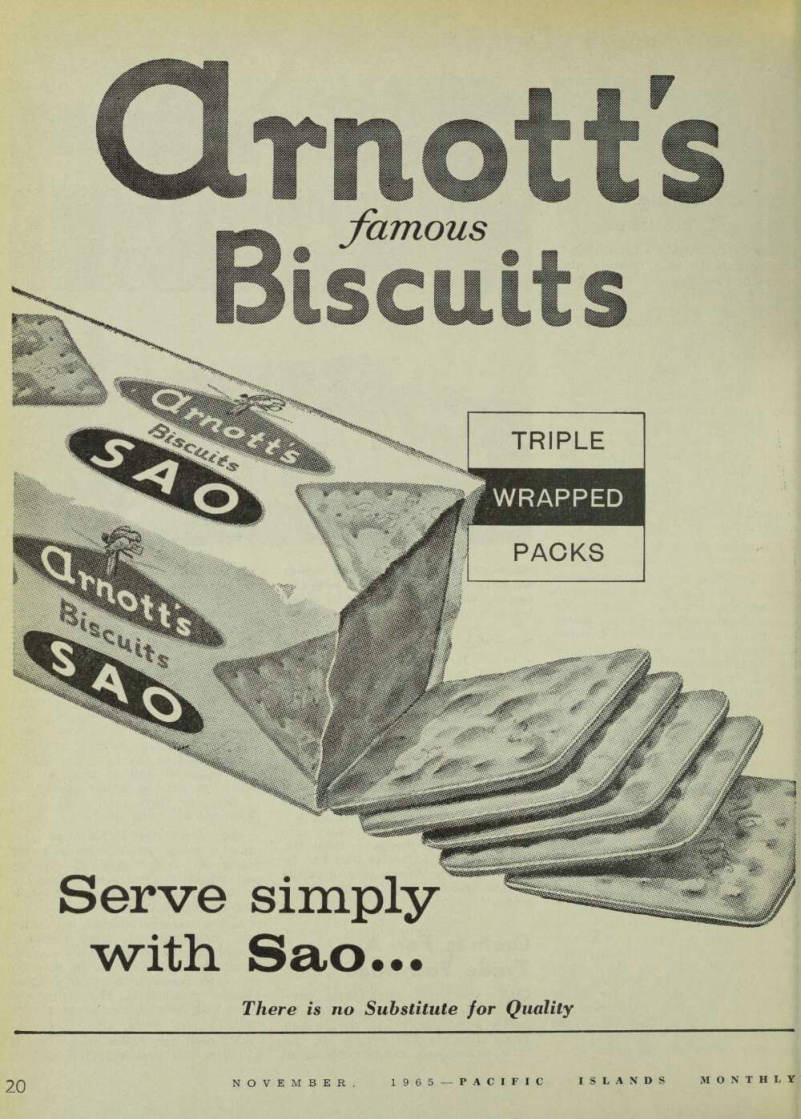
New Guinea coffee in their blends, and sometimes use pure New Guinea coffee, took turns in staffing and supplying a free coffee bar at the Papua-New Guinea exhibit. On the first night they handed out 1,100 cups in three hours and on most days there were queues.
Even the Australian Customs regu tions were bent to allow genuine New Guinea coffee branches and orchids to be especially flown from Lae every few days to keep the coffee exhibit looking fresh. The plants were displayed out of reach of the public, in case somebody souvenired a twig or two, and they were destroyed after the display.
The Territories Department pro duced a glossy coloured leaflet giving details of coffee grading, growing and marketing and also enclosed a list of coffee firms to which trade inquiries could be made.
Many overseas businessmen at the fair, including some from Hungary, Canada and France, made inquiries about the coffee—although the fair was also boosting many other New Guinea products. More than 30 firms with New Guinea interests took part.
All-in-all the coffee idea was an excellent and practical gimmick and
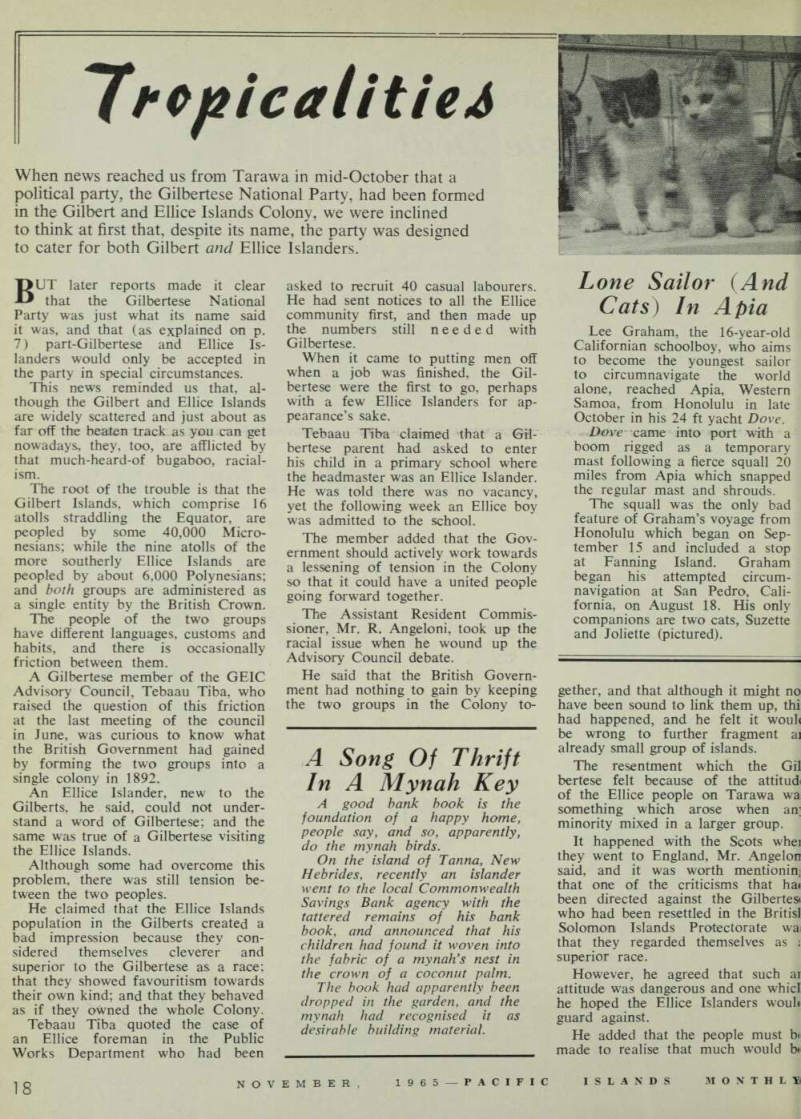
The magically sprouting coconuts outside Noumea's Customs House have helped to beautify this section. The nearby street, below, is in need of the same treatment.
:he Department of Territories and the firms concerned really ought to have been presented with those New 3uinea orchids.
Messages From The
Younger Fijians
FIJIAN students abroad have minds of their own, and they aren’t frightened to express themselves.
From time to time we hear from them, and we note with pleasure ;hat some already have gone on to promising careers.
We heard the other day from R.
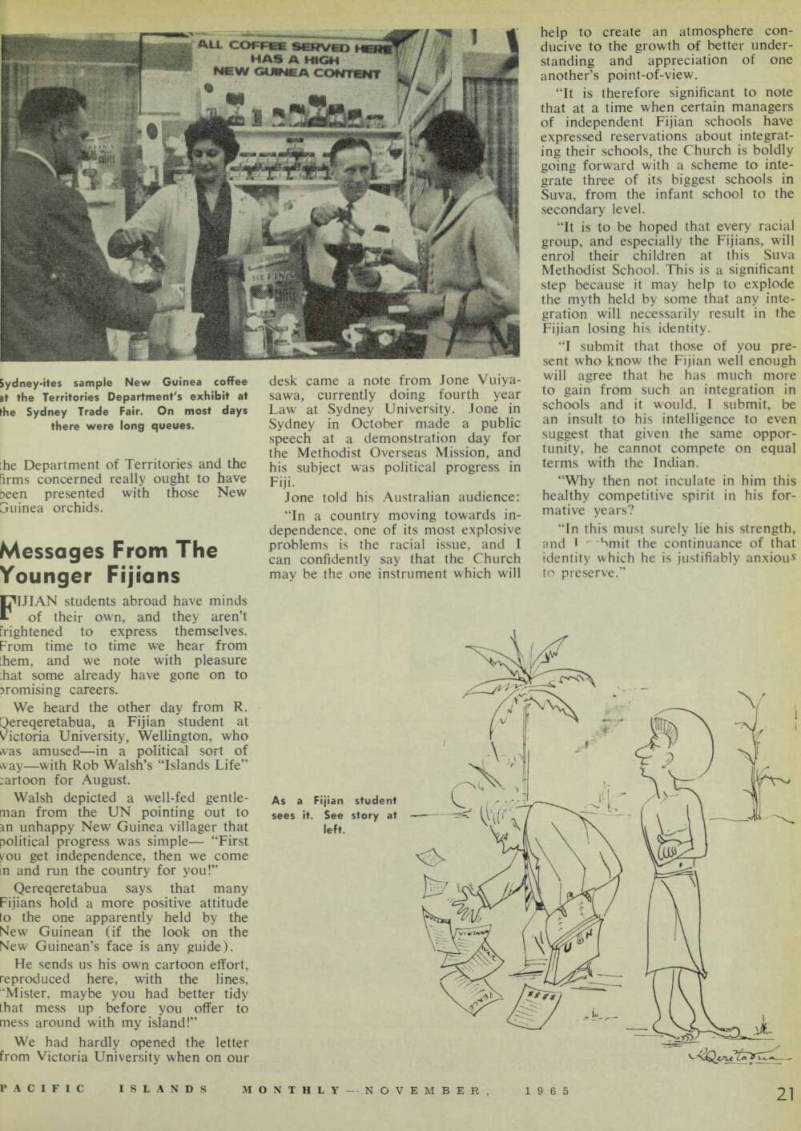
Qereqeretabua, a Fijian student at Victoria University, Wellington, who was amused —in a political sort of way—with Rob Walsh’s “Islands Life” :artoon for August, Walsh depicted a well-fed gentle man from the UN pointing out to an unhappy New Guinea villager that political progress was simple— “First you get independence, then we come in and run the country for you!”
Qereqeretabua says that many Fijians hold a more positive attitude to the one apparently held by the Mew Guinean (if the look on the Mew Guinean’s face is any guide).
He sends us his own cartoon effort, reproduced here, with the lines, ‘Mister, maybe you had better tidy that mess up before you offer to mess around with my island!”
We had hardly opened the letter from Victoria University when on our
desk came a note from Jone Vuiya sawa, currently doing fourth year Law at Sydney University. Jone in Sydney in October made a public speech at a demonstration day for the Methodist Overseas Mission, and his subject was political progress in Fiji.
Jone told his Australian audience: “In a country moving towards in dependence, one of its most explosive problems is the racial issue, and I can confidently say that the Church may be the one instrument which will
help to create an atmosphere con ducive to the growth of better under standing and appreciation of one another’s point-of-view, “It is therefore significant to note that at a time when certain managers of independent Fijian schools have expressed reservations about integrat ing their schools, the Church is boldly going forward with a scheme to inte grate three of its biggest schools in Suva, from the infant school to the secondary level.
“It is to be hoped that every racial group, and especially the Fijians, will enrol their children at this Suva Methodist School. This is a significant step because it may help to explode the myth held by some that any inte gration will necessarily result in the Fijian losing his identity.
“I submit that those of you pre sent who know the Fijian well enough will agree that he has much more to gain from such an integration in schools and it would, I submit, be an insult to his intelligence to even suggest that given the same oppor tunity, he cannot compete on equal terms with the Indian.
“Why then not inculate in him this healthy competitive spirit in his for mative years?
“In this must surely lie his strength, and I Smit the continuance of that identity which he is justifiably anxious to preserve.”
sydney-ites sample New Guinea coffee at the Territories Department's exhibit at the Sydney Trade Fair. On most days there were long queues.
As a Fijian student sees it. See story at left.