Uneasy Quiet On Fij's
pp. 11-13 · Read in the full issue
Political Field
From a Suva Correspondent Apart from a few odd words, things have been quiet on the political field in Fiji following the London conference of July, which came to an agreement on a new constitution.
iS it the calm before the storm, or L an acceptance by all the parties f that London agreement? The ondon agreement was not unani ious—for the three Federation Party ten, and middle -of - the - reader mdrew Deoki, were the odd men ut.
At the moment, nobody is ready to events. Changes in the con titution cannot come before next kpril at the earliest, and there might e nothing more than some political drmishing in the meantime. And ten there might not.
Federation Party leader A. D. Patel . finaly back in Fiji after spending long time in India, retracing his oyhood steps in the State of Gujerat. i his absence his opponents were tying he was in no hurry to come ack because he wanted the memory f his group’s tactics at London to ide in the public mind.
Without doubt he has lost sup orters over his London attitude, lor did he gain face following the üblication of a letter sent by the ritish Secretary of State, Mr. mthony Greenwood, to five of the ix Indian delegates to the cen tre nee.
The letter was in reply to one sent y the Patel group to Mr. Green 'ood after the conference.
The Patel letter warned Mr.
Jreenwood that implementation of
the London proposals “would create a grave racial disharmony leading to undesirable results”.
The letter went on: “In this process an irreparable harm would be done to the country as a whole and we fear that the goodwill, harmony and understanding which has existed among all races in Fiji over the last 90 years would disappear for ever.
“The responsibility for any course of events arising out of the imple mentation of these proposals and leading to this result should rest, in our view, on Her Majesty’s Govern ment.”
The group trotted out the hoary old argument of the Salisbury Des patch in their letter to Mr. Green wood.
“May we say without hesitation,”
the letter read, “that the proposal to give two extra seats to the Fijians constitutes, in our view, a clear breach of Lord Salisbury’s Despatch on the part of Her Majesty’s Govern ment.”
In reply, Mr. Greenwood asked the group to bear in mind the conse quences of outright opposition. This, said Mr. Greenwood, was “far more likely to increase the suspicions of the other communities, particularly the Fijians, than to win them over to support your point of view, which must surely be your objective.
“I believe a much more fruitful course of action,” said Mr. Green wood. “and one which would be far more likely to lead to the political integration and racial harmony which we all want to see achieved, would be to co-operate fully in the intro duction of the new constitution and, by showing that the measure of inter racial voting which it will introduce does not adversely affect the interests of any race, to pave the way to con stitutional progress.”
Perhaps Mr. Patel and his com rades will decide that that is the more statesmanlike approach, rather than continue with a private divide and rule policy—the very thing, oddly enough, they have been accusing others of doing.
A sample of this is given in the Indian newspaper Nav Bharat, in an interview Mr. Patel gave that paper while he was in India.
The neswpaper report was head lined: “Britain has not given up her policy of divide and rule—Fiji’s Minister of Social Services Patel’s statement”.
It said: “Fiji’s Minister of Social Services, Mr. A. D. Patel, said yester day (Sept. 27) that the British Govern ment is continuing her notorious policy of divide and rule in Fiji.
“Condemning Britain’s new con stitution for Fiji, he said that these proposals are undemocratic, biased and unjust to the Indian community
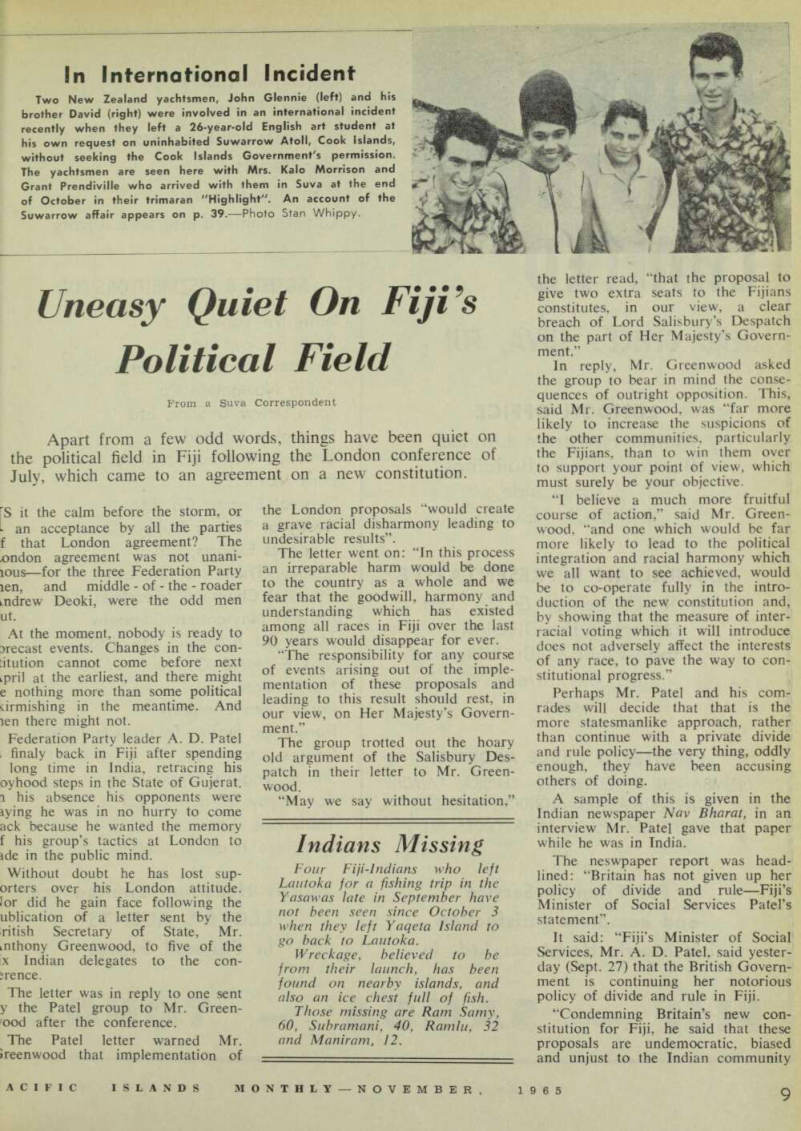
In International Incident
Two New Zealand yachtsmen, John Glennie (left) and his brother David (right) were involved in an international incident recently when they left a 26-year-old English art student at his own request on uninhabited Suwarrow Atoll, Cook Islands, without seeking the Cook Islands Government's permission.
The yachtsmen are seen here with Mrs. Kalo Morrison and Grant Prendiville who arrived with them in Suva at the end of October in their trimaran "Highlight". An account of the Suwarrow affair appears on p. 39.— Photo Stan Whippy.
►f Fiji. Fiji’s population is 450,000 nd out of it 51 per cent, are Indians.
“Mr. Patel at present is touring ndia. He has come here from xmdon where he went to discuss tie new constitution, but the con erence was a failure. After visiting ndia he will go back to Fiji.
“Mr. Patel told Press representa ives that Britain, by maintaining a ommunal roll, is trying to keep 'ijians, Indians and Europeans sepa ate from each other.
“If it is accepted, then Indians will et only 14 seats out of 40.
“Britain has the same policy for ■iji which she is practising in lauritius and British Guiana.”
That sort of stuff, republished in r iji, certainly doesn’t do much for acial harmony.
FOOTNOTE: The Salisbury Des atch to the Government of India in 875 was to do with the treatment nd position of Indian labourers in le countries to which they had been snt.
The Despatch held that each in entured labourer, having completed is agreed term of service, should e free to remain in the country in diich he had served, or return to ndia. If he preferred the former, he hould be treated as a first-class itizen and given all the rights and rivileges of a first-class citizen.
The Despatch referred only to lose indentured labourers who had ompleted their terms of service. At ic time it was made there was not single Indian in Fiji, and further lore, the proposals in the Despatch fere rejected by the Government of ndia two years later. The Despatch ecame a dead letter.