New Gilbertese Party
pp. 9-10 · Read in the full issue
Solomon Islander Inspired New Gilbertese Party
By Robert Langdon
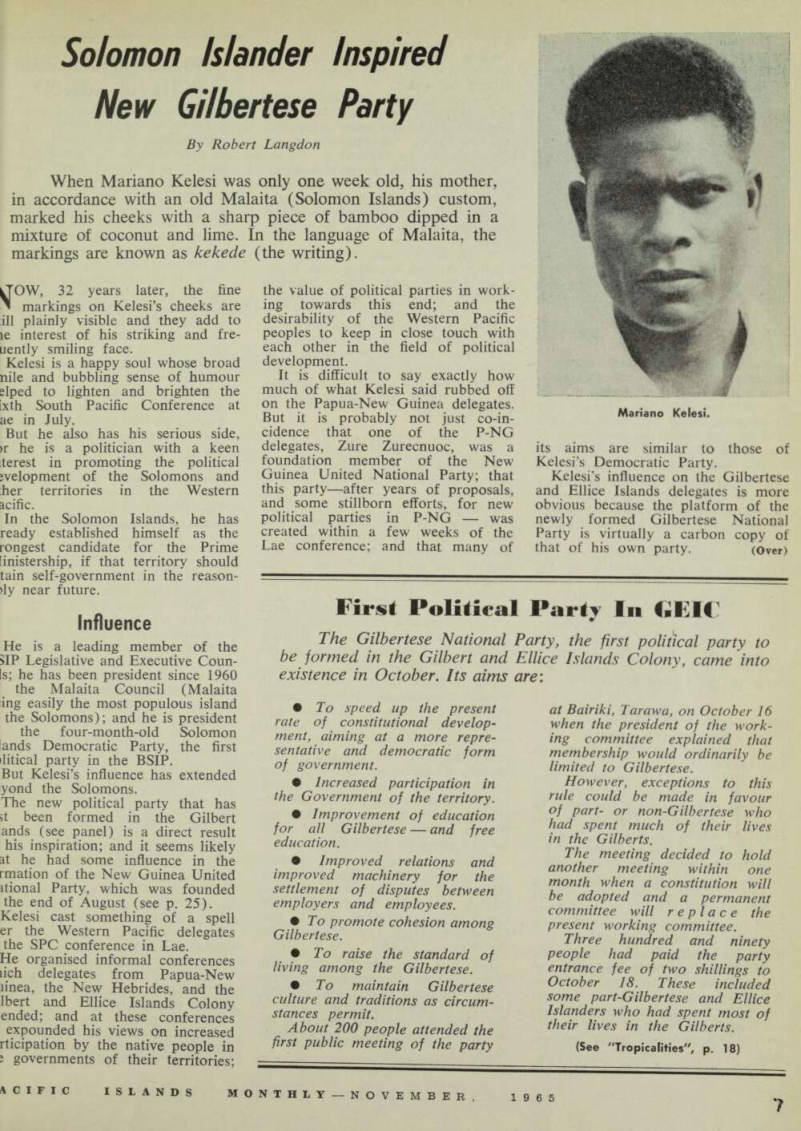
When Mariano Kelesi was only one week old, his mother, in accordance with an old Malaita (Solomon Islands) custom, marked his cheeks with a sharp piece of bamboo dipped in a mixture of coconut and lime. In the language of Malaita, the markings are known as kekede (the writing).
kTOW, 32 years later, the fine markings on Kelesi’s cheeks are ill plainly visible and they add to ic interest of his striking and fre uently smiling face.
Kelesi is a happy soul whose broad nile and bubbling sense of humour dped to lighten and brighten the ixth South Pacific Conference at ae in July.
But he also has his serious side, >r he is a politician with a keen terest in promoting the political welopment of the Solomons and her territories in the Western acific.
In the Solomon Islands, he has ready established himself as the rongest candidate for the Prime [inistership, if that territory should tain self-government in the reason >ly near future.
Influence
He is a leading member of the 51P Legislative and Executive Coun [s; he has been president since 1960 the Malaita Council (Malaita ing easily the most populous island the Solomons); and he is president the four-month-old Solomon 'ands Democratic Party, the first •litical party in the BSIP.
But Kelesi’s influence has extended yond the Solomons.
The new political party that has >t been formed in the Gilbert ands (see panel) is a direct result his inspiration; and it seems likely at he had some influence in the rmation of the New Guinea United itional Party, which was founded the end of August (see p. 25).
Kelesi cast something of a spell er the Western Pacific delegates the SPC conference in Lae.
He organised informal conferences uch delegates from Papua-New linea, the New Hebrides, and the Ibert and Ellice Islands Colony ended; and at these conferences expounded his views on increased rticipation by the native people in J governments of their territories;
the value of political parties in work ing towards this end; and the desirability of the Western Pacific peoples to keep in close touch with each other in the field of political development.
It is difficult to say exactly how much of what Kelesi said rubbed off on the Papua-New Guinea delegates.
But it is probably not just co-in cidence that one of the P-NG delegates, Zure Zurecnuoc, was a foundation member of the New Guinea United National Party; that this party—after years of proposals, and some stillborn efforts, for new political parties in P-NG was created within a few weeks of the Lae conference; and that many of
its aims are similar to those of Kelesi’s Democratic Party.
Kelesi’s influence on the Gilbertese and Ellice Islands delegates is more obvious because the platform of the newly formed Gilbertese National Party is virtually a carbon copy of that of his own party. (Over)
Mariano Kelesi.
The aims of the Solomon Islands Democratic Party, of which all elected members of the BSIP Legislative Council are now members, are: • Increased participation in the government of the Protectorate, and eventual control of the Budget and improvement of the economy. • Self-determination under the Crown, within the British Common wealth. • Better education in the Solomons, including free education for all children and more technical schools. • Improved industrial relations and improved machinery for the set tlement of disputes between employers and employees. • Unification of the peoples of the Protectorate, • Greater participation by women in the affairs of the Protectorate.
In a talk I had with Kelesi in Lae, he told me that the idea of the Democratic Party had been his, and that he had asked the permission of the Chief Secretary of the Western Pacific High Commission to form it.
The party was open to people of all races. It then (July) had some European and Fijian members besides Solomon Islanders, but no Chinese members.
“Each Legco member will be chairman of a sub-branch of the party in his constituency,” Kelesi said, “and we will work through the sub-branches to get members of the local councils to become members.
“The constitution of our party will be based on those of the Australian Labour Party and the Democratic Party of the United States.”
Moderate
In discussing his party’s aims, Kelesi revealed himself as moderate and tolerant.
He told me, for example, that although he resented the fact that Solomon Islanders were forbidden to drink in the public lounge at the Hotel Mendana in Honiara, he was not anti-European—as many of his countrymen were —for this reason.
“My view is that all Europeans should not be condemned for what goes on in one hotel, and I have tried to get other Solomon Islanders to accept this view,” he said.
At the South Pacific Conference itself, Kelesi probably had more to say on more subjects than any other delegate—which prompted several Europeans to say that he talked too much and that much of what he said was ill-informed and better left un said.
There was some truth in this, but
Kelesi certainly never gave the im pression that he was enraptured by the sound of his own voice or was striving for effect.
He would simply become carried away by his eagerness to con tribute to the subject under discussion, and would be “holding the floor” almost before he realised it.
Kelesi’s English is good—except ionally good when one learns that he could not speak a word of the language when he finished his formal education—at Standard 6 in primary school.
“I picked up my knowledge of English through speaking with Euro pean friends and other Solomon Islanders, and through reading books,” he told me.
When I asked him what books he had recently read, he mentioned The New Ghana, a biography of Wiston Churchill, and Martin Luther King’s Why We Can’t Wait, a book on civil rights for Negroes in the United States.
First Job
Kelesi said that after he left school his first job was as a clerk in the income tax section of the Treasury.
“I was there for one year,” he said. “Then I left to go home to Malaita because my father and brother had died, and I had to take care of our property—about 20 acres of coconuts.
“After a year at home, I went back to Honiara and took a job in the Customs agency of William Breckwoldt & Co. I worked at the agency for two years.
“In 1956-57, I attended a South Pacific Commission fisheries course in Noumea; then I worked as a fisheries officer in the Malaita Dis trict for the Malaita Council.
“In 1958, I was elected to the Malaita Council; and in 1960, when I was elected president of the council, I was also nominated as an un official member of the Solomon Islands Legco. Since then I have been a full-time politician.”
Kelesi is one of the most widely travelled islanders in the Solomons.
He visited the Gilbert and Ellice Islands in 1961, when Sir John Gutch paid a farewell visit to that Colony as High Commissioner for the Western Pacific.
In 1962, he attended the Fifth South Pacific Conference in Pago Pago, American Samoa; and in 1964, the BSIP Government sent him to Port Moresby for two weeks to see the newly-elected House of Assembly in action.
More recently, he became the first
Solomon Islander to visit the United States on a foreign leader grant— a grant which he obtained on his own initiative, first by approaching the BSIP Education Officer to find out what scholarships were available for people such as himself, and ther by writing to the US Consul in Fiji On his US trip, which took ir visits to Puerto Rico and the Virgir Islands, Kelesi was away from the Solomons for three months.
Kelesi’s overseas experience has no doubt smoothed a good man> rough edges, has given him maturity and has convinced him that Pacific Islanders, given time and education will be quite capable of running their own affairs.
He made this last point clear when he told me that he was a strong believer in the value of the South Pacific Commission, but that the Islanders should have more say in it “I believe each territory should have a commissioner sitting on the SPC; that the territories should con tribute to the SPC; and that qualifier.
Islanders should be allowed to work on the SPC staff,” he said.
“And one thing we don’t want is the United Nations coming here tel ling us what to do.”
All this adds up to the fact that Kelesi is a force to be reckoned withi and that much more will be heard from him, and of him, in the future;