Court Over Wages
pp. 7-8 · Read in the full issue
New Guinea Goes To Court Over Wages
From AAP-Reuter and PIM correspondents in Port Moresby
Results of an arbitration claim, which began in Port Moresby on October 26 and which is expected to last several months, will have far-reaching effects on the Territory’s economy.
IHE claim is for salary increases for P-NG’s 7,300 native public wants, and is being heard by the blic Service Arbitrator, Mr. L. G. itthews.
The P-NG’s Public Service As fiation is seeking a specified basic ge with margins. It wants the sic wage to be based on the needs a man, wife and three children.
Phe Administration has objected the association’s claim on the >unds it is not sufficiently specific, also has denied it should take a account a basic wage and rgins in fixing salary rates. There no basic wage in the Territory at sent, fhe present minimum salary for w Guinean public servants is £220 year. The highest salary they reach under the present scale £1,680.
"Controversy"
'he arbitration hearing is taking ze against a background of con rersy over the Australian Gov ment’s decision last year to rganise the Territory public fice with local officers on lower .ry scales than Europeans, his resulted in many New neans getting only about 40 per t. of the salary a European was 1 for the same job. he Government argues that salary s for local officers should be ;d on the Territory’s ability to t public service salaries from its l resources in future, oth the Administration and ate employers are concerned at nt signs of industrial unrest, icularly in the Port Moresby area p. 25). here are widespread fears that :tion of claims for higher wages d mean a spate of serious strikes racial unrest. [any New Guinean workers in ate enterprise have made no
secret of their hopes the arbitrator will decide on a basic wage of at least around £7 a week for public servants.
Such a decision would mean strong pressure on private employers to match the wage.
The Public Service Association is being represented by its president, Mr. John Greville Smith, a prosecutor in the Territory’s Crown Law Department, and by its industrial advocate, Mr. lan MacPhee, a young Sydney solicitor who recently re signed from the Crown Law Depart ment to become the Association’s full time advocate.
The Australian Council of Trade Union’s industrial advocate, Mr. R.
J. Hawke, will assist the PSA dur ing the hearing.
The Administration has briefed Sydney barrister Mr. J. H. Wootten to conduct its case. He is being assisted by Mr. N. Rolfe, a senior member of the Public Service Com missioner’s staff.
While the PSA is fighting for a
basic wage for its local officers, the European officers appear to have reached the end of their patience in their own fight for a compensation scheme for Europeans who will lose their jobs with the approach of self government.
The PSA has been requesting such a scheme for several years and has had Government promises ( PIM Oct., p. 12). The P-NG Public Service at present employs 3,315 overseas officers—2,362 of whom are
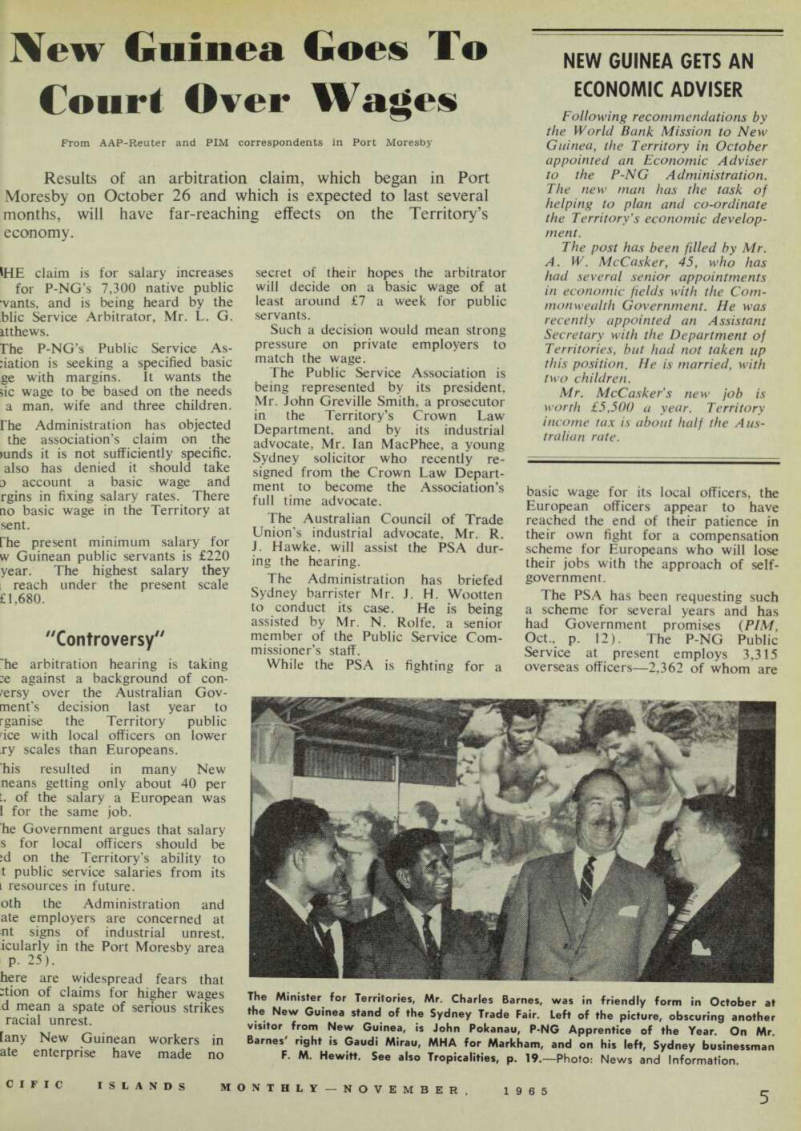
The Minister for Territories, Mr. Charles Barnes, was in friendly form in October at the New Guinea stand of the Sydney Trade Fair. Left of the picture, obscuring another visitor from New Guinea, is John Pokanau, P-NG Apprentice of the Year. On Mr.
Barnes' right is Gaudi Mirau, MHA for Markham, and on his left, Sydney businessman F. M. Hewitt. See also Topicalities, p. 19.—Photo: News and Information.
permanent and the Government intends to recruit 2,000 more in the next five years.
When the Australian Minister for Territories, Mr. Barnes, agreed to address the PSA annual congress in Port Moresby at the end of October the members felt they would hear, at last, the long-awaited announce ment of a detailed scheme.
But it didn’t come.
Mr. Barnes told the congress the Government had approved a com pensation scheme, but details still had to be decided.
Officers would be offered alter native employment with the Gov ernment or Government authorities (presumably in Australia) and where “reasonable” employment could not be offered displaced officers would be given cash compensation, Mr, Barnes said.
This was not good enough for the public servants.
They regarded Mr. Bames’ state ment as no more adequate an assurance than they had had from Mr. Hasluck, the previous Minister, in 1962.
The congress resolved that, “It is not prepared to accept any longer that the Australian Government may take its own time about promulgating a detailed scheme for compensation”.
Slopwork Threat
It instructed the association’s executive to seek permission from the Prime Minister, Sir Robert Menzies, for the association to call stopwork meetings throughout the Territory on Australia Day (January 26) if the Australian Government had not then announced a detailed scheme.
The congress expressed its “deep concern at the deteriorating morale within all ranks of the public service”.
It said this had been caused by: • The Government’s failure to announce a detailed compensation scheme. • The Administration’s “total in difference” to the housing needs of local public servants. • The Administration’s “active and extensive obstruction” of the as sociation in its preparation of the native public servants’ salary case. • The Administration’s obvious intention to recruit large numbers of skilled overseas officers on the basis that houses will be provided for them, but without revealing that the standard of these houses will be such that they would not be permitted to be built in Australia for habitation.” • The Administration’s departure from the principle of parity with the Commonwealth Public Service in fix ing salaries.