Pacific Commerce and Produce
pp. 138-141 · Read in the full issue
Some Facts Behind Australian Commercial Interest In Fiji
From a Suva Correspondent Critics in Fiji many times have claimed that Australia, sell ing so large a quantity of goods to Fiji, and owning so large a proportion of the trading and
manufacturing enterprises in
Fiji, could do more than it does to help Fiji in various ways. criticism was answered in a -A- long, well-reasoned address to the Ba Chamber of Commerce, in Fiji, on Septmber 1, by Mr. R. N.
Hamilton, Australian Commissioner in Fiji.
The establishment, development and maintenance of the Australian controlled sugar industry in Fiji were described, in figures. In the two years, 1963 and 1964, the company exported from Fiji sugar worth £32,200,000. The taxes collected by Fiji in that period, from profits and from dividends paid, were over £850,000 and port and customs taxes collected were £600,000—£1,450.000 together. Some £1,400,000 went over seas in two years in dividends to shareholders. In the same period, the company spent over £2 million in Fiji on expansion of the industry.
£32m. Earnings
In other words, that Australia owned sugar industry, in the two years, earned more than £32 million for Fiji, plus large sums in taxation, and took £1,400,000 out.
Other Australian corporations con tributed to the economic strength of Fiji by processing Fijian material and using Fiji labour to produce:— Coconut oil and meal, which re presented £2,400,000 of the £2,900,000 worth of coconut products exported in 1964.
Biscuits, which supplied the local market (thus reducing imports). £lOO,OOO worth were exported.
Gold bullion, of which £1,400,000 was exported in 1964 (making £11,200,000 worth in 10 years). In that period, the company paid
dividends totalling only £114,000 — but ploughed back £5,000,000 of earnings in development.
Cement—3 0,000 tons in 1964, thus reducing imports.
Passionfruit juice—£16,000 worth exported in 1964.
Beer—soo,ooo gallons in 1964, correspondingly reducing imports.
Nails and barbed wire.
Preparations being made by Aus tralian concerns to begin timber milling, container manufacture, flour milling, stock food manufacture, manufacture of industrial gases, are all likely to reduce imports, said Mr.
Hamilton.
Other industries established in Fiji by Australian interests, and using Fijian labour and materials, are in the fields of shipping, publishing, bank i n g , insurance, commercial aviation and commerce generally.
Mr. Hamilton calculated that Aus tralian interests provided the facilities which produced £21,900,000 of Fiji’s 1964 exports which totalled £23,100,000. To this could fairly be added the value of the products made in Fiji by Australian enterprise, and which reduced imports considerably.
Total Profits
In 1964, the Government employed 5,279 persons for wages. The sugar company and the goldmines, alone, employed 4,657.
It was officially estimated that, in 1963, the shareholders’ funds in Australian companies operating in Fiji (not including insurance) totalled £22,500,000. The total profits of those companies, as assessed for taxation, was £4,980,000. Out of those profits, less than £1,400,000 went out of Fiji as dividends. 72 per cent of the profits made before tax was not paid away as dividends.
Mr. Hamilton calculated that the amount paid away as dividends amounted to only 6.2 per cent, of the £21,900,000 of Fiji exports for which the Australian corporations were re garded as responsible.
The Commissioner also replied to statements that Australia charged unduly high prices for goods sent to Fiji. He quoted, as part of his argument, the comment of the New Zealand Trade Mission that NZ goods met with “stiff competition” in the Fiji market, especially from Australian goods.
He also explained and defended the “adverse” trade balance between
Fiji and Australia by pointing i that Fiji bought its goods in i most suitable market and that was virtually impossible for F with its small range of exporta commodities, to attempt to strike balance with individual countrie But while defending the pres< Fiji-Australia trade position, t Commissioner pointed out that 1 imbalance could be reduced. A tralia imported well over £6O milli worth of agricultural and fisher products which conceivably could supplied by Pacific Islands like F Fiji, he said, “was immediately o side Australia’s front door”.
He replied also to the criticism tl Australia was giving millions in z —through Colombo Plan and otf agencies— to undeveloped countr to her northwest, and nothing to F 1 one of her best customers. He point out that there was an obligation upi Australia and other Western natic to give aid to undeveloped countr' which otherwise were unaide whereas Fiji enjoyed a high standard of living than those Asii countries, and already was receivii outside aid—especially from Brita —of about £4 per head of populatio In any event, he said, Australii money had been made freely ava able to Fiji, through investments, he had described. Moreover, At tralia was contributing £lOO,OOO year to the South Pacific Commissio through which Fiji received beneff Also, Australia provided education facilities—out of 11,000 oversea students now in Australia, abc 400 were from Fiji, and being i sisted in various ways.
Australia’s contribution to the a* of the Nadi international airport w 40 per cent.—or about £F2 million
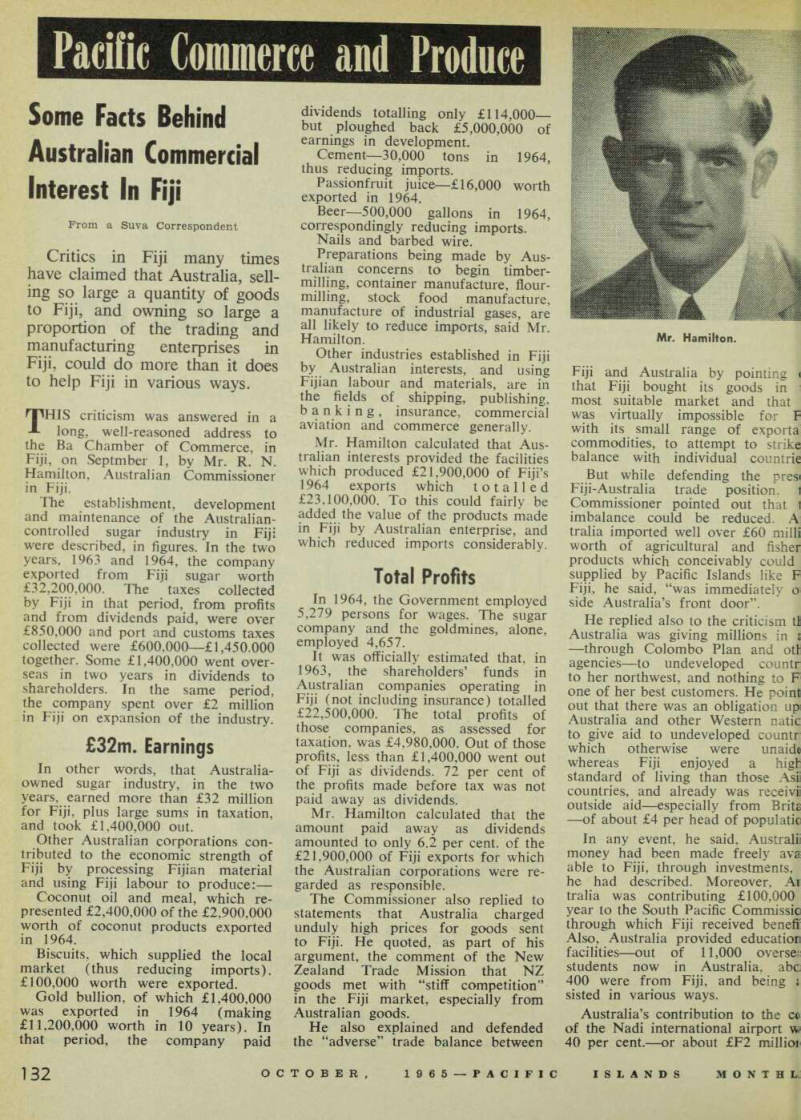
Mr. Hamilton.
NG Cocoa Growers
sk For Subsidy
'ATIVE cocoa growers in New Guinea have asked the Admini tion to subsidise the growing of oa in the Territory, rhe price of cocoa in September 5 just over £l2O a ton compared h an estimated growing cost of 10 a ton. fhe New Guinea Cocoa Growers’ lociation has rejected a proposal a stabilisation scheme, folai growers say they already ke payments to such organisations the Tolai Cocoa Project and re ments on loans to growers, and not undertake payments to a >ilisation fund.
"hey said the Government per ded natives to plant cocoa and uld now help growers experiencing iculties.
"he cocoa price has dropped from average of £2OO a ton over the t few years.
'ighter Outlook
>r Copra
FTER falling back to £stg7l/13/4 per ton at the beginning of tember, the market for Philippine ; copra began to firm, and by l-month was up to £74/14/2 and wing signs of strength.
"he chairman of the P-NG Copra rketing Board, Mr. lan McDonald, I PIM that the earlier weakness uld no doubt be attributed to the that two Continental dealer is in copra and coconut oil had ed”. This led to larger quantities oming available on the market, lowever, this situation was quickly in the opening of hostilities veen India and Pakistan, with eeds, particularly laurics, rapidly ring upward as sellers began to s advantage of the increasing rand, although after some profit ing there was an easing partic rly in palm kernels.
Prices remained more or less hanged in soft oils and oilseeds, the market at the moment has a y firm appearance, and prices in sections could go higher,” Mr.
Donald said.
Already there are indications of in groundnuts and groundnut and there is an active market in abeans in the UK, despite the fact t private estimates in the US scast a soyabean crop of around I million bushels, compared with year’s record output of 700 mil i bushels.
“Copra production in Papua-New Guinea is currently running about 3,000 tons ahead of last year, the comparative figures being around 79,500 tons this year and 76,750 in 1964.
“Thus, unless there is any heavy drop in plantation output between now and the end of the year, 1965 should be a record year with a pro duction of about 117,000 or 118,000 tons.
“My board’s tentative main ports purchase price for copra remain un changed at: Hotair, £7l/10/-; FMS, £7O, Smoke, £69.”
West Somoa Reviews
Its Copra Policy
ALTHOUGH it has reserves of about £WSSOO,OOO, the Western Samoa Copra Board has up till now been prevented by law from doing much to benefit the producer, except to set and stabilise the local buying price. After years of effort by the Board the picture has now been changed, reports R. F. Rankin in Apia.
Heeding complaints by growers
against cuts to the middleman, and acknowledging the failure of Govern ment to stimulate copra production, the Assembly has amended the act setting up the Board to allow it to; • Invest for the direct benefit of producers the profits from investments (now amounting to £20,000). • Charter or purchase ships to transport Samoan copra overseas. • Purchase directly from pro ducers instead of, as at present, through the various traders. • Build its own shed on the new wharf. • Lend to the Treasury when authorised by Parliament up to 40 per cent, of the reserve fund.
The secretary of the Copra Board, Mr. Herman Thomsen, said that it was not intended to immediately im plement all these changes. He did, however, envisage building a shed on the new wharf and having copra from the villages delivered directly to the wharf shed instead of to the sheds of various firms around Apia.
He also expected the £20,000 profit from investment to be used in some scheme aimed at stimulating produc
tion. The export figures of 16,956 tons achieved in 1922 have been exceeded only three times in the succeeding years—l 947 18,181 tons), 1952 (17,037) and 1955 (17,178 tons). Pro duction is currently running at about 15,000 tons.
Meanwhile a report by FAO and SPC coconut expert W. Pieris, pre pared at the Government’s request several months ago, has been on the secret list since its receipt in Apia in August. The report, which surveys the present state of the industry and contains specific recommendations for future development, is said to be critical of the Government’s lack of direction in the industry over past years.
P
Rto Tit Rot
S 110(11* Mills
COUTH Pacific Sugar Mills Ltd., . . the CSR Company’s Fiji sub sidiary, had a net profit of £1,206,994 for the year ended March 31. The result was about 22 per cent, lower than the previous year’s profit, The dividend of 7\ per cent, will absorb £693,750.
The parent company gets the bulk of the dividend; Fiji residents, who own about 800,000 of the shares (they were offered five million shares dur ing the financial year) will get the rest.
The chairman, Mr. H. G. Nicholls, in his address to shareholders recently,
said sugar production was sligl higher than in the previous year, free world prices were much lows Mr. Nicholls said new marl that Fiji had gained had to be m£ tained in future to avoid the le of economic activity falling and ca ing undue hardship to a large p portion of Fiji’s population.
“Fiji must obtain a satisfact quota if there is to be a new ini national sugar agreement,” ] Nicholls said.
The world price level of ab £Stg.2o might persist for some tii That price was well below j reasonable assessment of the cost production in even the most effici sugar-producing countries.
Provided economy measures tak and present estimates of crop j sugar production for 1965 were alised, and there was no further dine in world price, the directors pected to be able to maintain per cent, dividend for the curr year.
Copra Beetle Reach*
Fiji's "Last Bastior
COPRA producers on Vanua Ia and Taveuni, the second £ third largest islands in Fiji, are s< ously concerned at the recent ne that the rhinoceros beetle has b< found on Koro Island, about half-v between their islands and the m island of Viti Levu.
The rhinoceros beetle, which attai coconut palms, has long been est lished on Viti Levu.
Hundreds of thousands of poui have been spent over the last f years to prevent its spread to otl copra-producing areas in the Color However, despite all precautio the beetle keeps on turning up in an where it was not known before.
Commenting on the Koro discove Fiji’s Acting Director of Agricultu Mr. K. J. Garnett, said: “We are m faced with the fact that a major cop producing island is infested. Kora the last bastion before Savusavu ( Vanua Levu) and Taveuni, so that i risk of eventual spread to these an becomes more pressing than ever.’
Mr. Garnett added that coj planters should begin a clean-up of possible breeding places on th plantations.
About a fornight later. The F Times reported that half-a-doz grubs had been found at the site the original discovery on Koro, If no other beetle markings had be seen. However, a survey of the isla by representatives of the Cocod Pests and Diseases Board still had: long way to go.
ji Foctory To Make
iper Products
EW ZEALAND. Australian and Fijian interests have joined es to establish a factory at Walu , Suva, for the production of board and paper products. hree companies, the giant Aus an Kiwi polish concern, the ted Empire Box Company of r Zealand and C. Sullivan (Pacific ids) Ltd. have registered a Fiji pany. Kiwi United (South fic) Ltd., with a capital of 50,000. he new factory is due to start ufacturing corrugated board, ligated board cartons, containers, r bags and toilet tissue in iber. The products will be sold 7 iji and in neighbouring Pacific ids at prices the company says be cheaper than imported pro s at present available.