travel
pp. 123-129 · Read in the full issue

Bright Future For The Warm And Friendly Sigatoka Coast
From Stuart Inder, in Sigatoka
The stretch of Fijian coast which I predict to have the brightest tourist future is the 30 miles of Viti Levu between Korolevu and Cuvu (pronounced Thuvu). The centre of this coast is only 70 miles from the international airport at Nadi and can be reached by taxi in about two hours. Another two and a half hours along the same scenic road takes you to Suva.
A LREADY nailing the reputation of this coast at one end is the Corolevu Beach Hotel, one of the >est known hotels in the South Seas, 'low work has begun at the opposite nd, Cuvu, on clearing a site for a nodera new hotel which should make l reputation for this part of the tretch, too.
In between, there is a buzz of hotel ind residential activity destined to urn the whole stretch into a Gold ?oast, a Riviera. It has become one ►f the “most wanted” areas of Fiji o visit and to live in—a popular •lace for the semi-retired who appreci te a pleasant view, a pleasant climate nd who want to be away from a nore demanding life without being ut off from civilisation.
New residential land is becoming lore difficult to find.
The climate is mild because it is >n the border of the wet and dry sides >f the island. Its scenery is generally
tropical and its seascapes usually superb, for the road hugs the coast for the entire stretch.
Its main beach, at Cuvu, and Cuvu’s
companion beach, at Yanuca, are two of the best beaches in the South Pacific Islands—and perhaps they might be the best. I have not seen better in my own travels.
Islands beaches are not noted for either the quality of their sand or their surf. Their sand is sometimes black, and usually studded with debris including sharp coral pieces. Surfs are mostly non-existent because of the fringing reefs.
Cuvu and Yanuca have pure, deep
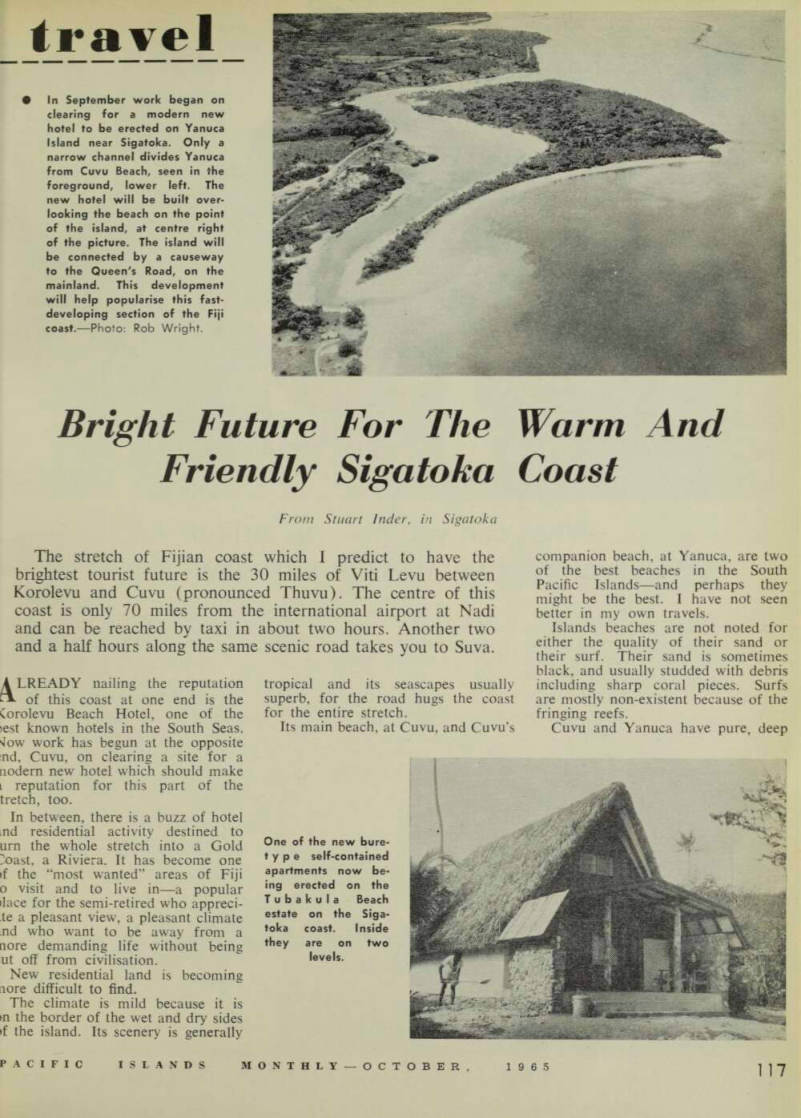
In September work began on clearing for a modern new hotel to be erected on Yanuca island near Sigatoka. Only a narrow channel divides Yanuca from Cuvu Beach, seen in the foreground, lower left. The new hotel will be built over looking the beach on the point of the island, at centre right of the picture. The island will be connected by a causeway to the Queen's Road, on the mainland. This development will help popularise this fast developing section of the Fiji coast.—Photo: Rob Wright.
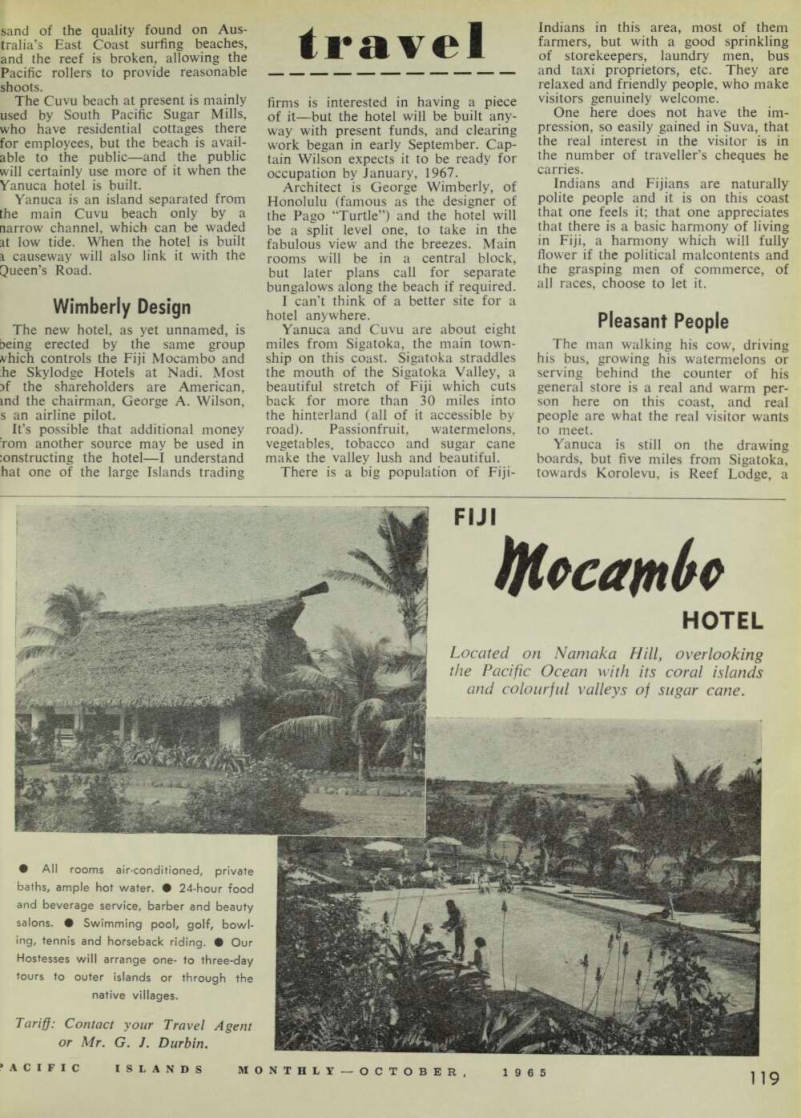
One of the new bure type self-contained apartments now be ing erected on the Tubakula Beach estate on the Siga toka coast. Inside they are on two levels.
sand of the quality found on Aus tralia’s East Coast surfing beaches, and the reef is broken, allowing the Pacific rollers to provide reasonable shoots.
The Cuvu beach at present is mainly used by South Pacific Sugar Mills, who have residential cottages there for employees, but the beach is avail able to the public—and the public will certainly use more of it when the Yanuca hotel is built.
Yanuca is an island separated from the main Cuvu beach only by a narrow channel, which can be waded at low tide. When the hotel is built a causeway will also link it with the Queen’s Road.
Wimberly Design
The new hotel, as yet unnamed, is aeing erected by the same group vhich controls the Fiji Mocambo and he Skylodge Hotels at Nadi, Most af the shareholders are American, md the chairman, George A. Wilson, s an airline pilot.
It’s possible that additional money rom another source may be used in instructing the hotel—l understand hat one of the large Islands trading
travel
firms is interested in having a piece of it—but the hotel will be built any way with present funds, and clearing work began in early September. Cap tain Wilson expects it to be ready for occupation by January, 1967.
Architect is George Wimberly, of Honolulu (famous as the designer of the Pago “Turtle”) and the hotel will be a split level one, to take in the fabulous view and the breezes. Main rooms will be in a central block, but later plans call for separate bungalows along the beach if required.
I can’t think of a better site for a hotel anywhere.
Yanuca and Cuvu are about eight miles from Sigatoka, the main town ship on this coast. Sigatoka straddles the mouth of the Sigatoka Valley, a beautiful stretch of Fiji which cuts back for more than 30 miles into the hinterland (all of it accessible by road). Passionfruit, watermelons, vegetables, tobacco and sugar cane make the valley lush and beautiful.
There is a big population of Fiji-
Indians in this area, most of them farmers, but with a good sprinkling of storekeepers, laundry men, bus and taxi proprietors, etc. They are relaxed and friendly people, who make visitors genuinely welcome.
One here does not have the im pression, so easily gained in Suva, that the real interest in the visitor is in the number of traveller’s cheques he carries.
Indians and Fijians are naturally polite people and it is on this coast that one feels it; that one appreciates that there is a basic harmony of living in Fiji, a harmony which will fully flower if the political malcontents and the grasping men of commerce, of all races, choose to let it.
Pleasant People
The man walking his cow, driving his bus, growing his watermelons or serving behind the counter of his general store is a real and warm per son here on this coast, and real people are what the real visitor wants to meet.
Yanuca is still on the drawing boards, but five miles from Sigatoka, towards Korolevu, is Reef Lodge, a
w hotel that is now becoming own to overseas tourists. It was ened about 18 months ago, and is med by a New Zealand syndicate.
The hotel has 32 rooms in a central )ck, and overlooks the beach. It a accommodate 70, Tariff includes d and breakfast (the other major tels in Fiji usually charging for all sals separately). A double lanai is 5, and a single is £F3/10/- Lunch 12/6 and dinner 15/-.
There is room service and a Fijian nd in the lounge every evening, mager is a New Zealander, Mr.
I. Cowlishaw, and the atmosphere relaxed, the service both efficient d friendly.
The local residents occasionally )p in for a hotel meal and a change scenery.
Tubakula Beach
Virtually alongside the Reef Lodge a complex of bure-type cottages ng erected at what used to be led St. Anne’s-on-Sea.
St. Anne’s was started by Mr. E. F. rbett in 1959, and comprised five f-contained beachside cottages ich visitors rented, supplying their n food. the end of last year the cottages, more than four acres with a beach ntage, were bought by Cathay •tels, Fiji, owners of the Grand :ific Hotel, Suva, and the Cathay •tel, Lautoka. Mr. Corbett has been ained as manager.
Fhe standard-type cottages are be : removed, and are being replaced
by A-frame, bure-type cottages (see p. 117) in the Fijian tradition.
Each contains six beds and all offices.
Construction of these is well ad vanced, and a line of six or eight should be ready for occupation by Christmas. They are virtually on the beach, and are designed to catch the breezes. The owners hope they will attract overseas visitors looking for something comfortable and different, at lower-than-hotel prices.
The eventual plan is for 31 cottages to be built, together with a central building containing probably a super
market and bar. There will also be a swimming pool, although the beach swimming in the area is excellent, as some of the coral has been bulldozed away.
The new Cathay property has been named Tubakula Beach Bungalows.
Next door are Baxter’s cottages— the design being different but the idea being the same—comfortable, self contained accommodation for those who don’t want to stay at a hotel.
Visitors with children should be warned that among the multiplicity of signboards on the property is one
bidding children to use the swim ig pool, although the beach and oon are, of course, wide open and koning. rhe Korolevu Beach Hotel, pride the Northern Hotels’ chain, is )ut 15 miles down the Suva road m Reef Lodge, and Korolevu is ckly recovering from the fire in gust which destroyed 26 of the nous Fijian-type bures at the height the tourist season. The bures that re lost were the most luxuriously >ointed, and they are being replaced with more bures but with two rey units in concrete. This method building is faster and safer, and t of them should be finished by ristmas.
Korolevu Plans
Managing director of Northern tels, Mr. David Ragg, does not ieve that the new type of build s will take away the atmosphere the hotel, which has been so efully built up on its bure style architecture over the years. He s there are sufficient bures still naming, together with the main itral lounges built in Fijian style, enable the hotel to retain the nosphere that has been part of recipe for success.
Nevertheless, some visitors will 1 that the hotel isn’t quite the ne, and no doubt for a time the ;el will have to depend on its ;h standard of service to help recipe for success, rhe Korolevu fire has affected,
and will affect, building styles along this stretch of the coast for some years. Those in the hotel in dustry say they cannot afford to risk serious losses by putting all their eggs under bure-type roofs, and thatch is likely to be out as a hotel building material on a large scale.
he Reef Lodge Hotel, overlooking the beach at Korotogo, has recently been extended with this wing. All the rooms have a sea view.