Cruising Yachts
pp. 105-113 · Read in the full issue
Pacific Shipping And Cruising Yachts
High Costs Hit Islands
Small-Ship Owners
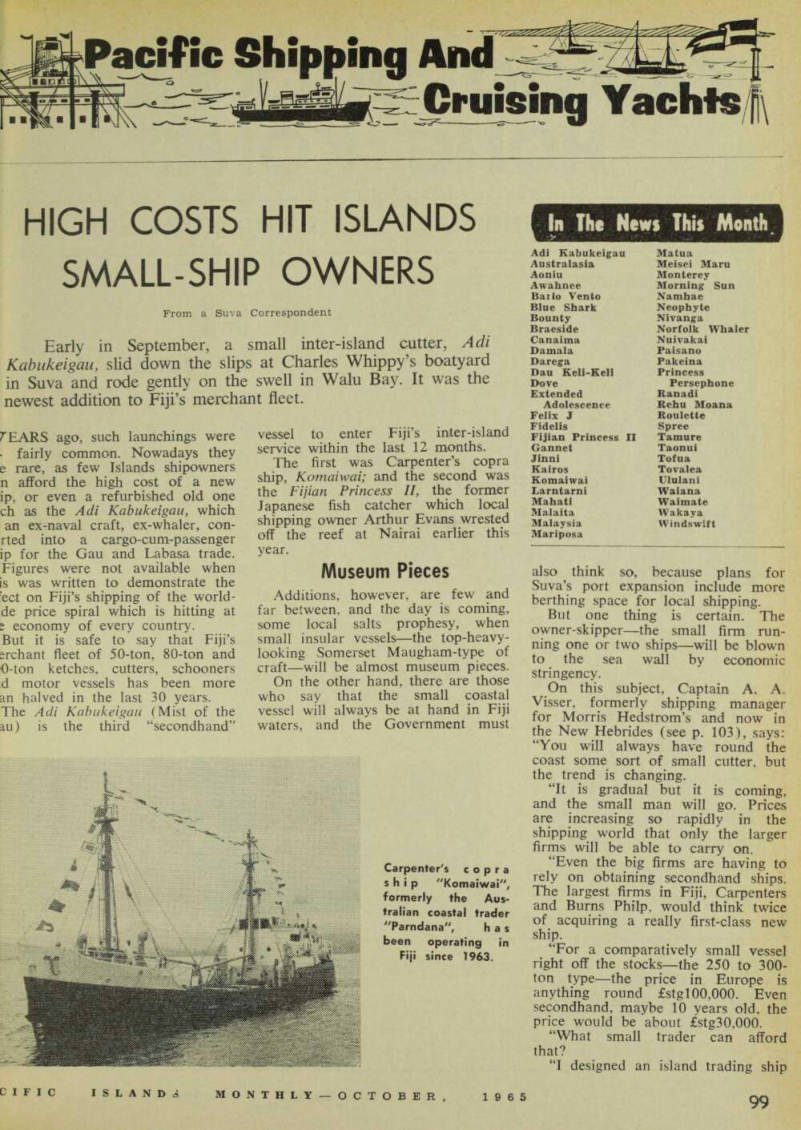
From a Suva Correspondent Early in September, a small inter-island cutter, Adi Kabukeigau, slid down the slips at Charles Whippy’s boatyard in Suva and rode gently on the swell in Wain Bay. It was the newest addition to Fiji’s merchant fleet.
rEARS ago, such launchings were - fairly common. Nowadays they e rare, as few Islands shipowners n afford the high cost of a new ip, or even a refurbished old one ch as the Adi Kabukeigau, which an ex-naval craft, ex-whaler, cou rted into a cargo-cum-passenger ip for the Gau and Labasa trade.
Figures were not available when is was written to demonstrate the ect on Fiji’s shipping of the world de price spiral which is hitting at 5 economy of every country.
But it is safe to say that Fiji’s erchant fleet of 50-ton, 80-ton and O-ton ketches, cutters, schooners d motor vessels has been more an halved in the last 30 years.
The Adi Kabukeigau (Mist of the au) is the third “secondhand”
vessel to enter Fiji’s inter-island service within the last 12 months.
The first was Carpenter’s copra ship, Komaiwai; and the second was the Fijian Princess 11, the former Japanese fish catcher which local shipping owner Arthur Evans wrested off the reef at Nairai earlier this year.
Museum Pieces
Additions, however, are few and far between, and the day is coming, some local salts prophesy, when small insular vessels—the top-heavy looking Somerset Maugham-type of craft —will be almost museum pieces.
On the other hand, there are those who say that the small coastal vessel will always be at hand in Fiji waters, and the Government must
also think so, because plans for Suva’s port expansion include more berthing space for local shipping.
But one thing is certain. The owner-skipper—the small firm run ning one or two ships—will be blown to the sea wall by economic stringency.
On this subject, Captain A. A.
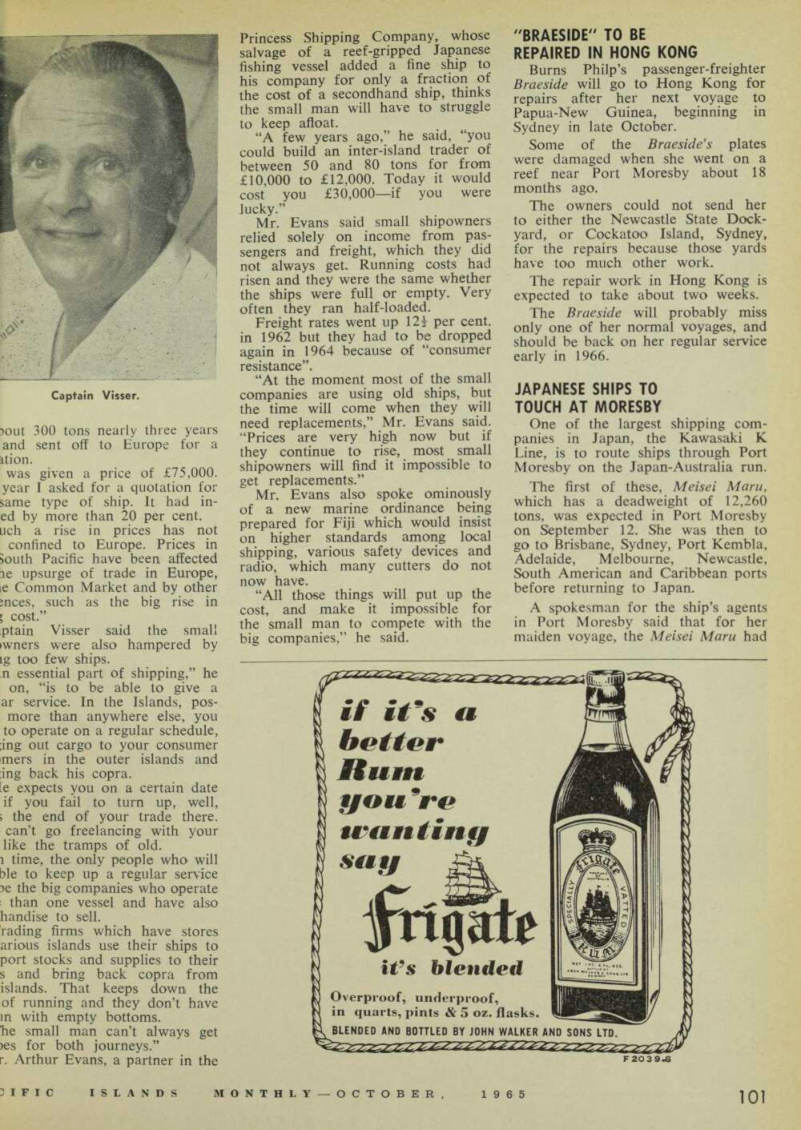
Visser, formerly shipping manager for Morris Hedstrom’s and now in the New Hebrides (see p. 103), says: “You will always have round the coast some sort of small cutter, but the trend is changing.
“It is gradual but it is coming, and the small man will go. Prices are increasing so rapidly in the shipping world that only the larger firms will be able to carry on.
“Even the big firms are having to rely on obtaining secondhand ships.
The largest firms in Fiji, Carpenters and Burns Philp, would think twice of acquiring a really first-class new ship.
“For a comparatively small vessel right off the stocks—the 250 to 300ton type—the price in Europe is anything round £stg 100,000. Even secondhand, maybe 10 years old, the price would be about £stg3o,ooo.
“What small trader can afford that?
“I designed an island trading ship
Carpenter's copra ship "Komaiwai", formerly the Aus tralian coastal trader "Parndana", has been operating in Fiji since 1963.
)out 300 tons nearly three years and sent off to Europe for a ition. was given a price of £75,000. year I asked for a quotation for same type of ship. It had in ed by more than 20 per cent, uch a rise in prices has not confined to Europe. Prices in south Pacific have been affected le upsurge of trade in Europe, ie Common Market and by other mces, such as the big rise in ; cost.” ptain Visser said the small iwners were also hampered by ig too few ships, n essential part of shipping,” he on, “is to be able to give a ar service. In the Islands, pos more than anywhere else, you to operate on a regular schedule, ;ing out cargo to your consumer mers in the outer islands and ing back his copra. [e expects you on a certain date if you fail to turn up, well, ; the end of your trade there, can’t go freelancing with your like the tramps of old. i time, the only people who will ble to keep up a regular service ie the big companies who operate ; than one vessel and have also handise to sell. fading firms which have stores arious islands use their ships to port stocks and supplies to their s and bring back copra from islands. That keeps down the of running and they don’t have m with empty bottoms, he small man can’t always get >es for both journeys.” r. Arthur Evans, a partner in the
Princess Shipping Company, whose salvage of a reef-gripped Japanese fishing vessel added a fine ship to his company for only a fraction of the cost of a secondhand ship, thinks the small man will have to struggle to keep afloat. . 4t couwi e uTld y ?n rS in?e?:island S tmder y °o U f between 50 and 80 tons for from £lO,OOO to £12,000. Today it would cost you £3o,ooo—if you were lucky.”
Mr. Evans said small shipowners relied solely on income from passengers and freight, which they did not always get. Running costs had risen and they were the same whether the ships were full or empty. Very often they ran half-loaded. • rate ? we ? t T 2 r ceQ j m 1962 but they had to be dropped again in 1964 because of consumer resistance”.
“At the moment most of the small companies are using old ships, but the time will come when they will need replacements,” Mr. Evans said.
“Prices are very high now but if they continue to rise, most small shipowners will find it impossible to n/ ep l acement f-, • » v radio which many cotters do no. n °“AIl those things will put up the cost, and make it impossible for the small man to compete with the big companies,” he said.
"Braeside" To Be
Repaired In Hong Kong
Burns Philp’s passenger-freighter Braeside will go to Hong Kong for repa i rs a fter her next voyage to p a pua-New Guinea, beginning in Sydney in late October.
Some of the plate we rf damaged when she went on a ree f near Port Moresby about 18 months ago.
The owners could not send her to either the Newcastle State Dock yard, or Cockatoo Island, Sydney, for the repairs because those yards have too much other work, The repair work in Hong Kong is expected to take about two weeks, The Braes i de w m probably miss only one of her normal voyages, and should be back on her regular service in 1966 ■ adakiccc cuidc rn JArANtit brilrb IU
Touch At Moresby
One of the largest shipping com panics in Japan, the Kawasaki K Line, is to route ships through Port Moresby on the Japan-Australia run.
The first of these, Meisei Maru,
POr Aew e ctle-
d u f h a l^ eri “f a 0 n 7&ribS“m before returning to Japan, A spokesman for the ship’s agents in Port Moresby said that for her maiden voyage, the Meisei Maru had
Captain Visser.
ed more than 1,000 tons of 5 for Port Moresby. >rt agents for the new line in Moresby are Islands Products ted.
Lern Fisher Based
>Ago Pago
ie of the most modern fishing in the world, the 202-Namhae, joined the Korean fishing fleet the Starkist Cannery, at Pago >, American Samoa, ie ship is capable of cruising at nots for 50 days, and can carry 0-ton catch. lown as a long-line fisher, she es a crew of 24 and about 70 i of tough fishing line, which is out in a huge circle. It takes :rew 12 to 14 hours a day to ; the line in with its tuna catch.
Imate" To Replace
Jana" On Islands Run
ie Waimate, 5,154 tons, built for USS Co. in 1951, will replace Vaiana on the triangular Pacific ds service from Australia to the ic Islands and New Zealand and to Australia. ie Waiana, which has been on icrvice for about five years, will withdrawn when she reaches land early in October, ie future of the Waiana, one of three pre-war ships left in the Co. fleet of 58, has not been led. e islands served on the trian voyage are Fiji, Samoa and ;a.
Stralasia" To
, At New Guinea
ie Austasia Line plans to in ice a 12,000-ton passenger ) ship, the Australasia, to the ralia-P-NG-Malaysia route, e company this year introduced other new ships, Makati and r ysia, on routes through P-NG.
Irf Storage
3Lem At Lautoka
ade at Lautoka in Fiji has grown mch in recent years that there iow' insufficient wharf storage sub-committee from the Lautoka nber of Commerce, which re y investigated wharf problems, come up with a request that ) square feet of additional space btained immediately by acquiring abour mess hall, ie sub-committee said that as Tted cargo was expected to in ;e by more than 50 per cent, by
1969, a further 15,000 square feet of storage space would be required to cope with it.
The sub-committee also considered that an extra berth would be required for overseas shipping by 1969.
Captain Visser For
New Hebrides
Captain A, A. Visser has resigned as shipping manager of Morris Hedstrom Ltd., Fiji, to go to the New Hebrides, where he will go into partnership with Captain Athol Rusden.
However, he does not expect to cut his connection with Fiji, as he will make visits in Captain
Rusden’s ship Darega, which will be on a regular schedule between the New Hebrides and Fiji.
Before he succeeded Mr. H, O. EL Palmer as Morris Hedstrom ship ping manager a few years ago, Capt.
Visser was in Tonga for three years as master of the Government ship, Aoniu.
He went to Tonga from his native Holland, where he was delivery master in a Dutch shipyard.
An Irishman, Mike Cassidy, who was deputy shipping manager for Morris Hedstrom’s, has been ap pointed to succeed Captain Visser.
Captain Visser was a member of the Fiji Marine Board.
Fua" Damaged By
In Auckland
le USS Co’s Tofua was unable save Auckland on schedule for September-October trip to Fiji, »a, Niue and Samoa because of which broke out in the ship September 9. le fires, which burned for about ; hours, destroyed a large itity of general cargo, le loss was estimated at £B,OOO 10,000.
Tongan Government
new long-line fishing vessel for fongan Government was launched srwick-on-Tweed, North England, August 26. Officially named ina by Tonga’s Queen Salote, jhip will be ready to be shipped onga about the end of October, lilt by the Fairmile Construction Ltd., Pakeina has an overall h of 73 ft 9 in., a deadweight 0 tons, and a hold capacity of ons of refrigerator space.
V\Er Whale Chaser
Ie Training Ship
ie Norfolk Whaler, a 125 ft. er whale chaser, has been ht by the P-NG Administration ise as a training ship for officers ie home and coasting trade in Territory. ie vessel was built in 1957 at na, New South Wales, at a of about £lOO,OOO. e was used for several years by Norfolk Island and Byron Bay
Whaling Company in its operations off the Australian coast and around Norfolk Island. More recently she was under charter to the Hydro graphic Survey Company.
The ship is powered by two GM engines, giving a speed of approx imately 11 knots. She is of heavy wooden construction.
According to P-NG’s Acting Director of Trade and Industry, Mr.
N. J. Thomson, it will cost £90,500 to convert her to Administration requirements.
By comparison, a new steel ship about 100 ft in length would cost at least £200,000, Mr. Thomson said.
Mr. Thomson said the conversion
would include the building of ac commodation and mess-rooms and the re-arrangement of the navigating bridge to suit the training function.
When completed, the vessel would be capable of accommodating the captain, four instructor officers and 30 trainees, who would constitute the crew.
The primary function of the training ship would be to provide practical and theoretical instruction for future officers —masters and engineers.
Cadets would serve three to four years on the training ship, and would receive intensive instruction to enable them to sit for the local
The "Norfolk Whaler", which has been bought by the P-NG Administration for use as a training ship, is seen here in her early days eight years ago as a whale chaser.
ine Board examinations for ficates of competency as masters; engineer cadets would supple t the two years spent ashore in :shop training by serving in the ing ship for a year, again under uction both in theory and in tice. le educational standard required cadets would be at Intermediate . When practicable the ship id also be used for the training re-sea trainees. r. Thomson added that the con on of the ship was already in ress. The ship would be ered to the Administration
Jy More Ships
L At Fiji
le number of overseas ships ig at Fiji ports increased by ap imately 25 per cent, last year the previous year. 1964, 518 ships with a registered tonnage of 1,494,463 went to compared with 423 ships of 3,605 tons in 1963.
A Ketch In
ÜBle
le 46 ft Suva ketch Tovalea was centre of a sea drama early in imber when she ran out of fuel l voyage from Kadavu to Suva 27 people on board. She also out of drinking water because mgers and crew used it all for na brewing. le ketch was wallowing helplessly heavy swell and drifting further land when owner-skipper John On, of Toorak, Suva, and four lis crew launched an outboard •red dinghy and set off for Suva help. ; they were attempting to ride breakers over the main reef at , their dinghy capsized. Pushing dinghy in front of them, they i to the shore at Nasese. a few minutes they had reached Wharf and the Union Steam Company’s launch Ranadi ered their SOS. i hours later the Ranadi was at Suva with the Tovalea in
1 Pontoon Launched
Luva Shipyard
ie Fiji Public Works Depart ’s boatbuilding yard in Suva the scene of two interesting nonies at the end of August, ie first was the launching of the i pontoon Dau Keli-Keli (the who digs) by Mrs. J. P. Barron, of the Director of Public Works.
The second was the laying of the keel for a new steel landing craft by Mr.
Barron.
The pontoon will carry a crane for dredging and other work. It is the first venture of its kind undertaken by the PWD, It is of steel welded construction, utilising I in. steel plate on three channel-iron main keels, and reinforced with angle-iron frames, with a box support of 6 in. pipe columns to support the weight of the crane.
Designed by Mr. N. L. MacKenzie, Executive Engineer, Marine, who also supervised the construction, the keel for the pontoon was laid on April 5 and local welders and steel workers were employed on the construction.
The craft, of 15 tons, has an overall length of 68 ft, with 31 ft of moulded beam, and a depth of 8 ft.
Draft when fully loaded will be 2 ft 10 in., and the displacement when light will be 55 tons. The crane unit, which it is designed to carry, weighs
30 tons. There is capacity for 40 tons of oil fuel and 40 tons of fresh water.
The accommodation below is for one dredge master, and a crew of four in two two-berth cabins. In addition there is a galley, mess room, shower, and toilet facilities, making the unit self-contained, Provision has also been made for the installation of suction dredging equipment, should this be decided upon at a f uture date, The landing craft—the keel of w hich was laid by Mr. Barron wjn be constructed on the lines of wartime landing craft. It will have a landing ramp incorporated in the hull to facilitate the loading and unloading of earth-moving equipment such as tractors, graders, etc. This will be particularly useful when new airstrips are to be built on out lying islands. The landing craft will be self-contained and powered with twin 250 h.p. Rolls Royce super charged diesel engines.
Two views of the crane barge "Dau Keli-Keli" which was built by the Fiji Public Works Department. (See below.) — Photo: Rob Wright.