[?]is “Bully” Days
p. 99 · Read in the full issue
T oted Artist [?]ooks Back To
As one of the foundation unbers of the old Sydney dletin, probably no one is tier qualified to write about
early contemporaries than
togenarian, artist-writer Nor in Lindsay who has himself ver ceased to be a figure of itroversy.
TS Bohemians of “The Bulletin”, ■ just published, is illustrated with own black and white drawings, medium that first gave him ree to that Australian weekly gazine that was then “the only tural centre this country sessed”.
Tie Sydney Bulletin today is led by a daily newspaper group I bears not even a distant re iblance to The Bulletin created 1 dominated by J. F. Archibald il he died about the end of World r I. He is mostly remembered ay by the Archibald fountain in ney’s Hyde Park and the annual :hibald Prize for portraiture.
Vhen Lindsay joined its staff in 1, The Bulletin was in its hey- It was the spiritual home of ry Australian who ever wrote a agraph or made a drawing, t was, says the author, the means ;reby the Australian national ego ; fulfilled, for The Bulletin was only the national Australian *nal; it was Australia in concrete n.
Wandering In Limbo
Up to its appearance, the Aus ian-born were wandering in a bo begotten by a nostalgia in the y settlers who called England ne’. The Bulletin initiated an ized discovery that Australia was ne’ and that was the anvil on ch Archibald hammered out the gh substance of the national ego, i to the crude device of making Englishman in Australia a comic re.” i the first story in his book, dsay describes how The Bulletin :e. in Lower George Street, was established meeting place on irday mornings for all contributors ) lived in Sydney, hey gathered before the ground r counter with clippings of their
contributions in their hands and were paid on the spot at space rates. Out of town contributors had to clip their contributions from the paper and post them in.
Lindsay regarded this practice as an “astute device” as it forced each contributor to buy a copy of the paper to see whether his contribution was in; and a great many casual contributors—he estimated it at about 50 per cent. —did not claim payment at all.
This unorthodox method of pay ing contributors prevailed in the old
An "Annotated Bibliography of Select Government Publications on Australian Territories", which is in tended to present "a reasonably comprehensive list" of publications issued between 1951 and early 1964 by the Australian Department of Territories and the six Australian Territory Administrations, has just been issued by the Territories Department.
Bulletin virtually up to the time, only a few years ago, that it was taken over by larger interests. The rule remained: no claim, no pay.
The subjects of Lindsay’s 17 pen sketches range from Steele Rudd of Dad and Dare fame to Banjo Patterson whose verses about the Man from Snowy River have become part of the Australian language, although Lindsay’s portrait of him depicts him as a person who re mained a somewhat exclusive aristocrat.
These portrayals of famous literary and artistic Australians of the past are—just as the author says— sketches; an artist’s impression. They are by no means standard biographies. In some cases Lindsay’s contact with the subjects was slim, yet what he has to say about each of them turns them into human in dividuals and removes them from the myth that is already gathering around them. At 84, Norman Lindsay has outlived them all.
(Bohemians Of “The Bulletin”.
Angus and Robertson. 37/6.)
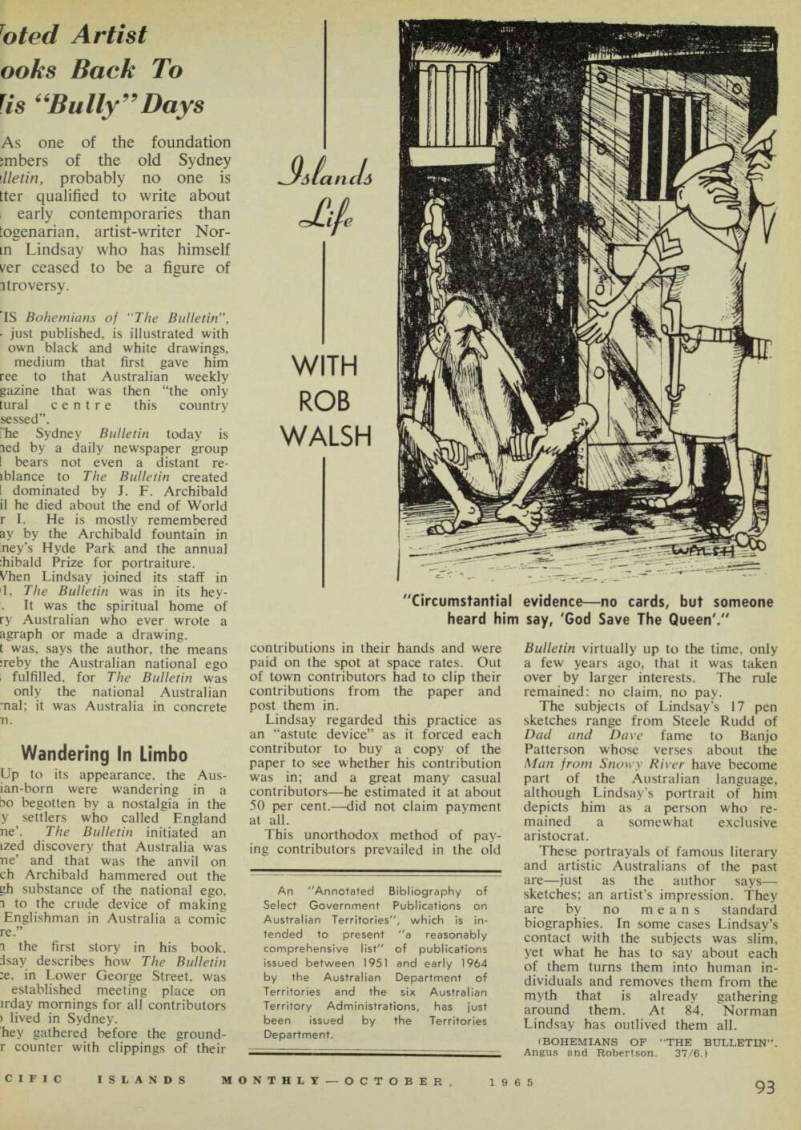
"Circumstantial evidence—no cards, but someone heard him say, 'God Save The Queen'."