Fiji Nuns Show The
pp. 87-89 · Read in the full issue

New Habits Are Modern And Distinctive
World A Thing Or
Two About Fashion
From Beryl Cates in Suva Until now Fiji women could scarcely be re garded as pacemakers in the world of fashion. In most matters of design they’ve been content to leave it to overseas countries to set the trend.
Hence it comes as something of a shock to learn that a local group of women has designed— and what is more, is wearing—clothes which will cause comment right around the world.
In design there is nothing startling in the new fashion. The reason it will cause world-wide interest is that its wearers are nuns—Fiji’s own order of the Sisters of Our Lady of Nazareth, an autonomous congregation since 1952.
r\)R nuns the style is revolutionary, r Gone are the veils, the voluminous skirts, the capes and the dnctures of the old days.
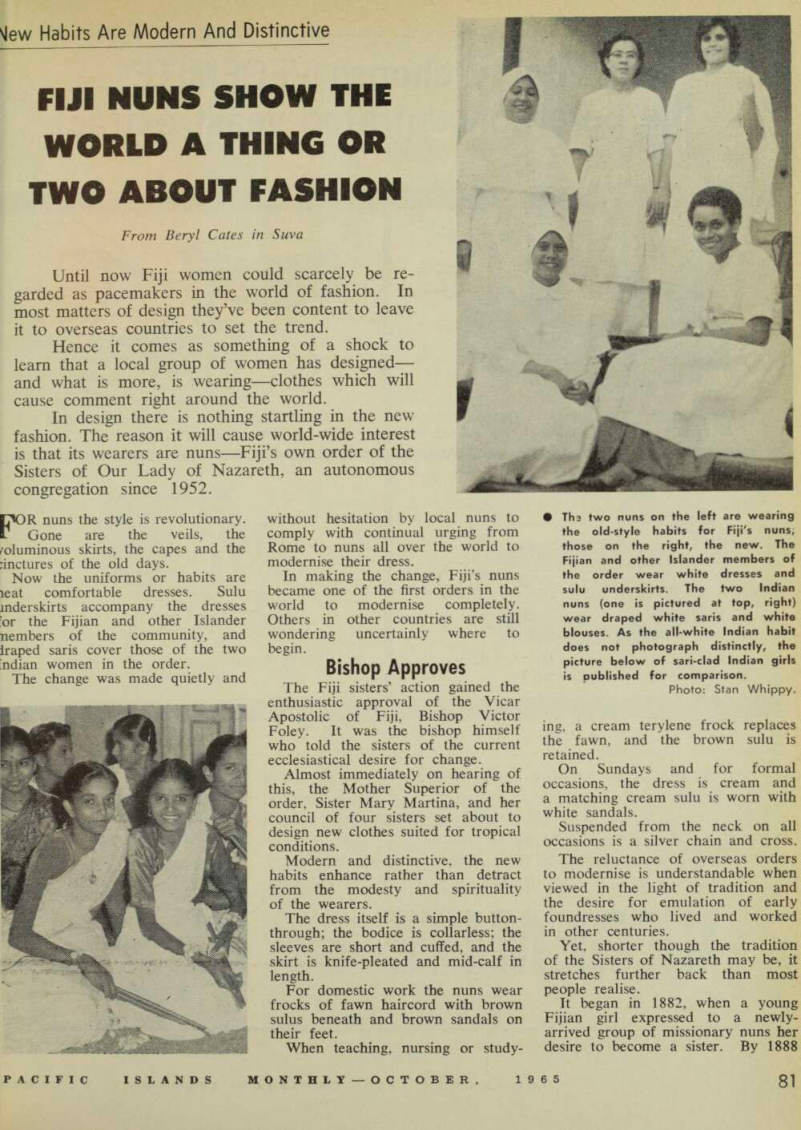
Now the uniforms or habits are leat comfortable dresses. Sulu mderskirts accompany the dresses : or the Fijian and other Islander nembers of the community, and iraped saris cover those of the two Indian women in the order.
The change was made quietly and
without hesitation by local nuns to comply with continual urging from Rome to nuns all over the world to modernise their dress.
In making the change, Fiji’s nuns became one of the first orders in the world to modernise completely.
Others in other countries are still wondering uncertainly where to begin.
Bishop Approves
The Fiji sisters’ action gained the enthusiastic approval of the Vicar Apostolic of Fiji, Bishop Victor Foley. It was the bishop himself who told the sisters of the current ecclesiastical desire for change.
Almost immediately on hearing of this, the Mother Superior of the order, Sister Mary Martina, and her council of four sisters set about to design new clothes suited for tropical conditions.
Modern and distinctive, the new habits enhance rather than detract from the modesty and spirituality of the wearers.
The dress itself is a simple button through; the bodice is collarless; the sleeves are short and cuffed, and the skirt is knife-pleated and mid-calf in length.
For domestic work the nuns wear frocks of fawn haircord with brown sulus beneath and brown sandals on their feet.
When teaching, nursing or study-
ing, a cream terylene frock replaces the fawn, and the brown sulu is retained.
On Sundays and for formal occasions, the dress is cream and a matching cream sulu is worn with white sandals.
Suspended from the neck on all occasions is a silver chain and cross.
The reluctance of overseas orders to modernise is understandable when viewed in the light of tradition and the desire for emulation of early foundresses who lived and worked in other centuries.
Yet, shorter though the tradition of the Sisters of Nazareth may be, it stretches further back than most people realise.
It began in 1882, when a young Fijian girl expressed to a newly arrived group of missionary nuns her desire to become a sister. By 1888
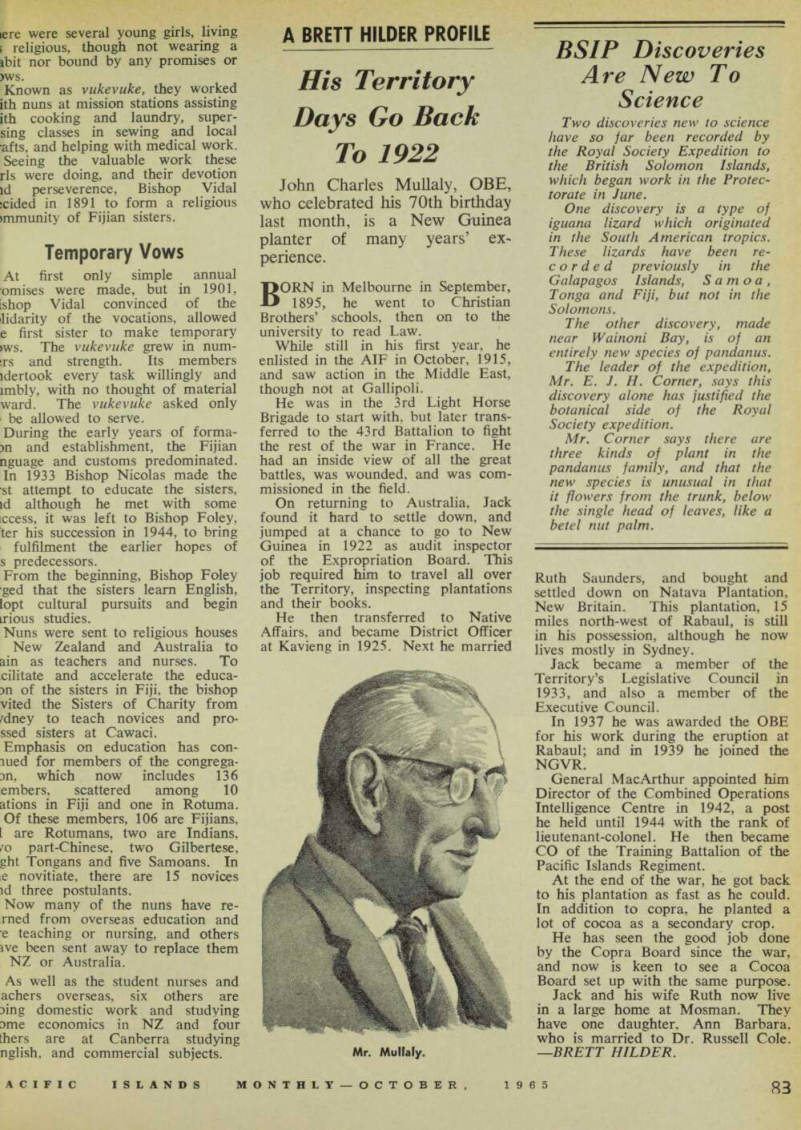
The two nuns on the left are wearing the old-style habits for Fiji's nuns; those on the right, the new. The Fijian and other Islander members of the order wear white dresses and sulu underskirts. The two Indian nuns (one is pictured at top, right) wear draped white saris and white blouses. As the all-white Indian habit does not photograph distinctly, the picture below of sari-clad Indian girls is published for comparison.
Photo: Stan Whippy.
iere were several young girls, living ; religious, though not wearing a ibit nor bound by any promises or >ws.
Known as vukevuke, they worked ith nuns at mission stations assisting ith cooking and laundry, super sing classes in sewing and local afts, and helping with medical work.
Seeing the valuable work these rls were doing, and their devotion id perseverence, Bishop Vidal scided in 1891 to form a religious immunity of Fijian sisters.
Temporary Vows
At first only simple annual omises were made, but in 1901, ishop Vidal convinced of the lidarity of the vocations, allowed e first sister to make temporary iws. The vukevuke grew in num ;rs and strength. Its members idertook every task willingly and imbly, with no thought of material ward. The vukevuke asked only be allowed to serve.
During the early years of forma >n and establishment, the Fijian nguage and customs predominated.
In 1933 Bishop Nicolas made the st attempt to educate the sisters, id although he met with some iccess, it was left to Bishop Foley, ter his succession in 1944, to bring fulfilment the earlier hopes of s predecessors.
From the beginning, Bishop Foley ged that the sisters learn English, lopt cultural pursuits and begin irious studies.
Nuns were sent to religious houses New Zealand and Australia to ain as teachers and nurses. To cilitate and accelerate the educa >n of the sisters in Fiji, the bishop vited the Sisters of Charity from fdney to teach novices and pre ssed sisters at Cawaci.
Emphasis on education has con med for members of the congrega an, which now includes 136 embers, scattered among 10 ations in Fiji and one in Rotuma.
Of these members, 106 are Fijians, I are Rotumans, two are Indians, /o part-Chinese, two Gilbertese, ght Tongans and five Samoans. In e novitiate, there are 15 novices id three postulants.
Now many of the nuns have re rned from overseas education and e teaching or nursing, and others ive been sent away to replace them NZ or Australia.
As well as the student nurses and achers overseas, six others are Ding domestic work and studying Me economics in NZ and four thers are at Canberra studying nglish, and commercial subjects.