Man Bows Out
pp. 79-81 · Read in the full issue


Influential U.N.
In W. Samoa
From R. F. Rankin in Apia An era of vital import to Western Samoa’s development came to an end in mid-August when the regional representative of the United Nations Technical Assistance Board, Mr.
Harry L. Spence Jr., left for retire ment in the United States.
HE represented the United Nations Secretary-General at Western Samoa’s attainment of independence on January 1, 1962, and has been in timately associated with the develop ment of Samoa during the 3i years since.
In the second month of independ ence he drew up the guidelines for development that resulted in the Stace- Lauterbach economic survey of human and natural resources, and recom mendations for development; the Elvins report aimed at bringing the administrative structure more in line with the needs of the country; FAO assistance; and the greatest UN Special Fund aid per head of any country in the world.
There are now about 20 UN ex perts working in various fields in Western Samoa.
In the years since independence Mr. Spence probably affected political attitudes and trends within Samoa more than any other man.
The wide acceptance now of the need for tourism, foreign investment, and internal and foreign loan capital largely springs from his efforts, backed by the Technical Assistance Board.
However, Mr. Spence and the UN programme came in for their share of criticism and there are some who claim the UN is ruining the country.
Mr. Spence, himself, admits facing difficulties, but claims that Western Samoa has used UN aid to greater effectiveness than any country he has seen—and after 15 years as a senior UN official, he has seen most of the developing nations in the world.
“The United Nations greatest contribution has been as a catalytic agent in the introduction of new attitudes and new ways,” he told me.
He said some of the achievements of Samoa since independence were: The establishment of Alafua Agricultural College; the setting up of a statistical department; the completion of a fiscal survey and the establishment of an economic development secretariat; the yaws, tuberculosis and
filariasis campaigns; fellowships in various fields and assistance in teacher training; the establishment of trades training; increased efficiency in Public Works, with harbour projects, and a new trans-island road; electrical ex pansion; town planning; furniture manufacture; agricultural extension— the sugar mill, rhinoceros beetle pro ject, bunchy top campaign and timber research; new schools and hospitals; greatly improved airline and com munication facilities; new biscuit and soap factories; the setting up of a UN regional office in Apia, and the join ing by Samoa of ECAFE and the South Pacific Commission, “No one can deny that this country has achieved a great deal in the short
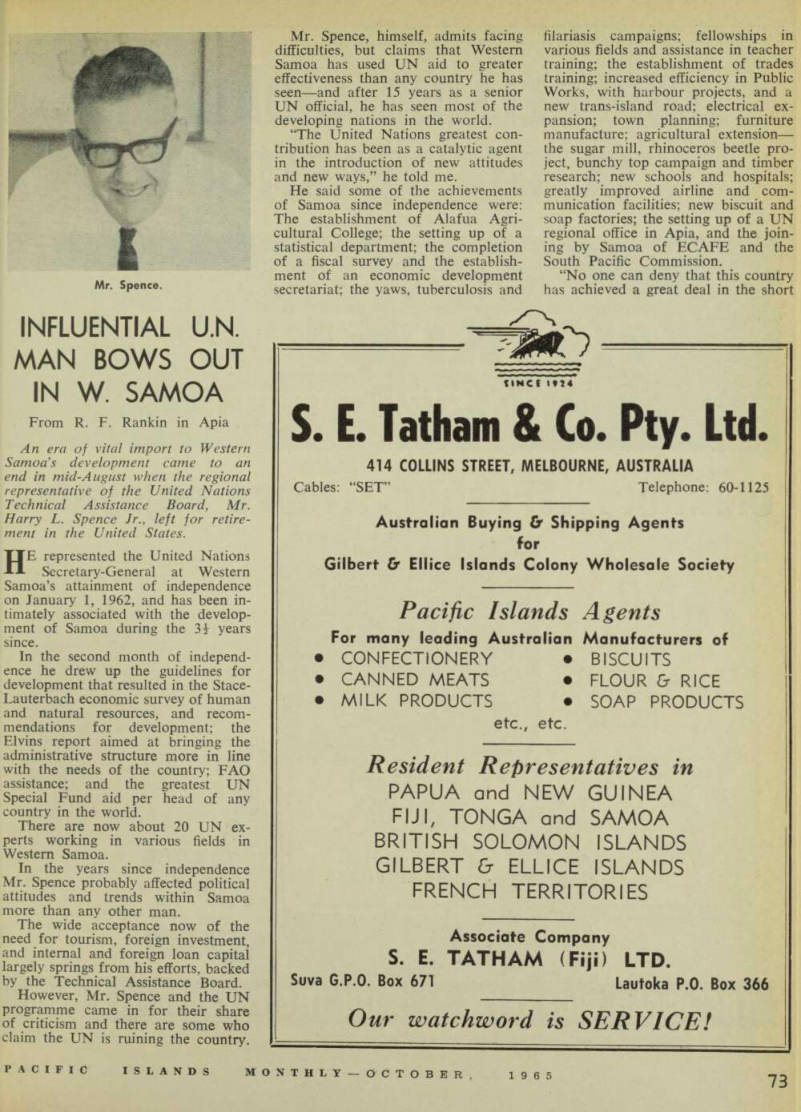
Mr. Spence.
ipan of 3i years since independence,”
Hr. Spence said.
His greatest disappointment, he vent on, was in the field of agriculture.
There was not sufficient political ippreciation of the need for expanded igricultural extension services, and he UN project had run up against ome unexpected personnel difficulties.
However, the basic problem was leeper than this.
“To work hard, people must have he incentive for a better life, and hey must be sure of enjoying the fruit »f their production in fulfilling their lesires,” he said. “This is denied hem under the traditional matai ystem.”
Mr. Spence said he had great ad niration for the Samoan social ystem, and he believed the good hings of the matai system could be alvaged as the country moved ahead.
But there was a great need for lexibility in the social structure, and or greater willingness at the top to tiake decisions and follow them hrough.
He added: “Despite the problems tow and ahead, I leave the country pith the good feeling that it is fol ding the right path to success that omes only through economic in ependence that makes political in ependence a reality.”