Schooling In
p. 75 · Read in the full issue
Western Samoa's
"State Of Crisis"
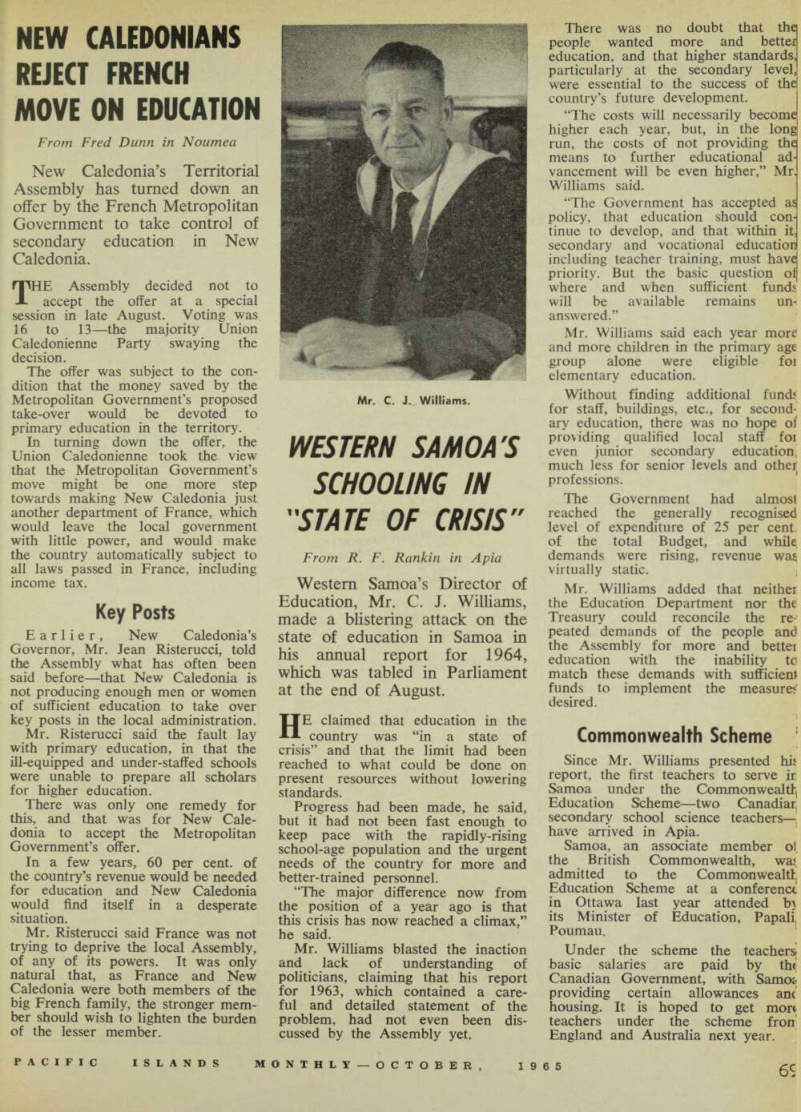
From R. F. Rankin in Apia Western Samoa’s Director of Education, Mr. C. J. Williams, made a blistering attack on tlie state of education in Samoa in his annual report for 1964, which was tabled in Parliament at the end of August.
HE claimed that education in the country was “in a state of crisis” and that the limit had been reached to what could be done on present resources without lowering standards.
Progress had been made, he said, but it had not been fast enough to keep pace with the rapidly-rising school-age population and the urgent needs of the country for more and better-trained personnel.
“The major difference now from the position of a year ago is that this crisis has now reached a climax,” he said.
Mr. Williams blasted the inaction and lack of understanding of politicians, claiming that his report for 1963, which contained a care ful and detailed statement of the problem, had not even been dis cussed by the Assembly yet.
There was no doubt that the people wanted more and better education, and that higher standards] particularly at the secondary level] were essential to the success of the! country’s future development.
“The costs will necessarily become] higher each year, but, in the long run, the costs of not providing the means to further educational ad vancement will be even higher,” Mr.
Williams said.
“The Government has accepted as policy, that education should con tinue to develop, and that within it, secondary and vocational education including teacher training, must have priority. But the basic question ol where and when sufficient funds will be available remains un-; answered.”
Mr. Williams said each year more and more children in the primary age group alone were eligible for elementary education.
Without finding additional funds for staff, buildings, etc., for second ary education, there was no hope oi providing qualified local staff for even junior secondary education.’ much less for senior levels and other professions.
The Government had almost reached the generally recognised level of expenditure of 25 per cent, of the total Budget, and while demands were rising, revenue was virtually static.
Mr. Williams added that neither the Education Department nor the Treasury could reconcile the re peated demands of the people and the Assembly for more and better education with the inability tc match these demands with sufficient funds to implement the measure; desired.
Commonwealth Scheme
Since Mr. Williams presented hi; report, the first teachers to serve ir Samoa under the Commonwealth, Education Scheme—two Canadiar, secondary school science teachers— have arrived in Apia.
Samoa, an associate member ol the British Commonwealth, wa; admitted to the Commonwealth Education Scheme at a conference in Ottawa last year attended b) its Minister of Education, Papal!
Poumau.
Under the scheme the teachers basic salaries are paid by th<’
Canadian Government, with Samoi providing certain allowances am housing. It is hoped to get more teachers under the scheme fron England and Australia next year.
Mr. C. J. Williams.