On Rotuma, They're Not
pp. 67-69 · Read in the full issue
Co-Operative Society Has Brought Changes
"In Hock" So Much Now
From a Suva Correspondent
When the Rochdale Pioneers, that small but big-hearted group of Lancashire cotton workers, scraped together their hard-won pennies, saved £2B and bought a small slum store in Rochdale’s Toad Lane where the modem co-operative movement was bom, they little dreamt that their ideas would, 120 years later, help to free Pacific Islands communities from economic pressures.
rHE co-operative movement, born as a constructive alternative to competitive industry, has spread so successfully throughout the Rotuman Group of Fiji, 400 miles from the Colony’s capital of Suva, that the whole community, once virtually “in lock” to the big trading companies if Burns Philp and Morris Hedstrom, ire now partners in their own trad ing business.
In the middle 1950’5, a group of Rotumans, viewing with dismay, like Jie Rochdale weavers, their increas ing dependence on the local stores, lecided to do something about it.
The new Pioneers, headed by Wilson Inia, headmaster of Malhaha Secondary School, surveyed the Rotuman scene.
The trading companies bought iheir copra, charging them freight rates to get it to Suva. The Rotumans’ bread and butter, their meat, their sugar, their milk, canned goods, clothing, all came from tillage stores run by the companies.
The firms, Morris Hedstrom and
Burns Philp, had divided the islands into respective spheres of influence, with the influential men of the villages acting as storekeepers for commission, which eventually reached a figure of 2/6 in the £.
The stores were firmly entrenched, and their turnover was so large that frequently the storekeepers’ com mission exceeded the manager’s salary.
Isolated
And Rotuma is so isolated, so far from regular shipping routes, that Suva might as well have been at the other end of the world. The odd ship came and went, but it was always a BP’s ship, or an MH’s inter-island trader, and freight was £lO a ton between Rotuma and Suva.
Money came hard but ebbed away easily. The Rotumans love a great occasion. It is nothing to spend £2OO on a funeral, plus another large handful of money for a tombstone.
Weddings are expensive but popu lar events.
The Rotuman has a new-born liking for a concrete house.
The money was always forth coming from the trading companies, but this meant that whole com munities were “in hock” to the companies.
Wilson Inia and his friends ap proached the Government-run Co operative Department and on March 4, 1957, was born the Rotuman Co-operative Association. It became the parent of a host of small village co-ops which mushroomed almost overnight.
One of the first jobs of the new movement was to obtain independent shipping. They chartered the old Kurimarau from Alving Berg, which was a great success. Today, with the
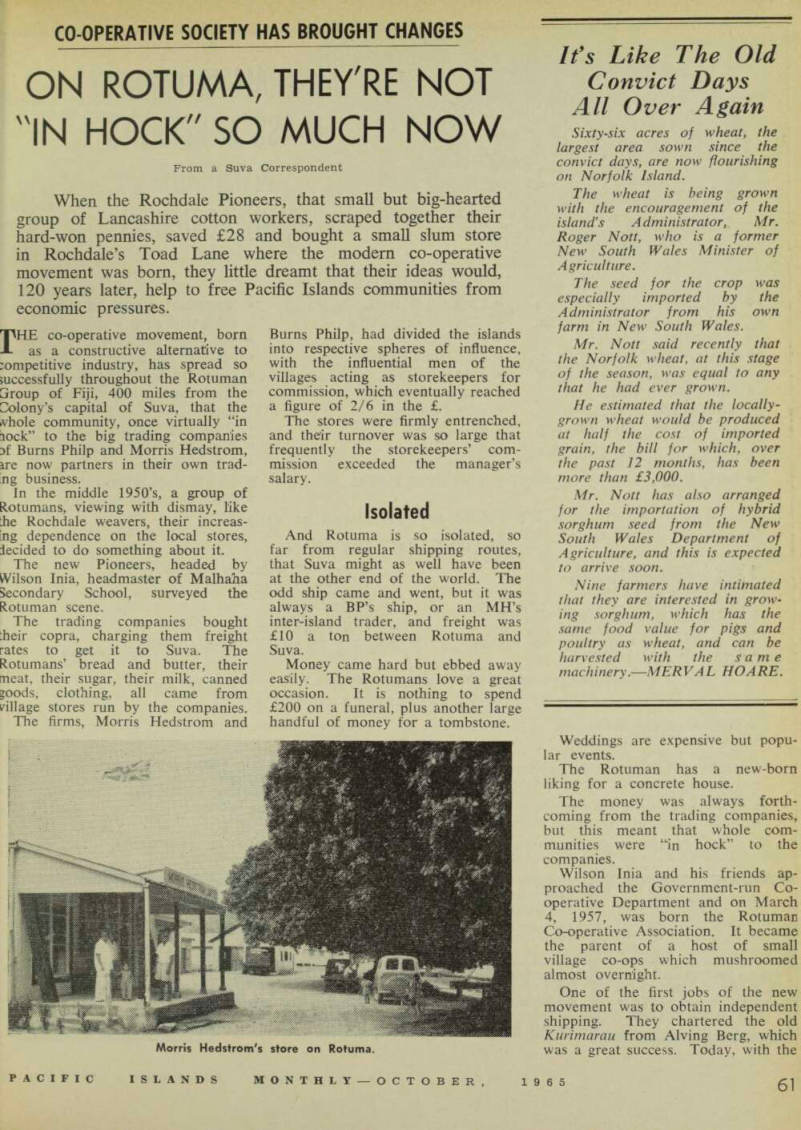
Morris Hedstrom's store on Rotuma.
Kurimarau gone, the Rotumans charter the Tongan Government ship Aoniu, at a price which works out at £2/13/4 a ton for freight and £l/10/1 a ton for lighterage at Rotuma—less than half what they paid the trading companies.
They decided to handle their own copra marketing. Once again they were successful.
Last year, the Rotuman Co operative Association, which in 1963 grouped all the individual village societies into one large association, handled 1,620 tons of Rotuman copra, which produced an average gross price of £5B/14/8 a ton, a few pounds more a ton than the price paid to producers who sold to local crushers.
The association turned to other commodities. Provision stores were opened and the villagers’ necessities began to come from those stores instead of along the previously well beaten tracks of the company stores.
Good Customers
The RCA stores became good customers of the Suva Co-operative Association, which now eschews the trading companies and buys direct from overseas, except where locally produced goods are concerned. (With co-ops springing up all over Fiji, the Suva Association has now assumed the role of a Co-operative Wholesale Society similar to the giant co-ops abroad. It acts as a regulator of prices, preventing exploitation, and, buying in its own chosen markets, it passes the benefits of free trading to the Rotuman and other societies.) Last year the RCA’s merchandise turn-over amounted to £83,000.
Indebtedness is disappearing. The association has set up its own savings deposit section and at the end of 1964, in spite of withdrawals, in spite of funerals, weddings and other money-spending efforts, deposits amounted to £5,900. The associa tion has 599 members representing about 599 families, about two-thirds of the Rotuman community.
And last year the Rotumans re ceived from their co-operative £9,000 in bonus and dividends. • Three postage stamps marking the 20th anniversary of the signing and ratification of the United Nations Charter will be issued in Papua-New Guinea on October 13.
The denominations will be 6d., 1/and 2/-.