Territories TALE-TALK
pp. 61-65 · Read in the full issue
With Tolala
When you are bedridden (as I was recently) there is nothing so good for company (at my age) as a good book.
And I was fortunate in having a copy of Keith Willey’s Assign ment New Guinea.
1T was described in August PIM “Tropicalities” as a “light-hearted romp through the country”. The country, of course, being Papua-New Guinea. I found it a delightful hotchpotch of what has been happen ing in this paradoxical country which has been so much neglected, and yet over-publicised by Pressmen of various capabilities and differing motives.
Keith Willey appears to be an honest bloke. Well, he has to live up to his Walkley Awards; but, judg ing from his writings (I have never met him) I should say that wouldn’t bother him a great deal.
He reminds me of Bobbie Burns’
“a chiel amang you takin’ notes and, faith he’ll prent it”. And that’s exactly what Willey has done.
If some of his informants have swerved a bit from the path of veracity; well, it makes a good tale.
And what country, which has neglected to tape-record its every event, does not find a divergence of opinion when critics browse through these same yams and get out their yard-sticks (or maybe micrometers) to test veracity?
No Abstract Daub
On the whole I found Keith Willey’s selection of yarns, legends, folklores—call them what you will— as handed on to him by pioneers, pseudo-B4s and Behinds, fairly successful in painting a true, tradi tional picture (all noses in the right place, thank you), and not an abstract daub.
There are one or two statements which I feel I must challenge in view of what I am pleased to call my more authentic information.
On page 79 he refers to the three masted brigantine Samoa as being “the flag-ship of the New Guinea Company”. This vessel, skippered by Captain Peters, was owned by the “Long Handle Firm”, or the DH&PG. whose NG headquarters were placed on Mioko Island. It was a Samoan
firm and for years used New Guinea as a source for recruiting native labourers for the plantations in Samoa.
His reference to Boluminski as “Lieutenant-Governor” of New Ireland elevates that gentleman a little bit. Not for a moment would I deprive him of any credit or prestige which surrounded him on New Ireland. I know what he did; I know how the natives honoured him.
His first lieutenant was Capt.
Doellinger for a number of years, then Doellinger was appointed Com missioner at Kieta down in Bougain ville and it was there I met him and we became good friends.
He used to navigate his own little wood-burning steamer, Buka (a sister ship of Nusa which belonged to the New Ireland district) fuelled by the local natives with heaps of firewood stacked at strategical points in the district. (Can you imagine our present government being so frugal?)
Older Natives
Willey’s quoting of Luander saying it was a “good time before, long time belong Germany”, was a very true statement of opinions held by a great number of the older natives. (This is a topic T hope to touch on later).
But I cannot accept all that Willey’s friend Dave Herbert told him as being gospel; I will give him full marks, however, for his evalua tion of Errol Flvnn as a “nasty little sod”.
But Dave damns himself (assum ing Willey has correctly reported him) by calling the natives “niggers”, Rabaul had its aristrocracy, again presumably quoting from Herbert: “Captain Rondahl owned most of the Gazelle Peninsula”.
This unassuming, gentlemanly, Swedish seafarer made no assaults on Rabaul’s aristocracy at any time; he married a half-sister of Queen Emma, possessed Kabakaul planta-
tion, which certainly included Cape Gazelle—but not the Peninsula.
And as for another Dave state ment that “Franz Patz” owned a plantation. Well, poor old Paatzsch, as everyone in Rabaul in the 1930’s knew, worked for Gottfried Furter in Rabaul.
The nearest plantation he ever owned was when he was manager for Hernsheim & Co., of Bougain ville plantation, Arawa, before World War I.
Incidentally, “Rabaul’s Great Strike” was on January 3, 1929; not in 1928 as Willey quoted—presum ably from Dave.
Notwithstanding all my pragmatic dotting of “i’s” and crossing of “t’s”
I really enjoyed Keith Willey’s book.
As you read it, you feel he is writing exactly what he wants to write and has no stuffed shirt standing over him telling him what to say in the interests of This or That or Some thing Else.
Doyen Of The B4S
T7K)R the last few months I have •I 1 been able to dig up a photo, taken in the past, of old-time identities. This month I have a present-day photo of an old-time
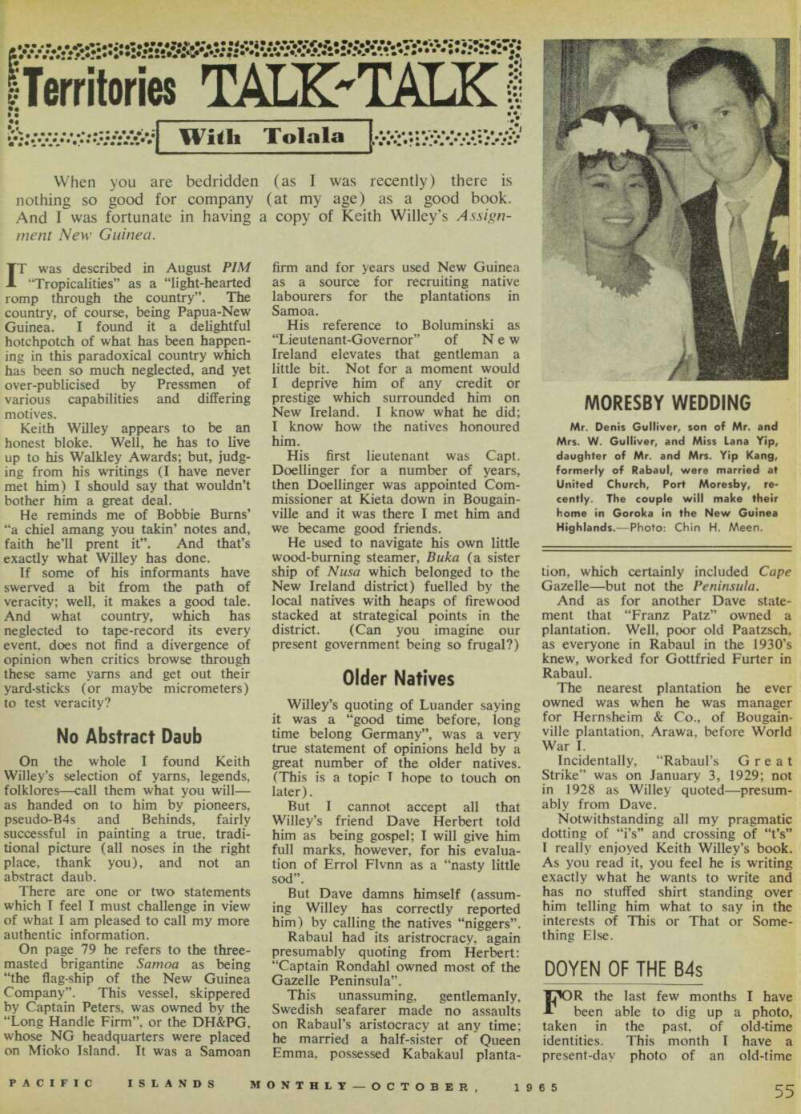
Moresby Wedding
Mr. Denis Gulliver, son of Mr. and Mrs. W. Gulliver, and Miss Lana Yip, daughter of Mr. and Mrs. Yip Kang, formerly of Rabaul, were married at United Church, Port Moresby, re cently. The couple will make their home in Goroka in the New Guinea Highlands.—Photo: Chin H. Meen.
dentity, and I do think that Rudolf anke is about the oldest European n New Guinea. Perhaps I should [ualify that and say “lay” resident, "here could be one or two priests ir brothers in the missions who beat ludolf’s record, which is now at jast 60 years in the Territory.
The St. Paul Massacre. It was he massacre of missionaries at St.
'aul in the Baining country in 1904 lat was indirectly the cause of the anke family going from North Queensland and settling at Neinduk 'here old man Janke and the two oys, Rudolf and George, carved out very nice coconut plantation.
There was a daughter, Dora, after horn they named their neat ketch.
J 1 too soon came World War I nd then later expropriation. . . .
Inducements
The St. Paul massacre brought a amber of German farmers from ueensland to settle along the Bain g coastline in response to the ducements offered by the German ilonial government for creating a oser settlement of Europeans Ijacent to an area which had been ibjected to such tragedy through itive treachery.
From the eastern tip of Massawa, Ataliklikun Bay, to Cape Lambert the west, the coastline and hinter nd was cut up into small “peasant ildings” (under 1,000 hectares) for ttlement by these specially onsored farmers.
As time went on plantations be me known at such places as Neu obisberg, Neu Kauem, Lassul, pper and Lower Seeberg, Neinduk, ivanakus, Galtum, Gavit, Lilinakaia, unambere, Rangarere.
The names of the planters have r the most part been forgotten by e. I do recall the Jankes, the erners on Galtum, the Batzes on linakaia, and the Bolten Brothers, 10 ran the Nambung sawmill. And ere was Till and there was Porteau, it I don’t think the last-named two me to the Bainings under the Land heme.
Rudolf Janke’s wife, Johanna, is a daughter of Ernst Till. He d his wife survived the Jap fu sion for I met them in the RC imp at Ramale, following the mistice in 1945. He died a couple years later.
Then there was Guntershohe tate, up in the hills, managed at e time by Alex Ortloff, a member the syndicate that owned the ice. Alex later managed the ikopo Hotel; he was a brother-in v of Wilhelm Mirow, and Mirow,
in turn, was big social and com mercial tonnage. Despite the hard times of expropriation and general austerity, Mirow retained his status; he had been brought up in the Wahlen School, than which none could excel.
There was another interesting feature as a result of the St. Paul massacre, a tragedy organised by a discontent, To Maria, who was for some time the “trusted” shoot-boy of the Mission station.
For years it had been the custom with Europeans to send out a “shoot boy”, holding a government permit, to shoot pigeons or pigs for the larder. The St. Paul Mission had To Maria as “shoot boy” and he performed his task quite well. There was, however, no check on the ammunition taken out and that expended.
Tragedy
It came out at the inquiry that To Maria had been gradually build ing up a stock of cartridges from the ammunition given to him for his daily shoot and which he later used in the massacre.
A regulation was then introduced making it compulsory for all employers of “shoot boys” to count all cartridge shells before and after expeditions.
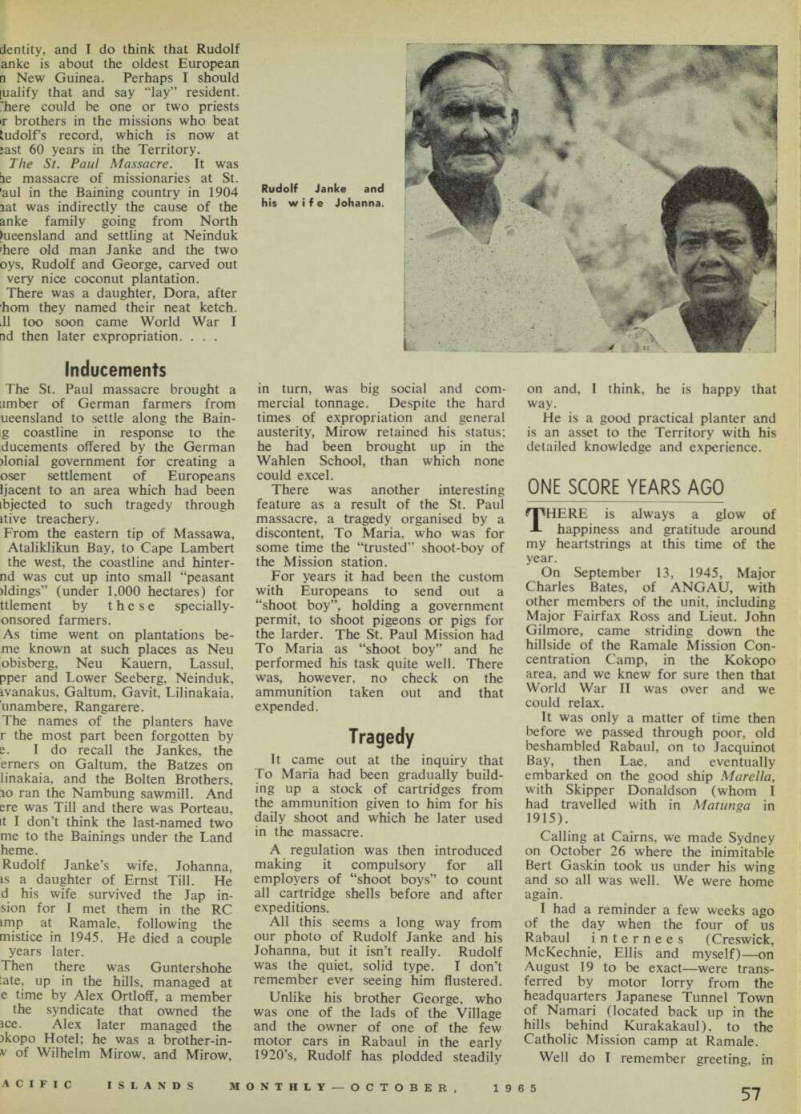
All this seems a long way from our photo of Rudolf Janke and his Johanna, but it isn’t really. Rudolf was the quiet, solid type. I don’t remember ever seeing him flustered.
Unlike his brother George, who was one of the lads of the Village and the owner of one of the few motor cars in Rabaul in the early 1920’5, Rudolf has plodded steadily
on and, I think, he is happy that way.
He is a good practical planter and is an asset to the Territory with his detailed knowledge and experience.
One Score Years Ago
THERE is always a glow of happiness and gratitude around my heartstrings at this time of the year.
On September 13, 1945, Major Charles Bates, of ANGAU, with other members of the unit, including Major Fairfax Ross and Lieut. John Gilmore, came striding down the hillside of the Ramale Mission Con centration Camp, in the Kokopo area, and we knew for sure then that World War II was over and we could relax.
It was only a matter of time then before we passed through poor, old beshambled Rabaul, on to Jacquinot Bay, then Lae, and eventually embarked on the good ship Marella, with Skipper Donaldson (whom I had travelled with in Matunga in 1915).
Calling at Cairns, we made Sydney on October 26 where the inimitable Bert Gaskin took us under his wing and so all was well. We were home again.
I had a reminder a few weeks ago of the day when the four of us Rabaul internees (Creswick, McKechnie, Ellis and myself)—on August 19 to be exact—were trans ferred by motor lorry from the headquarters Japanese Tunnel Town of Namari (located back up in the hills behind Kurakakaul), to the Catholic Mission camp at Ramale.
Well do I remember greeting, in
Rudolf Janke and his wife Johanna.
e Tolai dialect, several parties of fives along the roadside as we sped :>ng in the Jap military truck.
These greetings of mine, picked up the natives, who naturally knew thing of the armistice terms, be me the foundation for a rumour at a Talatala (Methodist mis >nary) was still alive in the district and had not boarded the prison vessel ontevideo Maru. I believe it sated several vain hopes.
Postscript : In “Yesterday” in Sep nber’s PIM (p. 87) I note a erence to men of the Australian th Division landing at Rabaul on ptember 10, 1945, and a Captain yce Morris, RAN (presumably >m HMAS Vendetta) going ashore and seeing “a group of eight Lite prisoners. . . . Later he took ;m to Jacquinot Bay”. An un iformed report at the time gave a ; of the prisoners and included Till and “two men called ndnagel”. The others mentioned re Ellis, Creswick, McKechnie i Thomas.
None of those named was a ■isoner” but an internee and all re in the Ramale Roman Catholic ssion camp at the time mentioned.
None of them, so far as I am are, ever met Capt. Morris. The left Rabaul on September for Jacquinot Bay, flying by talina. -apt. Morris probably got his ninal rolls mixed and those whom met were the military POWs who, mderstand, were kept on Watom md by the Japs.
Queen Emma
JUST as I was closing down along came R. W, Robson’s welcome book, Queen Emma and I must say that PIM’s Chief Executive deserves full marks for a stupendous research job, well done.
Emma Kolbe has become almost a legendary character of the Pacific; the main topic of hundreds of articles, short stories and historical reviews, written for the most part by people with little knowledge of the woman, her times or her surroundings.
So far as New Britain in the early part of the century was concerned,
Emma was even then shrouded in a good deal of mystery. She held her cards close to her ample bosom, to use a modern phrase.
But now, even the quick glance of the book I have been able to have shows me that RWR has given the world a collection of authenticated data which should dispel many of the fantasies which have surrounded the lady for these many years.
Future writers on this Queen of the South Seas will have no excuse now for inventing fantastic tales about her; her life was quite exciting enough without embellishments from the pens of imaginative writers.
More of Queen Emma anon.