Political Half-Light
pp. 51-55 · Read in the full issue
Honourable Members In A Political Half-Light
Judy Tudor looks at New Guinea politics
and politicians
Eighteen months after election to the Papua-New Guinea House of Assembly about 80 per cent, of members know what they are about, according to Mr. H. L. R. Niall, whose opinion should carry more weight than most.
IE was District Commissioner for the Morobe District before he signed to stand for election to the ouse. As most people know, he ent in unopposed and was sub quently elected Speaker, so that he ust sit there now, attired in gown id lop-eared wig, and listen to all le hot air that is spilled in the ouse. Somehow he manages to }t noticeably fall asleep, although >w he does so I know not.
Nor do I know whom he counts nong the 20 per cent, non-effective embers of the House (and likely ey are not all native); but as e House’s arbiter in and out of Iking sessions, he has his paternal oubles.
Best Expected
In the days of the old Legislative ouncil, the Government paid for the commodation of out-of-town mem :rs while the Council was meeting, aturally, every member expected e best accommodation that was Fering, and irrespective of where how he lived normally, he got Since the House of Assembly re aced Legco and members now all aw salaries, they are paid, in Idition, £5 a day expenses during tings and make their own arrange ents. The most expensive ac »mmodation is now left severely one, the European members try g to settle for something that can i covered by the sum allowed; and e native members trying to make a ofit out of the deal.
According to what Speaker Niall ls told me, he has had to “knock ick” one European member who, hen the accommodation situation in >rt Moresby was tight, asked to be lowed to put up a stretcher in the ouse in one of the offices reserved r members.
He has also, on occasion, had to
tell native members to wash their shirts and tidy themselves up. Most of these lads live, during sessions, with New Guinea friends in local villages and shanty-towns that spread like a fungus in some parts of Port Moresby, outstripping reticulated water supplies and all other services.
Water for washing shirts or persons is scarce and facilities for doing either virtually nil.
Nonetheless, within the House, looked at from a distance at any rate, they appear turned out from one mould, or one tailor, regimentally correct in almost identical suits of dark, drip-dry cloth. These days only John Guise, Leader of Elected Members, still affects the wrap-round lap-lap or rami; the rest go all-out for trousers. Guise has European in his ancestry and in these days of burgeoning nationalism perhaps feels that he has to stress the fact of his Papuan blood more than the others.
Intellectual Face
His soft voice, his taut-skinned intellectual face, remind me always of a Pondicherry Eurasian rather than a Papuan, although I’ve no doubt that he’d not be pleased to have anyone say so.
A large proportion of the native members (all those from the NG side) are Pidgin-English speakers and this, I think, has given a fillip to the language that was supposed to be on the way out. Not only do these native members address the House in it, but European members who are able have taken to using it also—those who represent open electorates invariably so.
This, I think, puts it over the official members, all but one of whom is a Head-of-Department and most of whom have lost, or have never had, any contact with the
people of the country outside the Port Moresby town limits.
Motuan, along with English and Pidgin, is one of the official languages, but it is rarely heard even Papuan John Guise occasionally speaking in Pidgin. Although the simultaneous translation of Pidgin into English has improved and is now far closer to actually being simultaneous, the nuances of what is being said—or rather the way in which it is being said—are lost in translation and largely go over the heads of those who must sit per manently clamped into ear-phones.
Fiery, Dramatic
The native members are fiery and dramatic speakers rather than erudite, even in their chosen language. They gesticulate wildly, rant and rave and some have voices that all but lift the roof. Boiled down, what they say could be put into a few English sentences, although this does not pre vent their saying it in several different ways, over and over again, and tak ing 10 minutes to do it.
This is traditional native oratory.
In the days of my youth we some times spent nights in native villages and occasionally would come across someone who evidently wanted to get something off his chest. He would walk up and down the village, perhaps all night, slapping his sides with his spears, waving his arms, yelling his head off. As he would be speaking in tok-ples we’d have no idea whether he was inciting his friends to riot, planning mayhem or announcing a local war.
I remember one such night in a
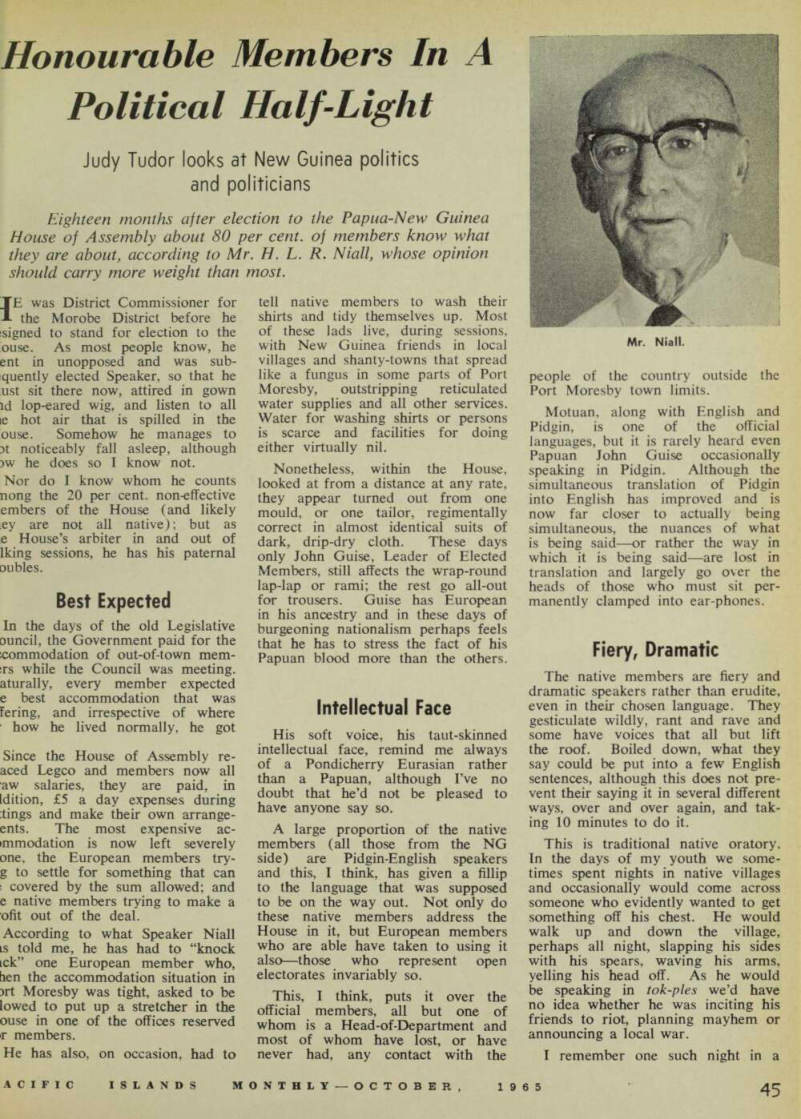
Mr. Niall.
ill village that looks down on what now Maprik, in the Sepik, when le skinny old man, naked and with raggling whiskers, had been more tan ordinarily rampaging, iciferously storming around the llage into the small hours. The rest ; the village had gone into their luses and shut themselves in and ir own boys had insisted on roost g under the house we were in (an ninous sign). With the racket going i, none of us had slept till late, it in the morning I asked one of ir lads what on earth had been oot.
Ah, he said, the lapun (old man) id been saying that someone had )t into his garden and stolen a impkin. Naturally he was kros mas.
Members of the House also fre lently speak as though they are :ry cross but what they say (looked from a Western point of view), is 'ten of not much more national iportance than a metaphorically nched pumpkin.
The member with the greatest nguage difficulty still is Handabe iaba, from Taxi, in the Southern ighlands, He speaks neither English, [otuan nor Pidgin and still brings s own interpreter with him into the □use.
The Speaker first refused to “hear m” and sent him off to learn one ; the accepted languages. I under and he has been going to the immer School of Linguistics in the ighlands but, up to date, without ly notable success. At the Budget ssion just ended, Handabe uttered ice and there was complete and tter silence from the ear-phones
until half-way through the oration, at which stage they sprang to life, I think because his interpreter had slipped an English equivalent into the hands of the translators while the Speaker turned a blind eye.
But none of this is to say that the House is not a going concern.
If Speaker Niall says that members are about 80 per cent, effective, he is probably right; but the way in which they are effective is something else again.
One would need to be a Solomon or very naive indeed to stick one’s neck out over prognostications on
either the present legislature or the political future of Papua-New Guinea. But it seems to me that there are already indications in this House of Assembly that the Terri tory is very likely to follow along the , well-worn lines of political evolution already seen in other ex colomal territories, As things stand at the moment, the elected non-official members have the numbers—s 4 to be exact. But the minority of 10 official members of the Hous ? f ll act as thou « h the V were - m fact - ,he government, They introduce controversial
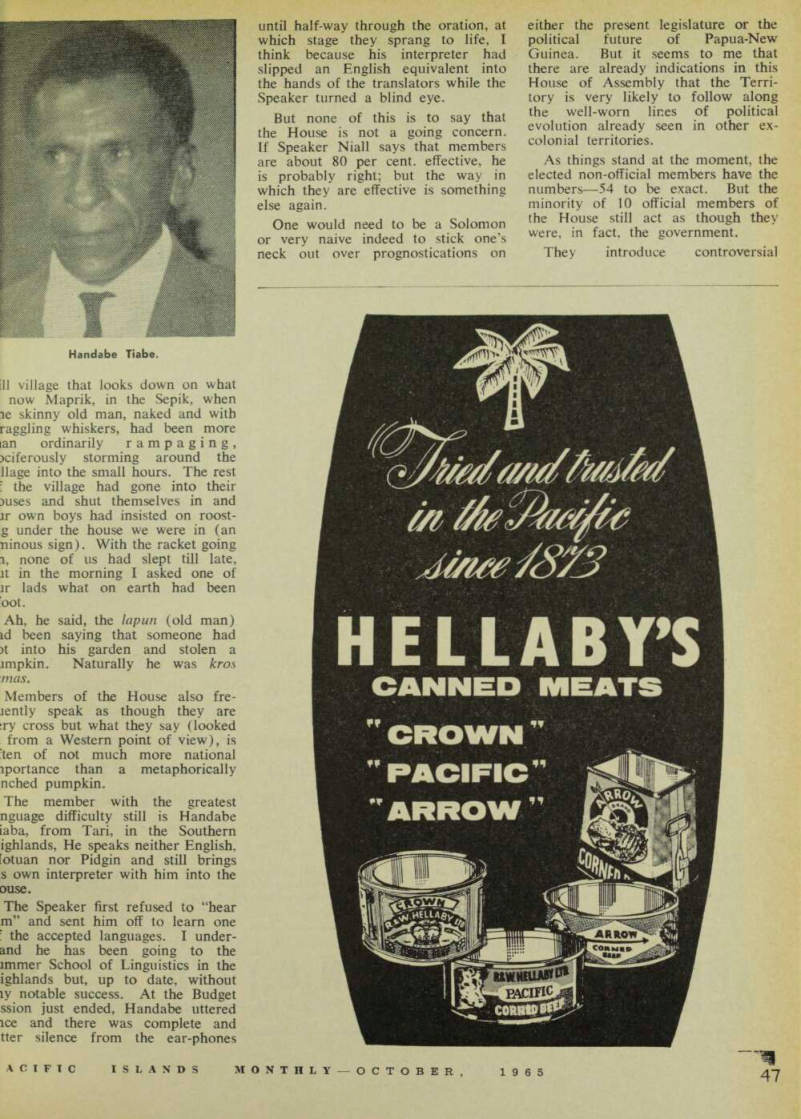
Handabe Tiabe.
legislation without consulting either the non-official majority or, what is worse, the elected members who sit in the Administrator’s Council, the policy-making body that takes the place of the old Executive Council.
More and more frequently the Administration is being forced into inglorious compromise on the floor of the House over some of its legisla tion; or when measures are forcibly amended by the majority and forced through, on final disallowance of Ordinances by the Administrator or the Governor-General.
As native members gain more confidence and feel the power that they have, this sort of government by attrition becomes more and more unworkable. I doubt that it will survive the life of the present As sembly unless the P-NG official policy-makers can get closer to the grass-roots of the country’s political thinking and further away from the Head-of-Department approach. They could wield far more influence on native members of the present House if they rid it of three-quarters of the Departmental chiefs and replaced them with official members from field staff—District Commissioners or even ADC’s.
Perhaps they are realising this but acting on it only reluctantly. Re cently, when one of the Depart mental official members left the service he was replaced on the official benches of the House by a District Commissioner Mr. Tom Ellis.
Ellis is a Before, his parents also were Territorians, and his whole life has been devoted to New Guinea.
He rules his Western Highlands District with a rod of iron but in a way that everyone, European and native, understands and respects.
All the signs are already in the House that despite all the trappings borrowed from the Mother of Parlia ments in Westminister—Speaker in long wig, clerks in short wigs, a gold mace, standing orders and all the conventions of inherited parlia mentary procedure—the minds of the majority of native members are already running in a very different groove.
In some ways the native politician is more devious; in some ways more direct than ours. He works at a problem from a different, strictly non-European angle and comes up with something that fits into the pattern of native, not Western, think ing—a fact that neither Canberra nor Port Moresby yet appreciates.
I think that the three bills intro duced by private native members during the recent Budget session illustrate this very well.
One was the (to us) ridiculous measure designed to curb native gambling—which all native members said threatened to undermine the whole of the Territory’s economic life.
They proposed to do this by pro hibiting the import or local manu facture of playing cards; and of placing those packs already in the Territory in the custody of licensed gaming-houses. People who wanted to play had either to go to the gaming houses or to hire a pack of licensed playing-cards therefrom and return it thereto as soon as practicable after the game was finished.
European members said that the legislation would make the Territory the laughing stock of the world but native members would not hear their arguments. They pushed the bill through and passed it on for the Administrator’s assent. (The follow ing week a European member intro duced another bill to rescind the first).
The second piece of private native legislation was designed to force villagers to cultivate unused native land. Those who supported the bill said that many villagers could never find money to pay local council taxes while at the same time they let patches of good land lie idle.
Against sustained opposition from official and some European non official members, they spoke for the motion all one afternoon. Even, when at the end of the debate, the Assistant Administrator got up to say that to pass the bill was useless, as it was ultra vires the Papua-New Guinea Act and violated international labour agreements on forced labour, and therefore would have to be dis allowed, they would have none of it. The member who introduced the bill forced it to a vote.
Finally, there was the Bird of Paradise Bill. Native members argued that as these rare birds had been killed from the beginning of history to the 1920‘s by local people, now, in certain areas, where there was little other means of economic development, BOP shooting should be allowed under controlled con ditions.
Unpopular
The bill was unpoular with the majority of non-native members and brought the nature-lovers of the world up in arms. Perhaps it was as well for international peace that this bill was defeated.
The three bills meant little of themselves but the closeness with which they were hugged to native members’ hearts leaves little doubt that when New Guinea’s parliament begins to speak with a truly New Guinea voice it is going to be about many things that have not concerned Western politicians since long before Magna Carta.
At the end of 1965, Papua-New Guinea finds itself in a strange period of political half-light. While Aus tralia says, on the one hand, that the native people are free to choose their future how and when they like, on the other she acts as though she will be in the Territory for at least the next half-century.
At the same time Australia has created a situation in the Territory under which aspiring native politicians (who have been chanting monotonously for the last five years only that they “want Australia to stay”), have absolutely nothing to say next, and nothing to demand, but that one ultimate thing: A fixed date for self-government.
Mr. Tom Ellis.