Angry Ocean Islanders Hav
pp. 38-48 · Read in the full issue
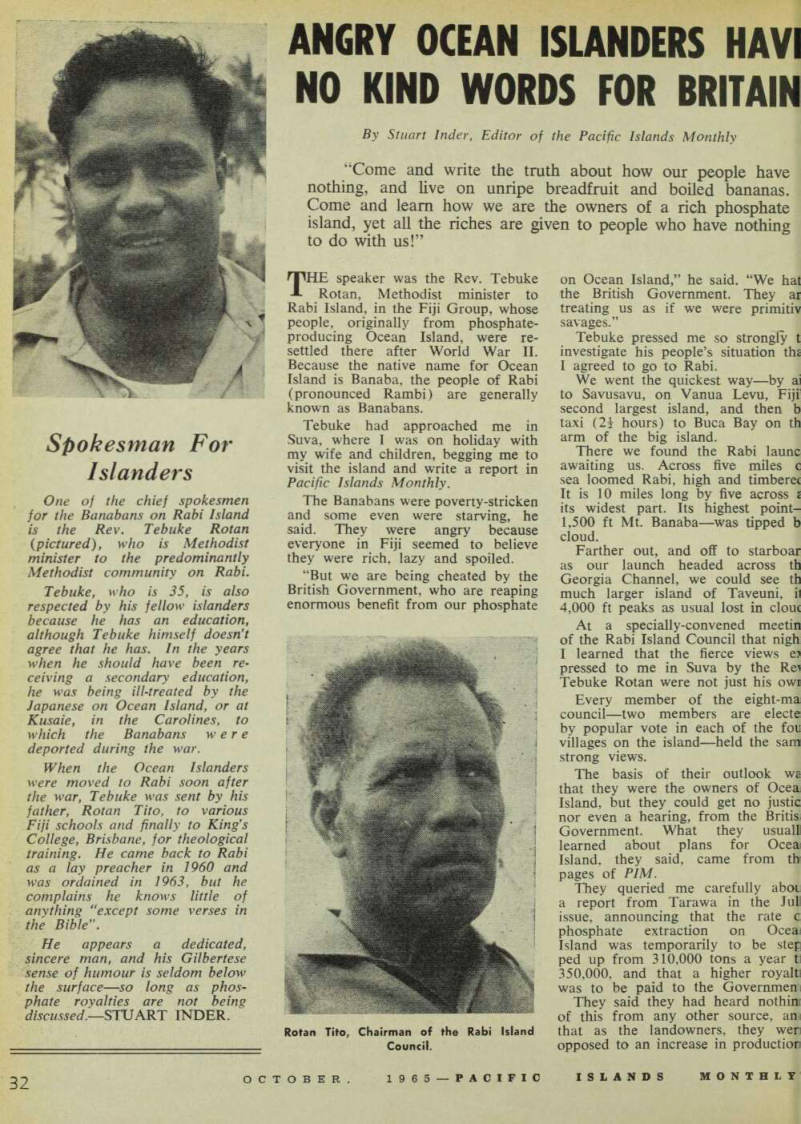
No Kind Words For Britain
By Stuart Inder, Editor of the Pacific Islands Monthly
‘‘Come and write the truth about how our people have nothing, and live on unripe breadfruit and boiled bananas.
Come and leam how we are the owners of a rich phosphate island, yet all the riches are given to people who have nothing to do with us!”
THE speaker was the Rev. Tebuke Rotan, Methodist minister to Rabi Island, in the Fiji Group, whose people, originally from phosphate producing Ocean Island, were re settled there after World War 11.
Because the native name for Ocean Island is Banaba, the people of Rabi (pronounced Rambi) are generally known as Banabans.
Tebuke had approached me in Suva, where I was on holiday with my wife and children, begging me to visit the island and write a report in Pacific Islands Monthly.
The Banabans were poverty-stricken and some even were starving, he said. They were angry because everyone in Fiji seemed to believe they were rich, lazy and spoiled.
“But we are being cheated by the British Government, who are reaping enormous benefit from our phosphate
on Ocean Island,” he said. “We hat the British Government. They ar treating us as if we were primitiv savages.”
Tebuke pressed me so strongly t investigate his people’s situation th£ I agreed to go to Rabi.
We went the quickest way—by ai to Savusavu, on Vanua Levu, Fiji second largest island, and then b taxi ( 2\ hours) to Buca Bay on th arm of the big island.
There we found the Rabi launc awaiting us. Across five miles c sea loomed Rabi, high and timbere* It is 10 miles long by five across £ its widest part. Its highest point -1,500 ft Mt. Banaba—was tipped b cloud.
Farther out, and off to starboar as our launch headed across th Georgia Channel, we could see th much larger island of Taveuni, il 4,000 ft peaks as usual lost in clouc At a specially-convened meetin of the Rabi Island Council that nigh I learned that the fierce views e? pressed to me in Suva by the Tebuke Rotan were not just his owi Every member of the eight-ma council—two members are electe by popular vote in each of the fou villages on the island—held the sam strong views.
The basis of their outlook wa that they were the owners of Ocea Island, but they could get no justic nor even a hearing, from the Britis Government. What they usual! learned about plans for Oceai Island, they said, came from th pages of PIM.
They queried me carefully aboi a report from Tarawa in the lull issue, announcing that the rate c phosphate extraction on Oceai Island was temporarily to be step ped up from 310,000 tons a year t! 350,000, and that a higher royaltJ was to be paid to the Governmem ITiey said they had heard nothin! of this from any other source, am that as the landowners, they wen opposed to an increase in production
Rotan Tito, Chairman of the Rabi Island Council.
Why hadn’t they been asked about ? It was merely one of a whole le of such official omissions, they id.
Before that council meeting lished, well after midnight, the anabans had told me much un ritten history about their fight for bigger share of phosphate royalties.
The man who has led this fight t many years was in the room help explain it—Rotan Tito, ther of Tebuke, who has been [airman of the Rabi Island Council er since the move to Rabi.
Only for one period of 18 months as he not in the chair—and then e post was held by Tebuke, who id returned fresh from Brisbane id was regarded as a man who ight help win the cause.
Rotan Tito, now about 62, was a y preacher in the Gilberts when he ve up his ministry in 1927 to turn home to Ocean Island and present his people in an appeal for greater share of royalties.
He continued to be an important fluence in the life of the Banabans len World War II came, and he came the leader of the Banabans, ilbertese and others when the panese transported them to Kusaie the Carolines.
He interceded with the Japanese i behalf of his people time and ain, and was frequently beaten up r his trouble.
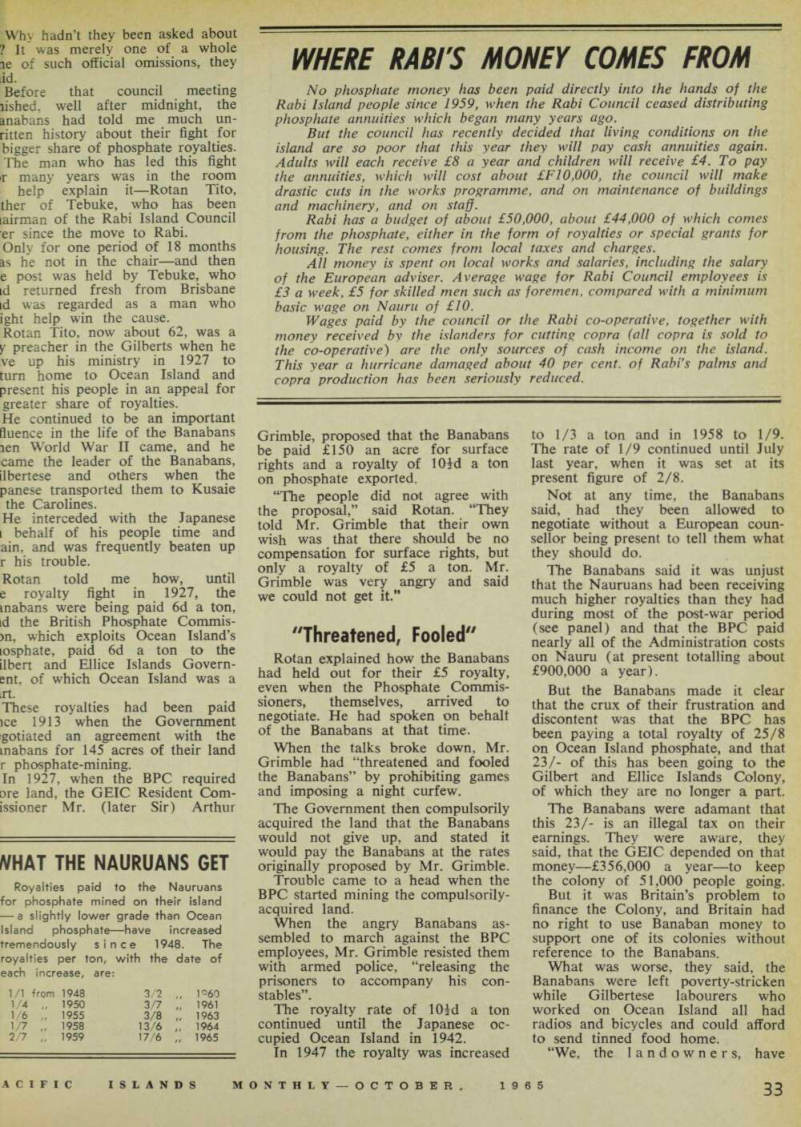
Rotan told me how, until e royalty fight in 1927, the mabans were being paid 6d a ton, id the British Phosphate Commis >n, which exploits Ocean Island’s losphate, paid 6d a ton to the ilbert and Ellice Islands Govern ent, of which Ocean Island was a irt.
These royalties had been paid ice 1913 when the Government gotiated an agreement with the mabans for 145 acres of their land r phosphate-mining.
In 1927, when the BPC required ore land, the GEIC Resident Com issioner Mr. (later Sir) Arthur
Grimble, proposed that the Banabans be paid £l5O an acre for surface rights and a royalty of IOJd a ton on phosphate exported.
“The people did not agree with the proposal,” said Rotan. “They told Mr. Grimble that their own wish was that there should be no compensation for surface rights, but only a royalty of £5 a ton. Mr.
Grimble was very angry and said we could not get it.**
"Threatened, Fooled"
Rotan explained how the Banabans had held out for their £5 royalty, even when the Phosphate Commis sioners, themselves, arrived to negotiate. He had spoken on behalf of the Banabans at that time.
When the talks broke down, Mr.
Grimble had “threatened and fooled the Banabans” by prohibiting games and imposing a night curfew.
The Government then compulsorily acquired the land that the Banabans would not give up, and stated it would pay the Banabans at the rates originally proposed by Mr. Grimble.
Trouble came to a head when the BPC started mining the compulsorily acquired land.
When the angry Banabans as sembled to march against the BPC employees, Mr. Grimble resisted them with armed police, “releasing the prisoners to accompany his con stables”.
The royalty rate of KHd a ton continued until the Japanese oc cupied Ocean Island in 1942.
In 1947 the royalty was increased
to 1/3 a ton and in 1958 to 1/9.
The rate of 1/9 continued until July last year, when it was set at its present figure of 2/8.
Not at any time, the Banabans said, had they been allowed to negotiate without a European coun sellor being present to tell them what they should do.
The Banabans said it was unjust that the Nauruans had been receiving much higher royalties than they had during most of the post-war period (see panel) and that the BPC paid nearly all of the Administration costs on Nauru (at present totalling about £900,000 a year).
But the Banabans made it clear that the crux of their frustration and discontent was that the BPC has been paying a total royalty of 25/8 on Ocean Island phosphate, and that 23/- of this has been going to the Gilbert and Ellice Islands Colony, of which they are no longer a part.
The Banabans were adamant that this 23/- is an illegal tax on their earnings. They were aware, they said, that the GEIC depended on that money—£3s6,ooo a year—to keep the colony of 51,000 people going.
But it was Britain’s problem to finance the Colony, and Britain had no right to use Banaban money to support one of its colonies without reference to the Banabans.
What was worse, they said, the Banabans were left poverty-stricken while Gilbertese labourers who worked on Ocean Island all had radios and bicycles and could afford to send tinned food home.
“We, the landowners, have
lothing!” said an angry councillor. ‘Britain has stolen our birthright md banished us to Rabi without lelp!”
The council claimed that develop nent on Rabi was stifled because >f lack of money. The island needed :learing for new coconut plantings.
V beef industry could be started, and l fish industry—if there were money or a freezer. Rabi also needed a arge boat to transport copra and to :mploy some of the islanders.
There were opportunities to export imber to Fiji if the Banabans could nstall a saw mill. The road had lardly begun.
School buildings were needed in he villages, and money was needed o send children to secondary school n Fiji. At present, only 10 were iway in Fiji because of lack of noney, and the whole island would ►e retarded if its children did not :et the education their parents russed because of the war.
The councillors said they had spent ! 10,000 in salaries on five Banaban Advisers (British officials appointed >y the Fiji Government) since they iad been on Rabi and that this noney could have been better spent Isewhere.
Having listened to the Rabi sland Council for more than four lours, I was left in no doubt that tie Banabans were worried sick over tieir future.
They fear that when the phosphate oyalties cut out in about 20 years, tiey will be left with nothing but a übsistence economy; and their hildren will be second-class citizens f Fiji, crushed in the hungry crowd.
They feel that Britain has delibera -ly cheated them and that the Fiji jovernment has neglected them— efusing to interest itself in their pecial problems.
It occurred to me that Head Chief lammer Deßoburt, who has relatives mong the Banabans on Rabi, may ave been inspired to fight for a
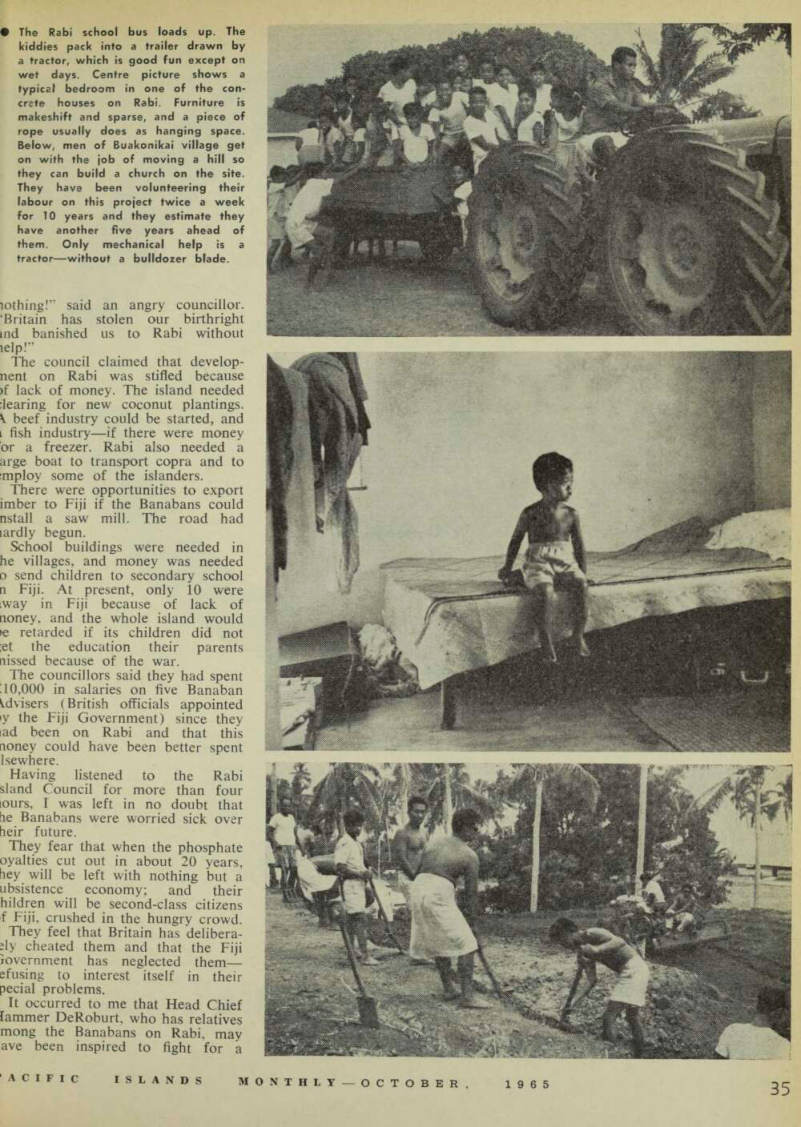
The Rabi school bus loads up. The kiddies pack into a trailer drawn by a tractor, which is good fun except on wet days. Centre picture shows a typical bedroom in one of the con crete houses on Rabi. Furniture is makeshift and sparse, and a piece of rope usually does as hanging space.
Below, men of Buakonikai village get on with the job of moving a hill so they can build a church on the site.
They have been volunteering their labour on this project twice a week for 10 years and they estimate they have another five years ahead of them. Only mechanical help is a tractor —without a bulldozer blade.
stter deal for his own people be mse of the Banabans’ plight.
Next day, I visited Rabi’s four illages. Three can be reached by >ad, although the road into one of iem is a hair-raising switchback ;miniscent of a forest fire trail, and afficable only by four-wheel drive and-Rover or tractor. The fourth illage, Buakonikai, is a long launch ip from the end of the road.
Roads are an issue on Rabi. dthough there are 36 miles of >astline there are only six miles of ot-very-good dirt road. The six dies have been completed, from land funds, only in the last two or iree years of the 20 years that the anabans have been on Rabi.
Their Own Road
The Rabi people built the road lemselves because the Fiji Govern icnt wouldn’t, and because they ere tired of living “in the bush”, ith communication only by launch.
The Rabi villages are big. The irgest, Uma, has a population of 00, and the next, Buakonikai, has lore than 400.
All are growing bigger. On present ends, the population will double i 20 years.
Of the present population of ,908 persons, 377 are under the ge of four, 557 are between five nd 14 and 429 are between 15 and 9.
The Rabi people are proud of their 3ad. So when the mainland police irned up recently demanding to now why the island’s vehicles aren’t registered and its drivers not censed, the council became in ignant. The road was its own, it aid, built of its own blood, and it ould do what it liked on it.
When the police pointed out, not
unreasonably, that there was nothing to indicate that Rabi’s road wasn’t a public road, the council promptly erected a sign, “Private Road, No Trespass”. The next stage in the battle is now awaited.
As it happens, the Fiji Government stands to lose little in licensing or registration fees for vehicles on Rabi. The only vehicles are one Land- Rover and six tractors, all owned by the council; two cars, one motorcycle and 10 bicycles. One of the council’s tractors hauls a trailer which operates a free bus service up and down the six miles of road, mainly to get the children to school and back.
One of the two cars is owned by the master of the inter-island vessel Ratanui, a well-heeled Banaban by Banaban standards.
The other is a beat-up ex-taxi bought by a syndicate of local families for a few pounds. The motor cycle was left by the school teacher.
The allegedly prosperous Rabi people own transistor radios in about the same proportions as they own cars and bicycles. The first village I visited, Tabiang, with 200 people, turned out to have one radio. At Buakomkai (population 400), there were nine, Buakonikai village is the only one without permanent housing. Con crete houses, the people hope, may get there in a year or two.
When the Banabans arrived on Rabi in 1945—there were then 1,003 of them—they were settled into 150 tents and 12 small wooden Army huts. Two years later the school was still in a tent and hospital facilities were primitive. Inadequate housing helped bring serious sickness and even death in those early years and the Banabans haven’t forgotten or forgiven although today they have a good hospital, but a bulging central school.
The small three-roomed concrete houses (lavatories and kitchens are
parate) have been erected only in e last three years with the aid of special grant from the BPC.
About 16 houses are being built year, all by local labour, and the heme is to erect 250 of them in 10-year period. About 65 houses ive been built from the BPC grant, us another 25 from council funds, tiey are rent free.
There are no tents on Rabi now, it some of the old Army huts are ill occupied and there are shanties ; flattened biscuit tins here and ere.
Already some of the first con ete houses have a dilapidated air ;cause of the lack of paint, and in hers the concrete floors have acked or are sinking. But the houses e certainly permanent and the abi people generally agree that ey are a big improvement on tents id their native-style buildings.
For me, a depressing note as the universal lack of furnishings • possessions in the houses. A bed ame was usually knocked up from d pieces of timber and covered ith mats; a cheap cardboard suit ise was pushed underneath the id or into a corner to act as a Lest of drawers”; there were perhaps sewing machine and a petrol iron, id that was about all. The inventory Idom varied.
A close look into some of the co- Derative stores and one small family ore (there is no “foreign commerce”
on Rabi) confirmed that there were no luxury items. The few tins of talc and the piece goods I saw on the shelves were mostly sold at Christmas time or as birthday presents.
The most prominent notices in the co-ops are the ones asking customers not to seek more credit unless they can pay off some of their old debts —many Banabans being in debt to the stores.
Rice And Flour Diet
The universal diet on Rabi appears to be rice, or dumplings made of flour, water and coconut. If the fish are running there is a special feast.
But the main complaint I heard was that it was difficult to cut copra and to fish at the same time.
Tinned pilchards or tinned meat are a Sunday treat, together with breadfruit, salted fish, dalo and octopus. Many of the men are away at copra cutting camps on the op posite side of the island during the week, and return by boat to their villages for the weekends.
The Rabi people do work, despite the belief to the contrary held by people in Fiji who have never been to Rabi. The Banabans work con siderably harder than the Fijians but
it is impossible for anybody to discuss the islanders’ development record without first making a close study of the effects of their transfer to their new environment.
The Banabans were on a cash economy before the war and were probably the richest islanders in the Pacific. They underwent a great up heaval during the war, and at the end of it the remnants of the community were collected and put ahsore on an island that was foreign to them, where their whole life had to be different. They were given no real start, financial or otherwise.
Various Banaban Advisers have helped them a great deal within limits, including their last one, Paul Laxton, whose tour of service was terminated just before my arrival.
Mr. Laxton appears to have fallen foul of both sides because he found himself dealing on one hand with understandably difficult and frustrated islanders and on the other with an unsympathetic and frequently stupid Fiji Government which throws a smoke-screen over the true position on Rabi whenever embarrassing questions are asked.
The Banabans want no more advisers; nor should they be forced to accept any—more especially as they have to pay the salaries of these men
splaying the Gilbertese smile on Rabi pretty Louise Bebeia. The Rabi Islanders orry about the future of the young [?]ople and want them to have something better than they had.
and have come to regard them a Government “spies”.
When the record is written, lani will turn out to be one of the key to the present problems of th Banabans. The lack of sub-divisioi Jaws and personal title have retarde development there as they have i: many other parts of the Pacific.
Nobody on Rabi wanted to mak new plantings, or clear overgrow groves, if the land eventually was t go to somebody else. Land sub division seemed always to be jus around the corner, so real develop ment could wait just a little longe (by which time, the Banabans hopec they might have more money fa development).
Bill Passed, Finally
A bill making sub-division legall possible was passed in the Fi; Legislative Council only at its las session in June—nearly 20 years afte the Banabans’ arrival on Rabi!
I say legally possible because somi months ago the Banabans got tire; of waiting for the Fiji Governmen to move (as they had once got tirei: of waiting for their road) am started to sub-divide the coconu land anyhow. In Buakonikai villag; the sub-division has been complete* and each man has his land, Alread;' new plantings are beginning to ap: pear and new heart has been pu into those who have long dreame* of development.
It could mean a new spirit on th*i island—and a new, forward outlool is needed if the islanders are to wii out in their new home. But the fuE therapy will require the removal oc the phosphate monkey from theii shoulder, and that can be done onb by a complete and impartial inr vestigation of just what Britain, Aus tralia and New Zealand —the BPO partners—have been doing to the um happy Banabans.
• These are the houses the Ral Islanders inhabit. The tradition, Gilbertese houses, whose style ws brought from Ocean Island, can sti be seen in the villages but they ar disappearing as permanent concret buildings are erected. The Gilbertes houses in the top picture opposit are in Buakonikai Village, where n permanent houses have yet been built Centre picture shows one of the ol Army huts which are still occupied b families. Lower photo is a street seen at Nuka, the main settlement, when most of the buildings are permanem The house in the centre of the groui is of aluminium, which was nc regarded as a success, and no mor of these are being built.
BEAUTY QUEEN: Attractive Miss Marie Tapare (Miss Tahiti 1966) was third runner-up in the International Beauty Pageant at Long Beach, California, in August. There were 90 entrants.
Marie won a prize of $1,500 and the handsome trophy she is holding. The pageant was sponsored by the City and Port of Long Beach and the County of Los Angeles. A publicity brochure describes it as 'the world's number one beauty event". Photo: Patrick Walsh.
YOUTH WORKER: The first leadership training course for youth work assistants in local government councils in Papua- New Guinea was held in Port Moresby recently. One of the 10 chosen for the course was 18-year-old Peru Bulo, of Asaro Local Government Council (above), seen painting a puppet.
BANK MANAGER: Mr. B. M. Warden (below), who served with the RAAF in the Pacific during the war, has been appointed manager of the Suva office of the Bank of New South Wales and chief manager of the bank in Fiji. He joined the bank in 1933.