Pearl Expert
p. 63 · Read in the full issue
Sees Rich Future For Pacific’s “White Gold”
By a Staff Writer
Lying on the reefs of islands hroughout the Pacific is “white ;old” worth millions of pounds, iccording to a Sydney culture >earl expert, Mr. C. D. George.
HE believes the culture pearl in dustry could provide a much iceded lift to the economy of everal of the island groups.
“There is plenty of pearl shell in he islands, and the future of the :ulture pearl industry lies there,” he ;ays.
After 15 years of experiment, luccesses and disappointments along he coasts in the north of Australia, md on nearby islands, Mr. George ms now produced culture pearls vhich, he claims, are bigger and of letter quality than anything the lapanese can produce in Japan.
Spherical
The pearls produced on the Aus xalian coast are spherical, and, he ;ays, are worth 50 times as much as similar pearls produced in Japan.
In fhe United States, on an average, i pearl produced and processed in Australia would be worth $125, while a pearl produced and proces sed in Japan would be worth $2.70.
Mr. George has produced both the spherical and half pearl, from black lip and gold lip oysters.
There is an abundant supply of black lip oyster shell, of different varieties, throughout the Pacific, and
reasonable quantities of gold lip oysters and other varieties of pearl shells in some of the groups, chiefly in Melanesia.
The half pearl takes six to nine months to develop to a commercial size, and the spherical pearl takes about two years.
But the shape of the pearl has nothing to do with the time taken to develop it, for both types are produced by different processes.
A half pearl produced and processed in Australia can be sold for £3 to £5 or £6, depending on quality and size, while the value of a spherical pearl ranges from £lO to £5O.
In many cases spherical culture pearls produced in Australia have sold for £l,OOO and more, and one, which was produced by a Japanese, sold for £5,250.
But, says Mr. George, the Japanese cannot produce in their home islands pearls of the size and quality which they can produce ,in Australia.
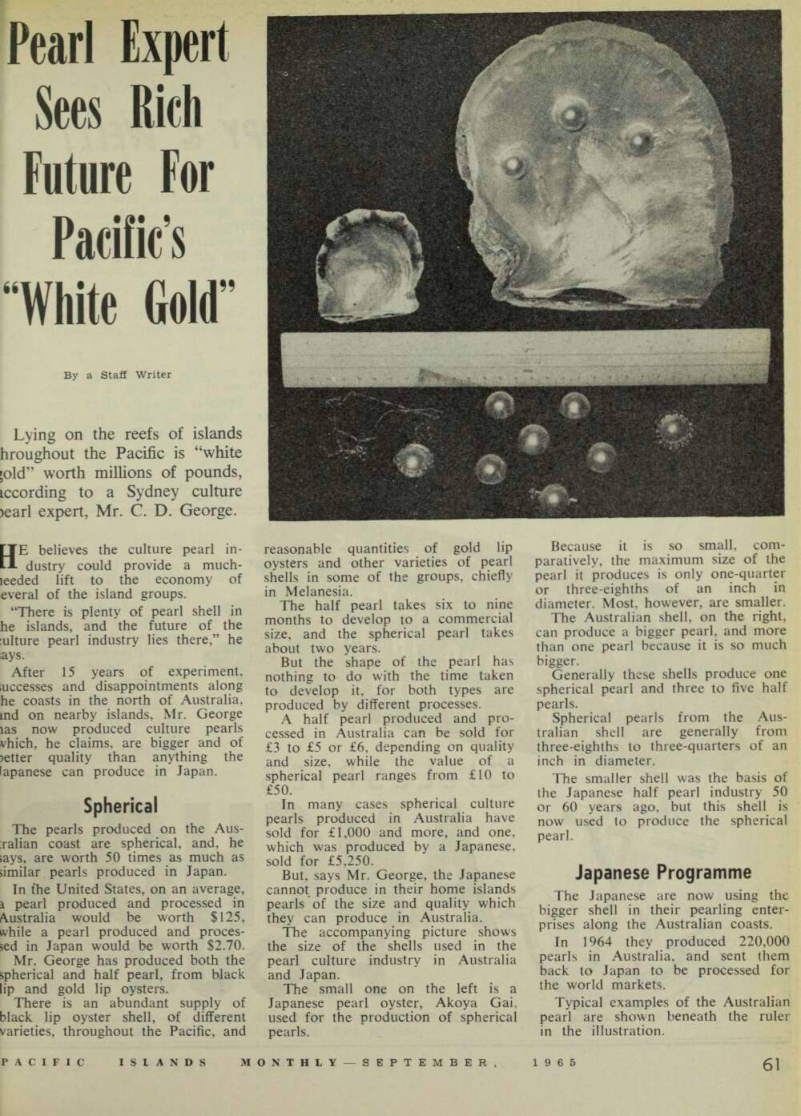
The accompanying picture shows the size of the shells used in the pearl culture industry in Australia and Japan.
The small one on the left is a Japanese pearl oyster, Akoya Gai, used for the production of spherical pearls.
Because it is so small, corn paratively, the maximum size of the pearl it produces is only one-quarter or three-eighths of an inch in diameter. Most, however, are smaller, The Australian shell, on the right, can produce a bigger pearl, and more than one pearl because it is so much bigger, Generally these shells produce one spherical pearl and three to five half pearls.
Spherical pearls from the Aus tralian shell are generally from three-eighths to three-quarters of an inch in diameter, The smaller shell was the basis of the Japanese half pearl industry 50 or 60 years ago but this shell is now use d to produce the spherical pearl,
JapdtlGSG PrOQrSffimG
Jhe Japanese are now using the bj sh £„ in their pearling enter , the Australian coasts.
H 15 ... Naa
1° 1964 they produced 220,000 pearls in Australia, and sent them back to J a P an to be processed for lb® wor ld markets.
Typical examples of the Australian pearl are shown beneath the ruler in the illustration.