Freedom To Drink Looms As
pp. 59-61 · Read in the full issue
Major Issue On Nauru
By a Special Correspondent
Restive but silent, the Nauruan drinker chafes while other Pacific Islanders indulge in their new freedom. Papua-New Guinea, the Cook Islands, Fiji, the Solomons, the Gilbert and Ellice Islands—the list grows.
BUT the Nauruan who wishes to drink can still only do so at a price involving both cash and risk.
Cash is no deterrent as he has plenty of it, but if caught in possession of either imported liquor or a locally made brew the un fortunate offender may spend time in prison or be slapped with a heavy fine.
The Arms, Liquor and Opium Prohibition Ordinance 1936 prohibits the consumption or possession of intoxicating liquor by the Nauruans and also by the Gilbert and Ellice Islanders recruited from their home islands to work for the phosphate industry. The law also forbids the manufacture of alcoholic liquor in the island. Breaches of the Liquor Ordinance constitute the greatest number of breaches dealt with by the Courts.
The island’s other two com munities, the Europeans and Chinese employed by the phosphate industry and the Administration, receive a regular weekly liquor ration.
The Chinese are indentured workers from Hong Kong and re ceive three 26 oz bottles of beer a week, and their wives each receive one bottle. When the wife gives
birth to a child she also receives a bottle of brandy.
The Phosphate Commissioners’
European married staff receive two dozen bottles of beer a week and two bottles of spirits a month. The smaller Administration European staff are on unlimited supplies, within reason.
Despite the law, the fact that most Nauruans and Gilbert and Ellice who want to drink, do so, is pretty openly acknowledged. They can buy either imported or locally made liquor.
High Price For Risk
The Chinese or European who wants to sell his imported ration asks for and gets 16/- for a 1/11 bottle of beer, or £8 a carton of one dozen.
The high price is considered com pensation for the risk involved.
Under the ordinance a supplier is liable to a maximum penalty of £2OO or imprisonment for two years. Sixty years ago visiting traders to the island asked for and got 500 coco nuts in return for a bottle of square gin.
Now it’s cash, not coconuts, although sometimes barter arrange-
ments are made between the Nauruans and Chinese. But the irritant remains—it’s against the law.
Before imported liquors became accessible to the islanders, sour toddy, methylated spirits and bush brews generally filled the gap, and even today some elaborate stills mak ing a very creditable whisky and vodka supply some of the “needs” of the island. There is profit in home-made brew.
Sour toddy is said to have been introduced to Nauru by a Gilbert Islander, but under German rule— which lasted from 1888 to 1914 the making of sour toddy was prohibited. This prohibition has carried on to the present day.
Fresh toddy which is the sap of the coconut tree is a good source of vitamin B but after a day or two it becomes fermented and is then highly intoxicant.
One seasoned drinker claimed the after-effects of drinking undiluted methylated spirits were “much less severe” than the effects of drinking imported brandy. The metho can be diluted with soda water or lemonade, depending on the strength required.
The favourite bush brew is “Eibertha”, The most recent still discovered and confiscated included a haul of 130 gallons of this brew.
A half-caste Gilbertese woman reputedly introduced the recipe of raisins to Nauruan drinkers, hence the name “Eibertha”, “ei” prefixing the female name in Nauruan. The most popular mixture is raisins, vegemite, sugar and water. When
Beer gardens such as this one at Boroko, Port Moresby, where drinking may be done in leisurely comfort, might be the answer to the kind of facilities to provide on Nauru.
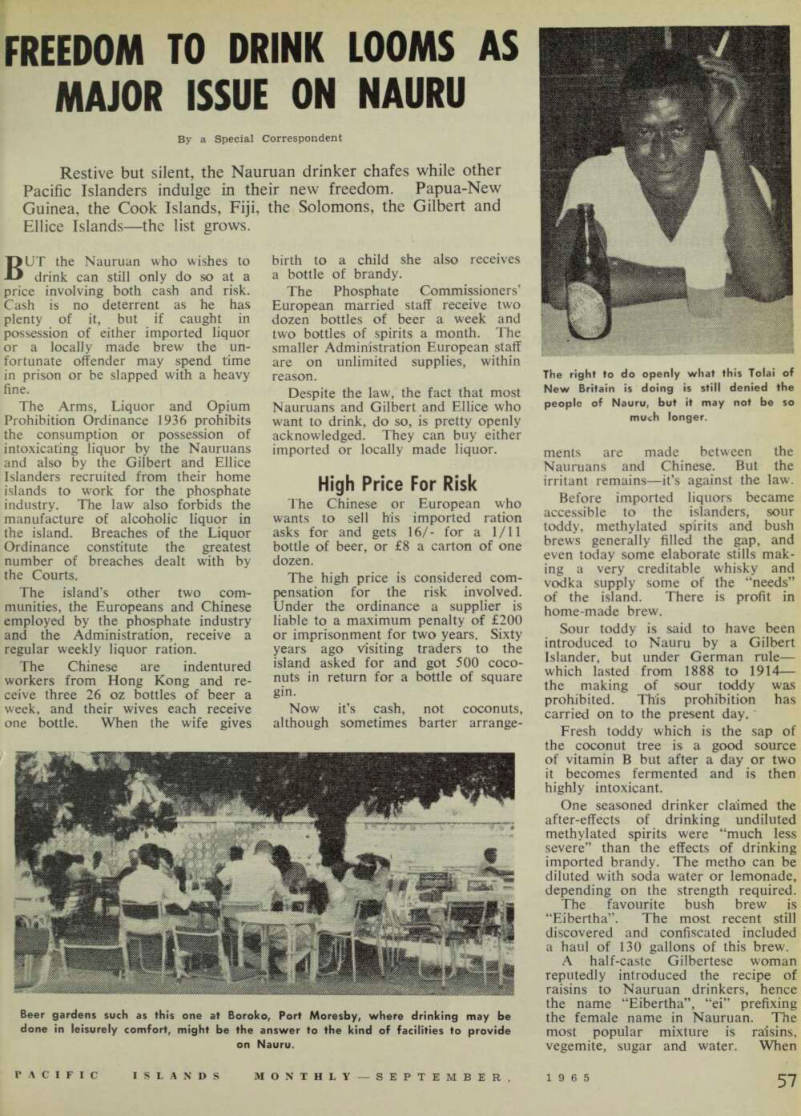
The right to do openly what this Tolai of New Britain is doing is still denied the people of Nauru, but it may not be so much longer.
put through a strainer it looks like coffee and tastes like port wine; it will keep for three days. This can also be made weak or strong.
Another brew called “Ebeda” uses yeast which is not easily come by.
The distillers of spirits do a lucrative trade until caught. Recently, the Administration’s Medical Officer cautioned the drinkers of home-made spirits and said they frequently con tain methyl alcohol, which can cause permanent blindness and death.
The fact that at official and private social functions held by Europeans to which Nauruans and Gilbert and Ellice are invited, liquor is pro vided, makes the law look a little silly. Both sides are conscious 9f the law and are embarrassed by it.
Soft drinks are, of course, provided but the guest chooses his own drink, and out of consideration for his host, many an islander will dutifully sip soft drink all night. Where he does not, the islander doing “time” for being caught doing the same thing somewhere else may be forgiven for wondering where justice begins and ends.
Referendum
Any Nauruan or Gilbert and Ellice may drink once he steps off the island. This applies to “wet” ships to and from Nauru.
As the present prohibition seems to serve little purpose, the question is: “Can the law be changed?”
A referendum held last year among a group of four Nauruan districts on whether the liquor restrictions should be lifted produced 111 “yes” votes, 67 “no” votes, and 86 abstentions from voting. So far there has not been an all-island referendum.
The Nauru Local Government Council, an all-Nauruan body, has the power to change the ordinance but has so far been reluctant to do this. At the Council’s monthly meet ing in June, 1964, a councillor moved that the liquor laws should be amended to enable Nauruans to drink alcoholic liquor. The voting was three in favour, two against and two abstentions. Abstentions were counted as negatives in accordance with the Council’s rules and the motion was declared defeated.
Afterwards, one councillor who voted in favour said that the fact that most people drink already, coupled with the fact that nothing could be done to stop them, in fluenced his vote in favour.
Those who do not want to lift the restrictions say they have no great faith in the ability of their own
people to know when to stop drink ing once they start. Money is plentiful on Nauru and imported liquors are cheap.
Some also fear an increase in the traffic accident rate. With over 1,000 registered vehicles and more than 2,000 licensed drivers on an island with only one main road 12 miles round, they perhaps have reason to worry. Now, a drinker tends to sleep it off rather than risk detection, but legalise the whole business, the “no” voters argue, and the drunks will be everywhere.
This danger could be minimised by the fact that the island has no hotels or drinking establishments.
The Europeans have a recreation club and bar open at certain hours, but the majority drink only in their
own homes or at each other’s. As the Gilbert and Ellice indentured workers live together in the BPC compound, a licensed club there has been suggested. Such an arrange ment would be workable.
But for the Nauruans a central club might not be the answer. Their homes are scattered around the island’s 12-mile coastal belt, and their drive home after a drinking session might well prove the traffic accident theorists right.
But one thing is certain: It is unlikely that the Nauruan drinker will allow his elected councillor to sidestep the issue much longer. For many Nauruans the lifting of the liquor prohibition ordinance is of more vital concern than the question of independence.