"Dictatorship"
p. 11 · Read in the full issue
End May Be Near For New Hebrides "Dictatorship"
By a Staff Writer
The revision of the Anglo- French Protocol of 1914 to enable a legislative council to be established in the New Hebrides may be the eventual outcome of a series of top level talks begun in Paris in July.
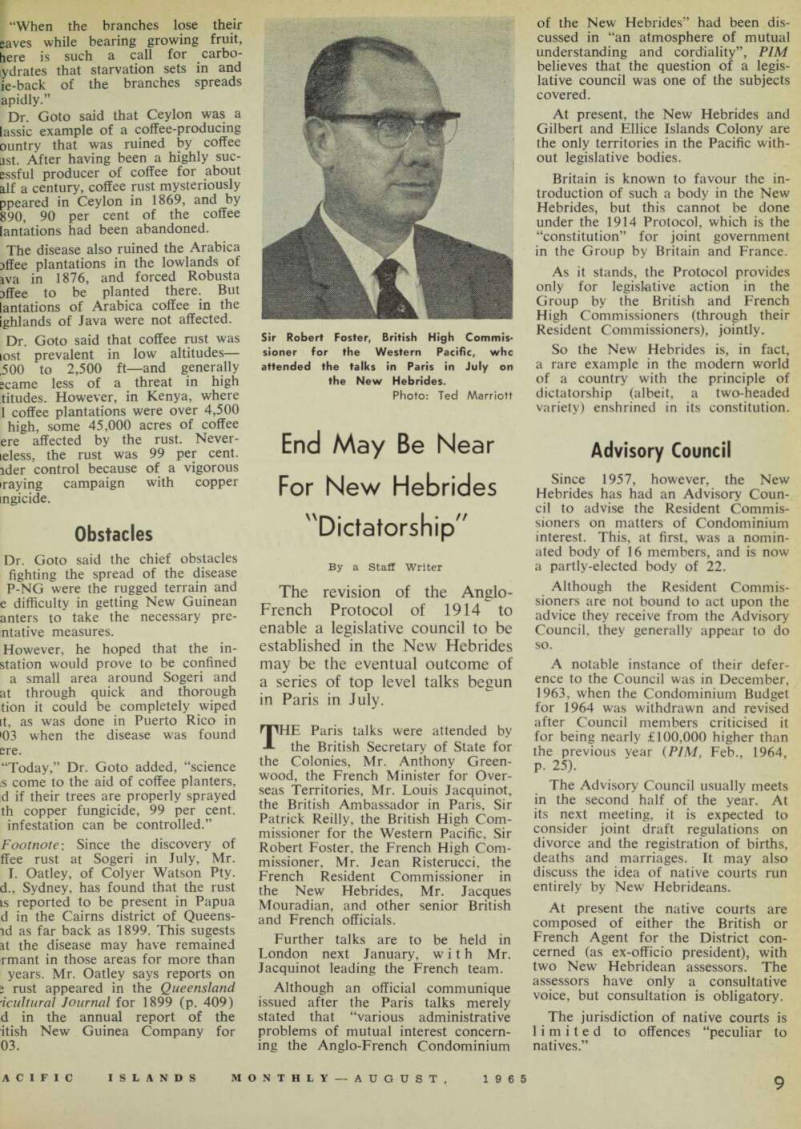
THE Paris talks were attended by the British Secretary of State for the Colonies, Mr. Anthony Green wood, the French Minister for Over seas Territories, Mr. Louis Jacquinot, the British Ambassador in Paris, Sir Patrick Reilly, the British High Com missioner for the Western Pacific, Sir Robert Foster, the French High Com missioner, Mr. Jean Risterucci, the French Resident Commissioner in the New Hebrides, Mr. Jacques Mouradian, and other senior British and French officials.
Further talks are to be held in London next January, with Mr.
Jacquinot leading the French team.
Although an official communique issued after the Paris talks merely stated that “various administrative problems of mutual interest concern ing the Anglo-French Condominium
of the New Hebrides” had been dis cussed in “an atmosphere of mutual understanding and cordiality”, PIM believes that the question of a legis lative council was one of the subjects covered.
At present, the New Hebrides and Gilbert and Ellice Islands Colony are the only territories in the Pacific with out legislative bodies.
Britain is known to favour the in troduction of such a body in the New Hebrides, but this cannot be done under the 1914 Protocol, which is the “constitution” for joint government in the Group by Britain and France.
As it stands, the Protocol provides only for legislative action in the Group by the British and French High Commissioners (through their Resident Commissioners), jointly.
So the New Hebrides is, in fact, a rare example in the modern world of a country with the principle of dictatorship (albeit, a two-headed variety) enshrined in its constitution.
Advisory Council
Since 1957, however, the New Hebrides has had an Advisory Coun cil to advise the Resident Commis sioners on matters of Condominium interest. This, at first, was a nomin ated body of 16 members, and is now a partly-elected body of 22.
Although the Resident Commis sioners are not bound to act upon the advice they receive from the Advisory Council, they generally appear to do so.
A notable instance of their defer ence to the Council was in December, 1963, when the Condominium Budget for 1964 was withdrawn and revised after Council members criticised it for being nearly £lOO,OOO higher than the previous year {PIM, Feb., 1964, P- 25).
The Advisory Council usually meets in the second half of the year. At its next meeting, it is expected to consider joint draft regulations on divorce and the registration of births, deaths and marriages. It may also discuss the idea of native courts run entirely by New Hebrideans.
At present the native courts are composed of either the British or French Agent for the District con cerned (as ex-officio president), with two New Hebridean assessors. The assessors have only a consultative voice, but consultation is obligatory.
The jurisdiction of native courts is limited to offences “peculiar to natives.”
Sir Robert Foster, British High Commis sioner for the Western Pacific, who attended the talks in Paris in July on the New Hebrides.
Photo: Ted Marriott