P-Ng Acts Fast To Stamp
pp. 10-11 · Read in the full issue
Out Deadly Coffee Disease
By a Staff Writer
Quick and drastic measures were taken in July to control an outbreak of Hemileia leaf rust, the world’s most dreaded coffee disease, at Sogeri about 30 miles from Port Moresby.
IF not checked, the disease could wipe out Papua-New Guinea’s coffee industry within a few years.
As soon as the disease was discovered, officers from the Department of Agriculture began spraying and burning coffee trees in the Sogeri area. The police also set up road blocks to prevent people moving out of the area to other coffee-growing areas, and coffee rust was declared a notifiable disease throughout Papua- New Guinea. .
At present, coffee is the third most important industry in the Territory after coconuts and cocoa, which has been hard hit by falling prices (see below). P-NG s coffee brings in ex .P? r t earnings of more than £2 million a year.
All the coffee grown is Arabica, and most of it is planted in the Highlands between Wau and Mt. Hagen.
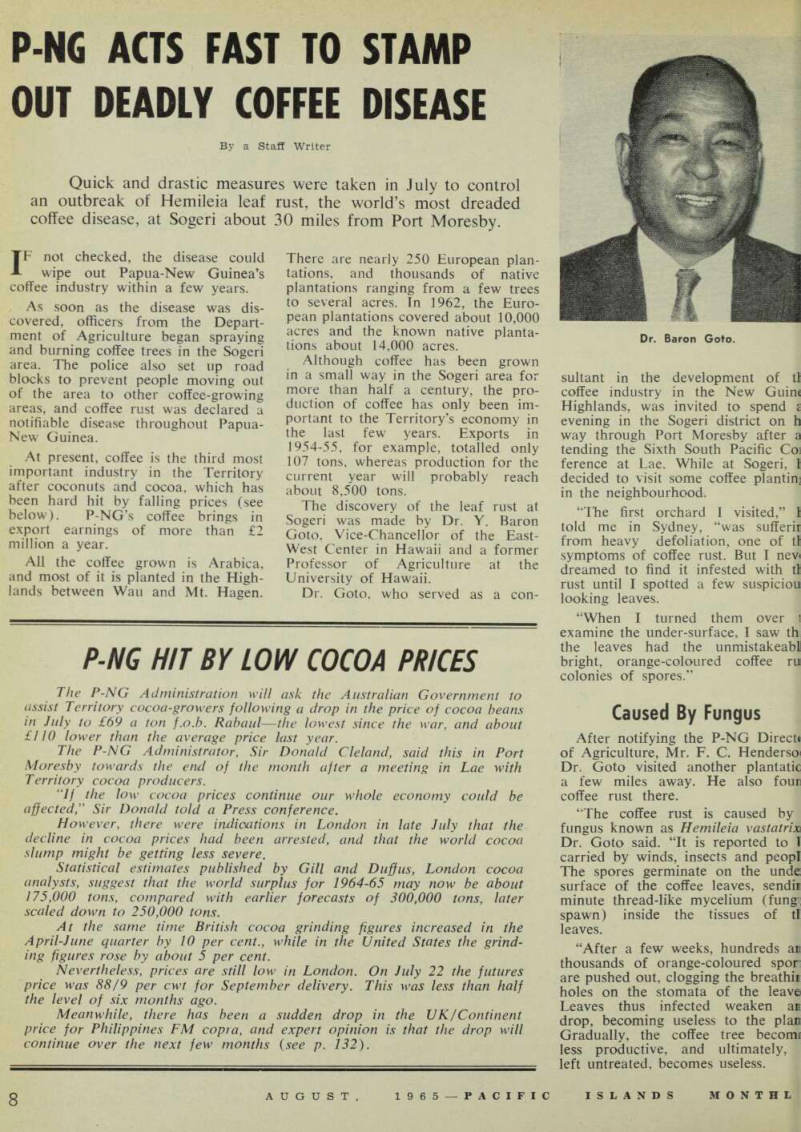
There are nearly 250 European plan tations, and thousands of native plantations ranging from a few trees to sev ® ra i acres - In 1962, the Euro- Pean plantations covered about 10,000 acres and the known native planta- U , t acres . Alt nough coffee has been grown In a snaa " way , r in Sogeri area for ™ or< r tha " ha £ f a century, the pro auction of coffee has only been im- P° rta nt to the Territory s economy in the l ast few years. Exports in 1954-55, for example, totalled only 107 tons, whereas production for the current year will probably reach about 8,500 tons, The discovery of the leaf rust at Sogeri was made by Dr. Y. Baron Goto, Vice-Chancellor of the East- West Center in Hawaii and a former Professor of Agriculture at the University of Hawaii, Dr. Goto, who served as a con-
sultant in the development of tl coffee industry in the New Guim Highlands, was invited to spend £ evening in the Sogeri district on h way through Port Moresby after a tending the Sixth South Pacific Coi ference at Lae. While at Sogeri, 1 decided to visit some coffee plantinj in the neighbourhood.
“The first orchard I visited,” 1 told me in Sydney, “was sufferit from heavy defoliation, one of tl symptoms of coffee rust. But I nev< dreamed to find it infested with tl rust until I spotted a few suspiciou looking leaves.
“When I turned them over 1 examine the under-surface, I saw th the leaves had the unmistakeabl bright, orange-coloured coffee ru colonies of spores.”
Caused By Fungus
After notifying the P-NG Direct* of Agriculture, Mr. F. C. Hendersoi Dr. Goto visited another plantatic a few miles away. He also four coffee rust there.
“The coffee rust is caused by fungus known as Hemileia vastatrix Dr. Goto said. “It is reported to 1 carried by winds, insects and peopi The spores germinate on the unde surface of the coffee leaves, sendii minute thread-like mycelium (fung': spawn) inside the tissues of t! leaves.
“After a few weeks, hundreds an thousands of orange-coloured spor are pushed out, clogging the breathii holes on the stomata of the leave Leaves thus infected weaken an drop, becoming useless to the plan Gradually, the coffee tree becomt less productive, and ultimately, left untreated, becomes useless.
Dr. Baron Goto.
“When the branches lose their eaves while bearing growing fruit, here is such a call for carbo ydrates that starvation sets in and ie-back of the branches spreads apidly.”
Dr. Goto said that Ceylon was a lassie example of a coffee-producing ountry that was ruined by coffee list. After having been a highly suc essful producer of coffee for about alf a century, coffee rust mysteriously ppeared in Ceylon in 1869, and by 890, 90 per cent of the coffee lantations had been abandoned.
The disease also ruined the Arabica jffee plantations in the lowlands of ava in 1876, and forced Robusta Dffee to be planted there. But lantations of Arabica coffee in the ighlands of Java were not affected.
Dr. Goto said that coffee rust was lost prevalent in low altitudes — ,500 to 2,500 ft—and generally scame less of a threat in high titudes. However, in Kenya, where 1 coffee plantations were over 4,500 high, some 45,000 acres of coffee ere affected by the rust. Never icless, the rust was 99 per cent, ider control because of a vigorous •raying campaign with copper ingicide.
Obstacles
Dr. Goto said the chief obstacles fighting the spread of the disease P-NG were the rugged terrain and e difficulty in getting New Guinean anters to take the necessary pre ntative measures.
However, he hoped that the in station would prove to be confined a small area around Sogeri and at through quick and thorough tion it could be completely wiped it, as was done in Puerto Rico in 'O3 when the disease was found ere.
“Today,” Dr. Goto added, “science is come to the aid of coffee planters, d if their trees are properly sprayed th copper fungicide, 99 per cent, infestation can be controlled.”
Footnote: Since the discovery of ffee rust at Sogeri in July, Mr.
I. Oatley, of Colyer Watson Pty. d., Sydney, has found that the rust is reported to be present in Papua d in the Cairns district of Queens id as far back as 1899. This sugests at the disease may have remained rmant in those areas for more than years. Mr. Oatley says reports on ; rust appeared in the Queensland icultural Journal for 1899 (p. 409) d in the annual report of the itish New Guinea Company for 03.