Racial Discrimination
pp. 12-14 · Read in the full issue
New Guinea Examines
Accusations Of
From a Port Moresby Correspondent
June was a sort of ‘'Discrimination Month” in the Territory.
The matter of discrimination, real or imagined, forced itself into the news from half-a-dozen different sources. A judge, a clergyman, an hotel keeper and a New Guinean member of the House of Assembly were all involved, and at the end of the month people were asking, “Is there serious discrimination in New Guinea today?”
THE Anglican rector of Port Moresby, Father lan Stuart, was one who said so, in a report published in the Northern Church man, the magazine of the Diocese of North Queensland. (There is no diocesesan magazine in New Guinea).
Father Stuart is a pleasant and very friendly clergyman—smiling, easy to meet, never blatant in his work. He looks young, in his open necked white shirt with the simple cross on the collar, but the grey is stealing through his crew-cut hair.
And he is frank and forthright.
Those who know him were not surprised to read his warning: “The outward peace and calm of Port Moresby could be deceptive—under the surface are tensions, resentment, niggling insecurity, a nagging sense of guilt, and a small cloud of fear on the horizon.”
Dual Standards
Dual standards of wages, working condition, housing and rents, he said, had made nonsense of the theory that there was no racial discrimination in the Territory. He contrasted the high salaries, generous leave conditions, special allowances and housing subsidies offered to attract Australians to the Public Service, with the living conditions of a much larger group who existed barely above subsistence level.
Father Stuart freely admitted in his report that the Australians were needed to do jobs that the Papuans could not do, as yet. But he warned of the consequences of abandoning the principle of equal pay for equal work in a country where the economic contrast was rapidly be coming more marked, along racial lines.
The average Papuan public servant, he added, paid twice as much rent
as his Australian counterpart, and for a vastly inferior house. His salary could be one-tenth of the Austra lian’s.
Father Stuart apart, there wouldn’t be many residents of Port Moresby who haven’t been aware, in recent months, of the increasingly widening gulf between the Australian and the New Guinean, in the town. The new
Public Service pay scales, w came into force last Septen sharpened the division at a where people of different races at last beginning to find com ground—on the job.
Then came the new system economic rentals which provided people of all races would pa> increased, but by no means rental by Australian standards, their homes. However, only Au lion public servants would get additional allowance—an am which exactly offset the ] Segregation of living, Borok Hohola, Kaevaga v Kaugere, thus enforced economically.
This situation moved one Ar lian mother, the wife of Bo United Church Minister, Paul Pa to write to an Australian newspj “During this past year, some Pa and New Guinean families m into Boroko, previously a Euro area. In our years in the Terri this is the first time our childrei within walking distance of a ft with whom they can share their cart and their books. The childre to school and church and
jether. I think we’re beginning to H common ground. And then this! onomic rents] What do I say? id luck you weren’t born white?’ ere are a lot of people in the rritory today who live only for i quick quid.”
As a visiting politician once suc ctly, but unpopularly, put it, Port )resby is a case of “hordes of idle-class Australians trying to live upper-class existence”, Port >resby undoubtedly contains a her proportion of these people ,n any other centre of Papua-New inea. Backyard baby-minders jrish as mother goes back to work pay off the Mercedes. These )ple exist in a national vacuum, r them, New Guineans provide only blurred background to their own lity and cupidity.
But there are many Australians in i rapidly-expanding urban areas of pua-New Guinea frustrated to find mselves in an emerging and ex ing country, but not really of it. ere is a genuine disappointment it their contact with the people fer extends beyond the master vant relationship with their house h
No Official Help
Rising educational levels and new rfessional abilities have given hope ■ better social contacts and an ier path to friendship between the :es, in towns like Port Moresby, t at this promising time, govera nt wage and housing policies ire effectively prevented the develop nt of the integrated suburban com inity—the most solid foundation racial understanding.
Criticism of the official wage policy ne from an unexpected quarter ring June. Dealing in the Supreme urt with a New Guinean found :lty of stealing from the mails, Mr. itice Frost said the temptation to al had come from under-payment s to the freezing of salaries and sitions as part of the Public rvice conversion, Ihe New Guinean, Gigiba Agia, m Daru, was a postal employee rking for £3/3/- per week, when stole £2 from a registered letter, i £3 from another letter the follow ! day. The judge pointed out that i freezing of positions had pre ited Gigiba’s promotion to a ary range of £177-£230 a year, fact, he had become worse off, ;ause on completion of training,
his bus fare allowance of 12/- a week was withdrawn.
Mr. Justice Frost said, “One can not live in Port Moresby and not know how real this burden is for the Papuan people. He has to pay the same price as Europeans for his food.
Living and working here in Port Moresby, it is inevitable and indeed proper that he should acquire some European tastes. I do not see how he could have lived on his salary of £3 a week in Port Moresby.”
He added, “This must concern a judge because men who are under paid are tempted to break the law.
This affects the steady observance of law and order.”
Gigiba was sentenced to nine months gaol, mainly, the judge in dicated, because his second theft could not be regarded as due to want.
Mr. Justice Frost put his finger on the point that is most riling to the New Guinean public servant about the new pay scales—lower wages in the service, but the same prices in the shops.
What appeared to be a straight forward case of discrimination, however, arose over a complaint about differential treatment in the Hotel Papua, Port Moresby’s “top pub”.
The matter was first aired in the House of Assembly, when the member for Ramu, James Meanggarum al leged that Simogun Pita, veteran legislator and now member for Wewak-Aitape as well as Under secretary for Police, had been un fairly ordered from the hotel for appearing in the lounge with only rubber thongs on his feet.
He claimed that Simogun had pointed out, unavailingly, that Euro peans in the hotel were similarly dressed. It was said that two Euro pean members of the House, later identified as Graham Pople (Gumine) and John Stuntz (East Papua), who were wearing thongs also, walked out in protest.
Investigation
The Administrator promised an immediate investigation, and set about collecting sworn statements from Messrs Pople and Stuntz that would make a charge of racial practices stick under the Government’s Dis criminatory Practices Ordinance. So far this law has not been used.
He also took the matter up with the Burns Philp management, which carried out its own inquiry into the affair.
After some weeks delay, Sir Donald was obliged to admit defeat. In a prepared statement, he announced that he had not received adequate supporting evidence to warrant pro ceedings under the ordinance.
“However,” he said, “as a result of consultations between the pro prietors of the hotel and myself, the person who was responsible for the act in question is leaving the Territory and will not return.”
This seemed somewhat less than fair to Mr. George Rooke, manager of the Papua Hotel, who was not named but was squarely identified just the same.
Sir Donald Cleland’s statement seemed to mean, firstly, that an act of discrimination had been com mitted, but could not be proved, and secondly that hotelier Rooke was being banished from the Territory.
At this stage, it is doubtful if any one could say how many Europeans were in the lounge that day wearing scuffs when Simogun was told to leave. But it does not appear that Sir Donald learned that, in fact, both
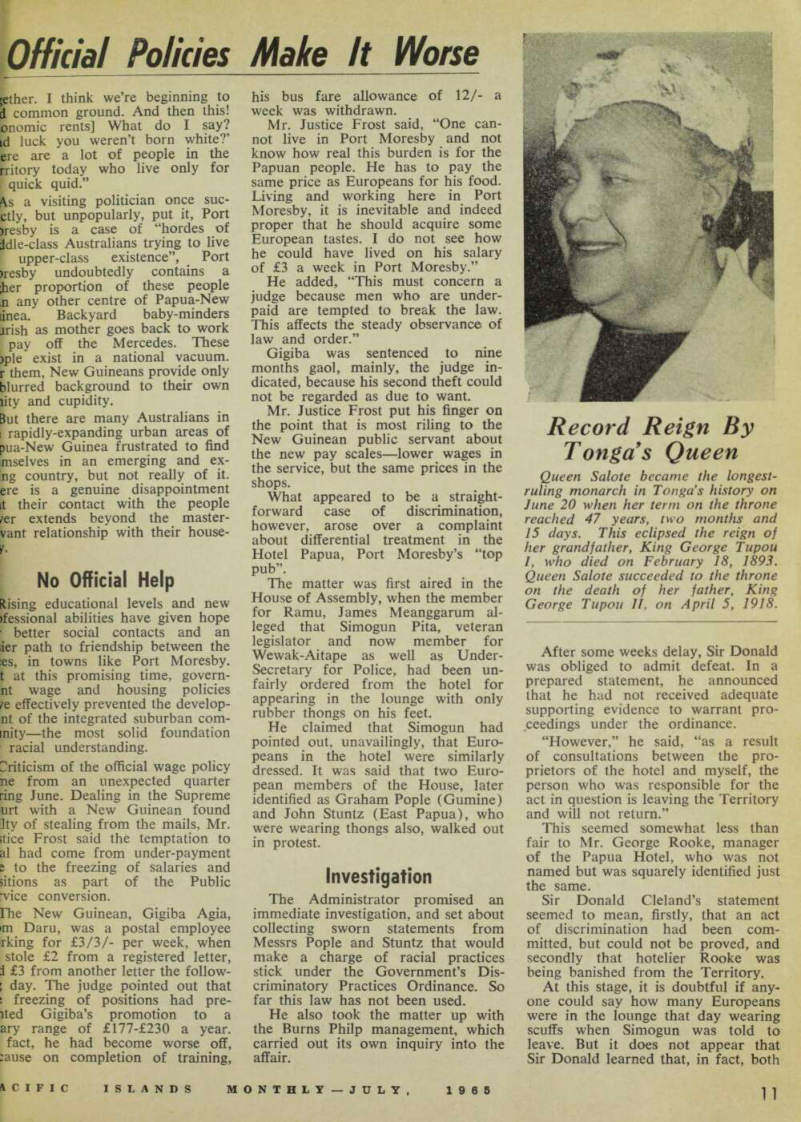
Record Reign By
Tongas Queen
Queen Salote became the longest ruling monarch in Tonga’s history on June 20 when her term on the throne reached 47 years, two months and 15 days. This eclipsed the reign of her grandfather, King George Tupou I, who died on February 18, 1893.
Queen Salote succeeded to the throne on the death of her father, King George Tupou II, on April 5, 1918.
Mr. Pople and Mr. Stunz were ordered out of the hotel at the same time as the member for Wewak- Aitape.
The hotel has a rule, ratified and approved by the Licensing Commis sion, and displayed publicly, requiring trousers, or shorts with long socks, to be worn in the lounge and saloon bar. The manager was within his rights in asking Simogun to leave, but did he discriminate? Certainly not between members of the House of Assembly, at any rate!
Burns Philp found it necessary to make clear, after the Administrator’s statement, that Mr. Rooke’s contract was not being renewed, but that this decision had been taken some months earlier.
The incident has served to em phasise the official determination to pounce upon any flagrant public dis criminatory act, now that the statute book has been wiped clean of almost every ordinance differentiating on the basis of race. And in its way, this highlights the segregation that exists in those areas beyond the reach of the ordinance.
Little Association
Despite the legal guarantee of racial equality, the right to equal service, equal treatment, equal op portunity and freedom from deliberate racial insults, there is little racial association, except by convenience. A law can only protect against injustice, it cannot change attitudes.
Not one European licensed club has admitted a New Guinean member since drinking was de-segregated two and a half years ago. Few visits are exchanged between families of dif ferent races.
Sportsmen meet in temporary equality on the field, but assume their tradition-dictated reserve towards each other on other occasions.
Not many government officers and under-studies ever meet outside work ing hours. New Guineans and Aus tralians retreat, on every possible oc casion, to the safety and seclusion of their own communities.
This apartheid, noticeable through out the Territory, becomes more exaggerated and more tragic in towns like Port Moresby, where New Guineans make the closest approach to the Australians’ standards in education, social conduct, employ ment and living conditions.
We find Australian superiority, complacency and indifference, and allegations of native jealousy, and desire to get something for nothing.
We find also, a distressing reluctance by New Guineans to invite the Aus
tralians to become real citizens of their country, and join their circles.
Yet the initiative for closer ties probably lies with the European, and at times it seems surprising that there is not more overt resentment to Aus tralians.
It is hard to determine the real Papuan feeling towards the European in the towns. Publicly, if questioned, the “we want Australia to stay” line is put forward. Sometimes with sin cerity. Sometimes, one suspects, merely because it has been found to please. The New Guinean, like the Chinese, would deceive rather than insult.
But there are signs—the rebellious ness shown in the streets, when New Guineans deliberately walk in the path of cars, throw stones and call insults, the attacks on women, the attacks on Australians seen in com pany with native and mixed race girls.
Is this merely hooliganism? Or is it deep-seated resentment boiling over? Is it the payback for years of taking second place at every shop counter and foodstall to that loud mouthed, ill-mannered Australian element? Or does it really spring from economic envy?
It is difficult to assess the real temper of the local people. For half a century criticism was not invited, and the lack of plain speaking by New Guineans about Australians is a bar to better understanding. There is an air of unreality about, with every second person professing to know “what the natives think”. So when a critical outburst does come,
it tends to be given more weight 1 it may really merit.
This happened when a membe: the House of Assembly, Gaudi Mi who represents the Markham e torate, was before the District O at Lae, in June, on a charge offensive behaviour. He was convi( and fined £5.
There was some evidence drunken behaviour and obsc language, but what aroused interest was the claim in court 1 he used the words: “I am going tell my people to rid white men fi our country. And I will tell tf again—rid white men so even dust will not be left behind them., that is why I am in the House Assembly.”
Gaudi Apologies
Later, a humbler Gaudi issuer public apology through the ne papers: “I love the Australians, i want them with all my heart to s with my people in this country . . . help Papuans and New Guine; develop this country in close assoc tion as friends and irrespective colour or race. I must apologise myself as an elected member of House of Assembly. I am very so for saying those words if I did : those words.”
Whether Mirau was venting dei rooted hatreds or merely blasting in a moment of drunken petulance not possible to tell. At this time change in New Guinea, Europez may look too hard at small straws see which way the wind is blowii