[?]hy Should NZ,
p. 11 · Read in the full issue
[?]stralia Dictate?
loeafu Moti wanted to know why British Phosphate Commission, more precisely Australia and New land, had to dictate the price of ►sphate to the Colony, le also asked: “Why should two 1-developed countries enjoy the efit of the Colony’s only valuable )urce? And had the people of : Colony been sufficiently well resented when the first agreement the exploitation of the phosphate ► signed?” dr. E. H. G. Blacklock, an LMS sionary, said the GEIC should m the right to levy export tax on :an Island phosphate without ing to go cap in hand to the three nber governments of the BPC— itralia, NZ, and the UK.
'wo of these governments, Mr. cklock said, “do nothing for us, one even looks upon us as unfit live with”. The last part of his iment was presumably a reference White Australia. n reviewing the history of Ocean nd phosphate exploitation from 0, Mr. Blacklock said that “one y be forgiven for thinking that fish protection was being extended the phosphates rather than the in stants” when Britain, in Nov ?er, 1900, declared Ocean Island form part of the Gilbert Islands tectorate that was set up eight rs earlier.
Ax. Blacklock said that in the
65 years that had passed since then conditions had changed greatly, and “the time had arrived for the three powers to have regard to the altered circumstances, and, in particular, that Ocean Island is part of a Colony on the threshold of some kind of in dependence.”
The world would judge Britain hardly if she held the territory as a colony only so long as the phosphates were of value to her. The world would judge her no less hardly if any earlier grant of self-government were to omit the transfer of control of the phosphates, the Colony’s main economic asset.
"Time Of Need"
Australia and New Zealand should beware also, for judgment would be no less hard on them if they, having received by far the greater share of the phosphates, did nothing to help the people of the Colony in their time of need.
Commenting on members’ speeches, the Assistant Resident Commissioner, Mr. R. Angeloni, said the people of the Colony must not look on the next step in constitutional develop ment as the final one. There was no suggestion that the next step would be independence.
The Government wanted to create
a situation where the people could say what they wanted.
Mr. Angeloni said the speeches made on Ocean Island phosphate would make Australia and New Zealand realise that the people of the GEIC were “not happy” about present arrangements.
"Not Ogres"
There were many aspects of the present arrangements that could be improved, and he thought Australia and New Zealand would be prepared to help.
But it was a mistake to be over critical about what happened in 1900 or 1920, as the conventions then used were then acceptable.
“The United Kingdom Government whole-heartedly supports the Colony in its request for a maximum return, and Australia and New Zealand understand the problems,” he said.
“They are not ogres, but they do have their own countries and con sumers to think about.”
In reply to a question by Mr.
Blacklock, Mr. Angeloni said the Government had “no information whatsoever” on the possibility of a transfer of sovereignty of Fanning, Washington and Christmas Islands to the United States ( PIM , April, P- 41).
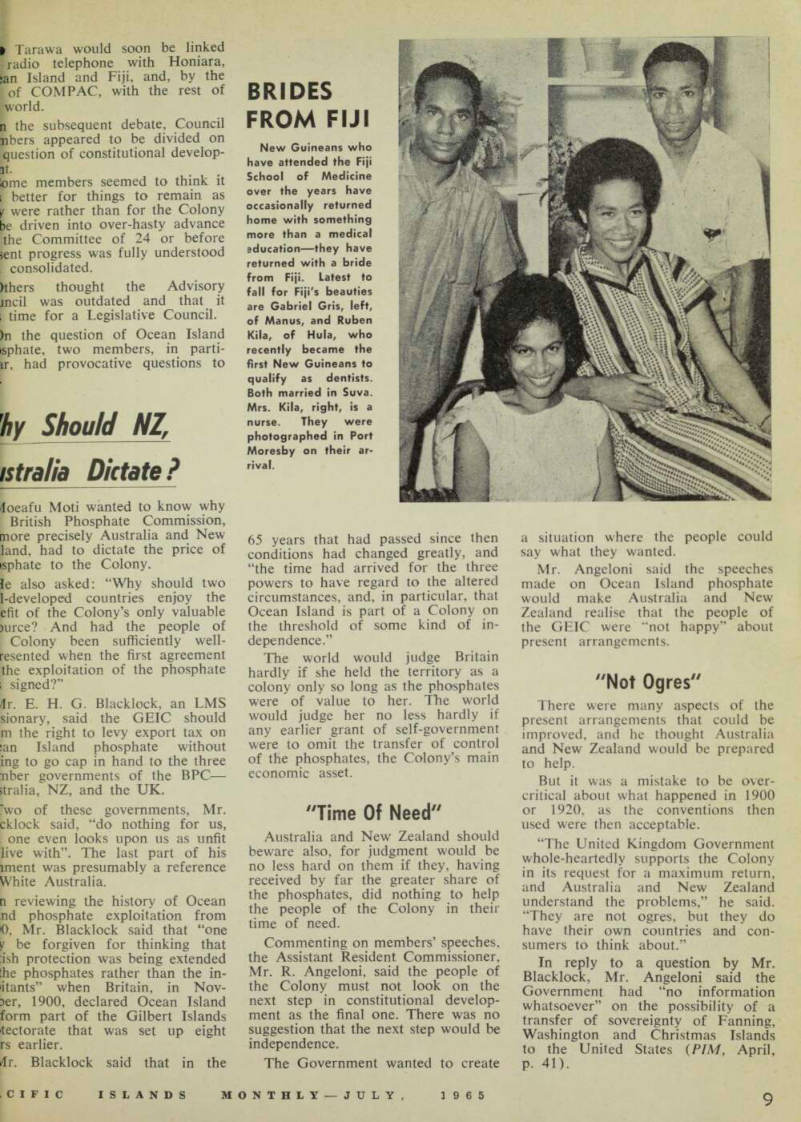
Brides
From Fiji
New Guineans who have attended the Fiji School of Medicine over the years have
occasionally returned
home with something more than a medical education—they have returned with a bride from Fiji. Latest to fall for Fiji's beauties are Gabriel Gris, left, of Manus, and Ruben Kila, of Hula, who recently became the first New Guineans to qualify as dentists.
Both married in Suva.
Mrs. Kila, right, is a nurse. They were photographed in Port Moresby on their ar rival.