Cook Islands Assembly
pp. 33-36 · Read in the full issue
Lively Start To Era Of Self-Government Independents Walk Out Of Cook Islands Assembly
From W. H. Percival on Rarotonga.
The newly-elected Cook Islands Legislative Assembly, which is expected to become the first with powers of internal self-government, began its first session in lively fashion early in May when all eight independents walked out of the chamber on the second sitting day.
IHE walk-out was in protest against a motion by Dr. Manea imarua, deputy leader of the Cook ands Party (which has 14 As mbly seats, and thus forms the jvernment), to amend the contro rsial residential clause in the Cook ands Amendment Act.
The amendment was to enable Mr. ben Henry, the Aitutaki-born ider of the Cook Islands Party TP), to stand for election to the jsembly.
He is at present debarred from >ing this because the Act, as it mds, requires a candidate to have ed in the Cook Islands for three ars before an election—and Mr. ;nry, who lived in New Zealand for any years, has been a resident of e Cooks only since last year.
After Dr. Tamarua had introduced s motion to amend the residential ause, Mr. William Estall, an inde ndent member for Aitutaki and the sputy Leader of Government Busi es in the old Assembly, objected at the Assembly had met to discuss e proposed consitution for the Cook land (see p. 35) and not the Cook lands Amendment Act.
However, the Assembly president led that the Act and the constitu >n were so closely related that the ct could, in fact, be discussed.
Mr. Estall raised further objections, id added that the independent mem -srs would leave the chamber in pro st—which they did.
The meeting was then adjourned ►r lack of a quorum of 14 members, i two of the 14 CIP members were )sent. These members, representing lands in the northern group, did not rive in Rarotonga in time for the art of the Assembly session, and ere not expected for about another eek.
However, the independent members burned to the chamber next day,
and after some spirited exchanges, Mr. Estall introduced a new amend ment to the residential clause which the Assembly passed.
This amendment, which cannot become law until the New Zealand Parliament approves it, reduces the residential qualification for both electors and candidates in Cook Islands elections to three months— provided that they are British sub jects and have previously spent at least one year in the Cooks.
First Sitting
At the first sitting of the Assembly, which took place on May 10, the Resident Commissioner, Mr. A. O.
Dare, remained in the chair at the Assembly’s request.
Next to him sat Mr. Omar Adeel, Sudanese leader of the United Nations team of observers, which
went to the Cooks in April to wit ness the elections. Also present were two other UN observers, Mr. James J. Lewis, of the US, and Mr. Bernard D. Dorkenoo, of Togo.
After the new Assembly members were sworn in, Mr. Dare made a speech of welcome. This was fol lowed by an address by Mr. Adeel. who was wearing Sudanese national dress.
As expected, Dr. Tamarua was elected Leader of Government Busi ness; and he announced that his Exe cutive Committee would comprise five CIP members. They are: • Mana Strickland, a headmaster and secretary of the CIP, who was one of the nine successful CIP can didates on Rarotonga in the April 20 elections. • Apenera Short, also of Raro tonga. • Julian Dashwood, English-born representative for Mauke, who has lived in the Cook Islands as a trader since 1929 and is the author of two books. He was a member of the Executive Committee in the pre vious Assembly—heading the Health, Social Development and Police De partments—until suddenly sacked last August (PIM, October, 1964, p. 35). • Tiakana Numanga, of Raro tonga. • Mrs. Marguerite Story, wife of Rarotonga’s “mechanical genius”, Mr.
Fred Story and sister of Albert Henry. She is expected to resign from the Assembly as soon as the law has been changed to enable her brother to contest a by-election.
Except for Mr. Dashwood, all members of the Executive Com mittee, as well as Dr. Tamarua, are
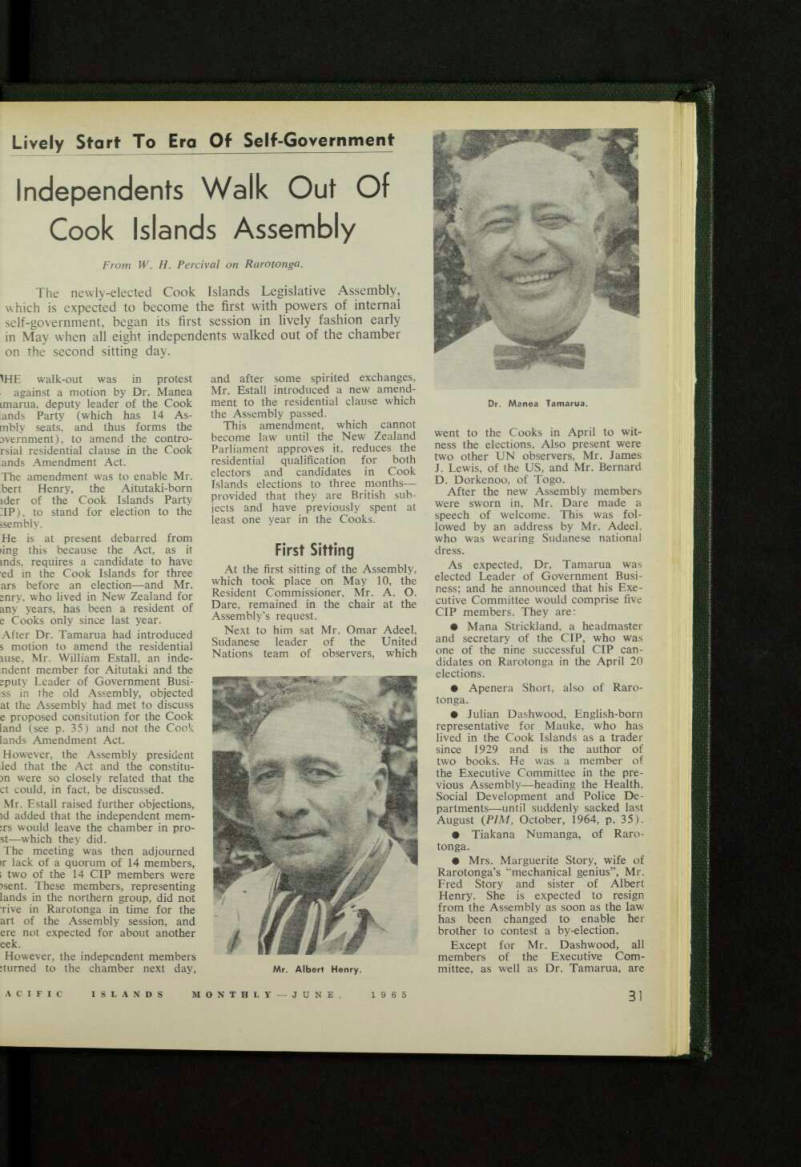
Mr. Albert Henry.
Dr. Manea Tamarua.
lewcomers to the Legislative As sembly.
The first business following the laming of the Executive Committee vas whether the Assembly should ac :ept the proposed constitution for the rook Islands, an amended version of t, or some alternative form of gov :rnment.
Dr. Pupuke Robati, independent nember for Rakahanga, set the ball oiling by moving “that the adoption if the constitution be deferred until uch time as the alternatives to self ;overnment are fully investigated and :xplained, and the wishes of the >eople determined by referendum”.
The alternatives, which he claimed lad not been fully explained, were ntegration with New Zealand, full ndependence, and membership of a *acific federation.
Dr. Robati said that the Raka langa people preferred integration to he proposed constitution, but wanted his fully explained to them before hey made up their minds.
The independent members from ‘enrhyn, Atiu, Aitutaki and Mangaia, 11 supported the motion and all said nuch the same thing—that the alter latives to the proposed constitution lad not been fully explained and that heir people did not wish to be ushed into accepting the constitution.
Some members said that if the lotion was defeated they would re ign from the Assembly.
Recommendations
Speaking against Dr. Robati’s lotion, Dr. Tamarua made it clear hat the C1P had indicated all along hat it would accept the proposed onstitution after certain amendments lad been made to it. He said that in oing this his party was following he recommendations of the previous assembly, which had accepted self overnment on the counsel of its ad isers.
Mana Strickland added his weight i Dr. Tamarua’s remarks by saying hat the alternative forms of govern icnt had already been fully ex lained to the people. He expressed urprise that members of the previous assembly, who had been re-elected nd who accepted the idea of self overnment, were now speaking gainst it.
When the motion was put to the ote on the second sitting day, May 1, it was defeated on a show of ands by 12 votes to eight—the CIP oting in a body against the indepen ents.
There had already been a consider ate display of verbal fireworks by his time, but the big bang came
when the Leader of Government Business moved that the residential clause of the Cooks Islands Amend ment Act be amended.
Specifically, he proposed that the residential period required for elec tors and candidates at Assembly elec tions should be three months for those born in the Cook Islands and one year for those born outside the Group.
Mr. Estall immediately objected to debating the motion at all. and after the president had ruled that the motion was in order, he and the other seven independents walked out, to give—as they said—“effective support to their protest”.
When the independents returned for the Assembly’s third sitting next day, one of their number, Mr. Geoffrey Henry, who is a “dissenting” nephew of Mr. Albert Henry, said that the non-Government members were will ing to discuss any matter provided that discussion on the constitution came first and the Cook Islands Amendment Act, second.
Dr. Tamarua replied that he still considered that his motion was in order.
During his speech. Dr. Tamarua referred to the non-Government members as the “opposition”. This brought Mr. Geoffrey Henry to his
feet once more to say that this was not the case.
Mr. Dashwood interposed tartly 1 that the opposing members could ■ rightly be called the “obstruction” not the “opposition”, as they seemed intent on obstructing the business of the Assembly.
On May 17, the Assembly that the Constitution should provide' for a House of Arikis rather than a Council of State including two arikis (see story opposite).
Final Session
At the final session of the Assembly on May 19, several Independent members said that the people of their islands wanted a full explanation of the other proposed forms of govern ment before accepting the Constitu-| tion.
Many people, they said, wished to know about integration with New Zealand, which might bring benefits such as old age pensions, child allowances, etc.
Mr. Geoffrey Henry pointed out that, although the independents were only eight in number, they represent ed almost half of the voters in the Cook Islands and that while Raro tonga was solidly behind the Cook Islands Party, about two thirds of the outer islands people were against it. [Mr. Henry’s claims are somewhat exaggerated. Of the 17,712 votes cast in the election, the successful CIP candidates alone gained 8,038, against 2,779 for the successful independents.
In the outer islands, the independents hold eight seats to five by CIP mem bers. However, the independents hold all five seats on Aitutaki and Mangaia, the two most populous outer islands.
They also have one each for Raka hanga, Penrhyn and Atiu. The CIP also has one Atiu seat, and one each for Mauke, Manihiki, Mitiaro and Pukapuka.—Ed., PIM.] Mr. Estall asked Mr. Adeel, the leader of the UN Mission, to confirm that the Cook Islands Government could request another form of government should self-government prove a failure.
In reply, Mr. Adeel read a] document published at the request of the New Zealand Government which said that the Cook Islands Government did have the right toi request another form of government] after self-government had been given a trial period.
This news caused the tension that had existed between the Government and “Opposition” from the outset to disappear and to be replaced by a spirit of co-operation.