On Pitcairn
pp. 31-32 · Read in the full issue

Motor Power Has
Made Ufe Easier
From Beryl Cates in Suva From 1790, when HMS )unty dropped anchor at Pit im Island until early this year, s Pitcairn Islanders had to put many backbreaking hours of il because of the steepness of sir island and lack of mechani
-1 equipment.
•UT now, thanks to a shipment of > mechanical equipment paid for Britain’s Colonial Development d Welfare Fund, life is much iier.
Pitcairn, which is semi-circular in ipe, is the southern end of a crater an extinct volcano.
All community life and agriculture ; within the edge of this crater, and im the crater’s rim the fall to the i is sheer at most places around the rve.
A rough road and sandstone steps wn the 250 ft cliff were, until re itly, the means by which the is iders made their descent to the i.
Untold man-hours were involved descending and ascending the cliff :e. Luxuries such as flour and fuel pped in by freighter were lifted to i crater edge by flying fox, limited 400 lb loads. On top, loads were oken up and either carried or leelbarrowed to Adamstown, the and’s village.
The cliff face caused losses in >rking hours the Islanders could ill : ord, particularly in recent years as numbers dwindled through igration. For Pitcairn is no lotus id. Even with the crater’s rich vol nic soil and money made from the le of postage stamps, life on the and is frugal and everyone must irk hard at curio-making, garden g and fishing.
New Era
The unpaid public work of hauling id carting, which every man be een 16 and 60 is called on to do, is therefore often been done grudg gly because it took time away from e productive work.
But the beginning of a new era me last June when the Colonial svelopment and Welfare organisa
tion made a grant through the Western Pacific High Commission to provide two tractors and ancillary servicing equipment for Pitcairn.
In December, Mr. Brian H. Webb, an honours graduate of agricultural science from Massey University of Manawatu, NZ, was seconded from the Fiji School of Agriculture to go to New Zealand to familiarise him self with the machinery and equip ment, and then to introduce it to Pitcairn Island.
The equipment included a crawler tractor with a bulldozer blade, ripper, bucket, winch and 3-point hydraulic linkage; a 40 hp wheel tractor fitted with a trailer, transport box, cord wood circular saw, mouldboard plough, tandem discs, tyne harrows, post-hole borer, grader blade and electric arc welder, and servicing tools, jacks, chain hoist, tyre pumps and spare parts. There was also a workshop and an equipment shed.
Mr. Webb landed on Pitcairn on December 31 and was there for seven weeks. During his last two weeks he was joined by Mr. T.
Templeton, a New Zealand mechanic, who trained three Pitcairners to work and maintain the equipment.
The work began with the unloading of the crawler tractor parts from the ship. They were assembled on the only level strip at the island’s landing place—a site 20 ft by 15 ft.
The steep road up the cliff was wide enough for the crawler as New Zealand Army crawlers had used it during World War II to drag radio masts and equipment up to the radio station on the highest plateau of the crater’s centre.
But the ascent was not without hazard for the steep ascent has grades of cut in three in two places.
The wheel tractor, workshop and other equipment were broken down to case lots and winched up the track gradually by the crawler. (over)
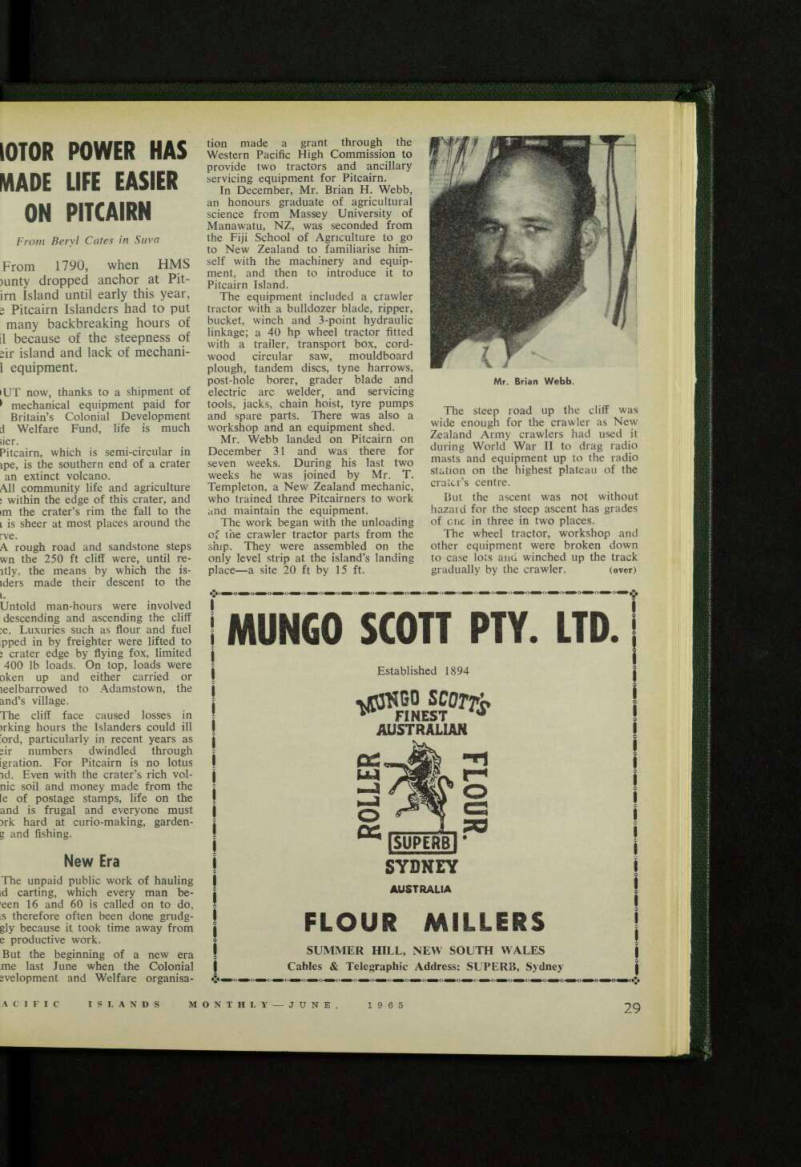
Mr. Brian Webb.
Once on top the wheel tractor was assembled and road work began.
The first road to undergo recon struction was that from the cliff base to the crater’s edge, which is known as the Edge. New cuttings were made —some 20 ft to 30 ft deep. At times the machines were working on a face with a precipitous drop of 200 ft to 250 ft.
The main village road was resited and rebuilt to give easier access to the generating plant, and to facilitate easy transport of fuel.
Road Built
Later, six days were spent build ing a road from the Edge to Radio Station Road after Mr. Stewart Cameron, a geographer from Otago University, who was on the island preparing an accurate map of it, had mapped out the route.
The new road gives easy access to all the flat agricultural land on the top plateau, and enables the tractors and all the agricultural equipment to be used effectively. As a result, labour is much more efficient.
In the old days, for example, fuel was transferred from 44-gallon drums to 10-gallon containers and then shouldered up to the radio station 650 ft above the Edge. Now one trailer load easily moves three drums the same distance in less time.
Meanwhile, the cordwood circular saw is estimated to have reduced the task of firewood collection by one third.
Road maintenance, once a major, unpaid, public works chore, can now be undertaken by the road grader on the wheel tractor.
Transport of goods up and down the cliff face has been faciiltated even though the road, so far, is accessible only by crawler tractor. Further work has yet to be done by the islanders on the lower incline.
Land Cleared
While on the island, Mr. Webb also cleared much of the agricultural land of lantana and guava, first with the bulldozer, then with plough, disc and harrow.
He also demonstrated contour planting and cultivation with an end to preventing soil erosion, and prun ing techniques on citrus and pine-j apples.
Suggestions were made on how to improve water supplies, particularly for irrigation, and better spacing of banana trees was strongly urged.
There seems little doubt that the Pitcairners will benefit all round.