travel
pp. 125-127 · Read in the full issue
Concern In Tahiti Over
Closure Of Consulate,
Decision On Visas
travel
A Regular Rim Department
Reporting News Of South
Seas Tourism And Travel
From The Inside
People connected with the tourist industry in French Poly nesia were gravely concerned in April over French Government decisions forcing the closure of the United States Consulate in Papeete and requiring tourists wishing to visit that territory for more than 10 days to apply to Paris for visas.
THE decision on the visas provoked hostile criticism in the local Press, and after the Governor of French Polynesia, Mr. Jean Sicurani, had made representations to Paris, the decision was revoked.
The Papeete daily, Le Journal de Tahiti, hailed the news of the revo cation of the visa decision with a front page editorial headed: “Good Sense Triumphs”. In this, the paper said that if tourists had been obliged to apply to Paris for visas, there would have been a total recession in the tourist industry in French Poly nesia.
It added that the closure of the American Consulate was “stripped of good sense” as any resident of the territory who wished to visit the United States would now have to go through the long and tedious business of writing to the US Consulate in Suva for a visa.
The US Consulate in Papeete is due to close down on April 30 after having been open for barely three months.
The US Department of State sent a cable to the consul, Mr. George Grey, on April 16 ordering him to close the consulate. The cable said the order followed a decision by the French Government.
The Governor of French Poly nesia later gave Mr. Grey permission to remain at his post until April 30.
Mr. Grey, who was US consul in Fiji for three years, flew to Papeete from Suva in mid-January to open the Papeete consulate after the French Government had given provisional approval for its establish ment.
The United States had previously
maintained a consulate in Papeete continuously for more than 100 years, but had closed it in 1948 for economic reasons.
No reason has been given for the French Government’s decision forcing the closure of the consulate, but it appears that the French do not want American Government representa tives to be in the vicinity of Tahiti between now and next year when they plan to hold nuclear tests at Mururoa Atoll in the Tuamotus.
News that the French Govern ment would not give the US definitive approval for the establishment of its consulate began circulating outside Tahiti early in April after it had been “leaked” to the Press by the French Government.
The leakage technique is one that the French Government appears to resort to whenever it wants to soften the blow or lessen the shock of a controversial decision. The technique was used, for example, when France decided to build the nuclear testing base at Mururoa and when it decided to recognise Red China.
Its use in the case of the US consulate resulted in stories about the impending closure appearing in newspapers in the mainland United States, in France, American Samoa and Honolulu well before the Tahiti Press got wind of the decision.
The Papeete daily, Le Journal de Tahiti, for instance, did not publish anything on the subject until April 16 —a few hours before the news was made official. This was exactly a week after the news had been pub lished in the weekly Samoa News of Pago Pago.
"Disagreeable Measures"
In its issue for April 16, Le Journal de Tahiti took the view that the closure of the consulate and proposed visa requirements would have a seriously adverse effect on the local tourist industry.
In an editorial headed “Disagree able Measures”, the paper said that every French Minister who had visited French Polynesia recently had preached that the economic future of
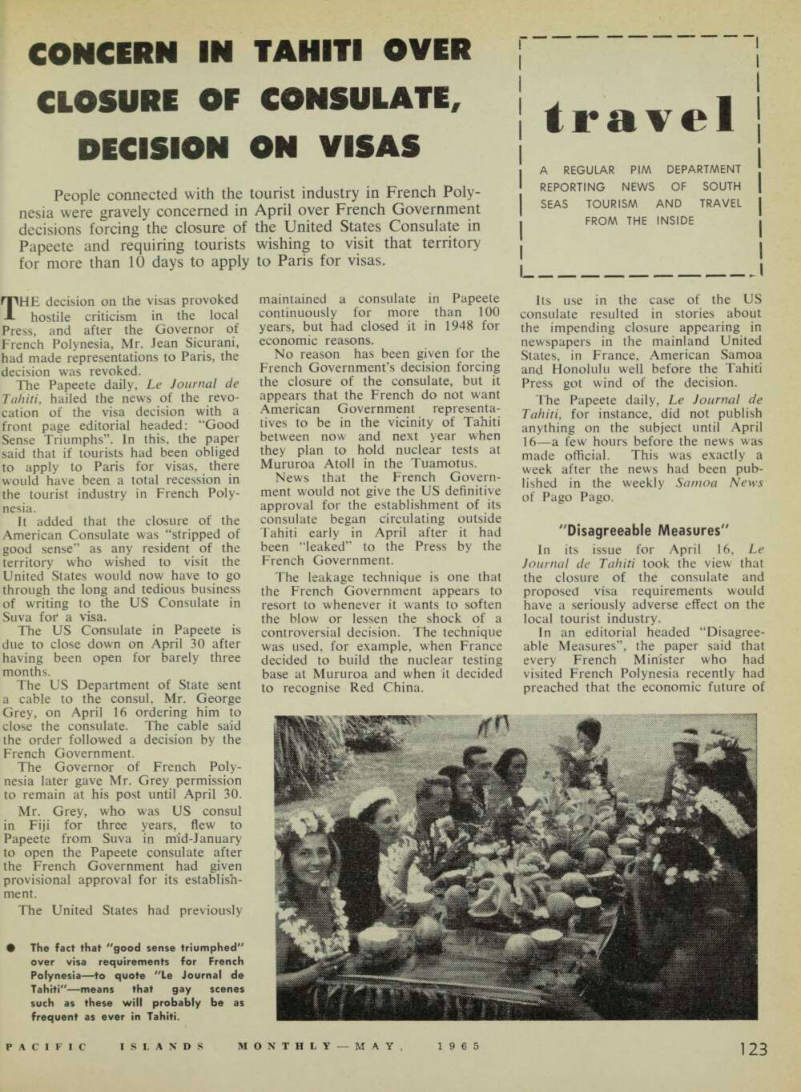
• The fact that "good sense triumphed" over visa requirements for French Polynesia—to quote "Le Journal de Tahiti" —means that gay scenes such as these will probably be as frequent as ever in Tahiti.
he territory rested on tourism, and hat tourism was the key to Tahiti’s urvival and prosperity.
“But what is tourism?” the paper isked. “Statistics prove that nearly 7 0 per cent, of our tourists are \mericans. So are we going to ruin he economic development of Poly lesia?”
Next day, Le Journal de Tahiti eported that Governor Sicurani had sxchanged telegrams with the 3 aris authorities in an effort to obtain i relaxation of the new visa regula ions.
According to Le Journal de Tahiti )f April 22, the regulations on visas low are that: • No visa is required by foreigners risking French Polynesia for less than '0 days. • Foreigners wishing to visit the erritory for from 10 to 30 days may )e granted visas by any French consul >r by the Governor of French Poly lesia without reference to Paris. • Visas for sojourns of more than 10 days may be granted by any french consul or the Governor of Tench Polynesia after referring the ipplication to Paris.