Cruisig Yachts
pp. 107-118 · Read in the full issue
Pacific Shipping And Cruisig Yachts
Tough Action Against New Guinea Ships' Masters
The large number of vessels which have gone aground on reefs and beaches in New Guinea waters in the past 12 months is leading to tougher action against negligent ship masters.
THE findings of a marine board of inquiry, released in Port Moresby in April, cancelled the licence of one master, suspended an other for a year and severely repri manded a third. All were Europeans, some with long experience.
The Administrator of the Territory, Sir Donald Cleland, announced the board’s findings. He said the board viewed “with the gravest concern” the conduct of Ronald Stephen Judge, master of the MV Wynvale, a 55-ton coaster.
The Wynvale ran aground on Kar Kar Island on December 3 last year and became a total loss.
The board found that Judge was to blame for navigating his vessel without due care and cancelled his local master’s licence.
Karl Jacob Thomas Kramer, master of the MV lisa was deemed not qualified for command for one year.
The board found Kramer negligent when his 48-ton, twin screw vessel
ran aground at Cape Gerhards on November 30 last year. The ship was refloated but became a total loss when she was beached at the entrance to the Mongai River in a sinking condi tion.
The board found that the master of the 662-ton vessel Fijian Trader, Captain D. Cleary, had manoeuvred his vessel in a manner which was “dangerous in the extreme” when she attempted to rescue another ves sel, MV Dorothie, which went aground on lombard Reef last year.
In the salvage attempt Fijian Trader went aground herself.
Sir Donald Cleland said the Fijian Trader had not been suitable for the salvage job and the master had hazarded his ship.
Arthur Evans
Gets A Bargain
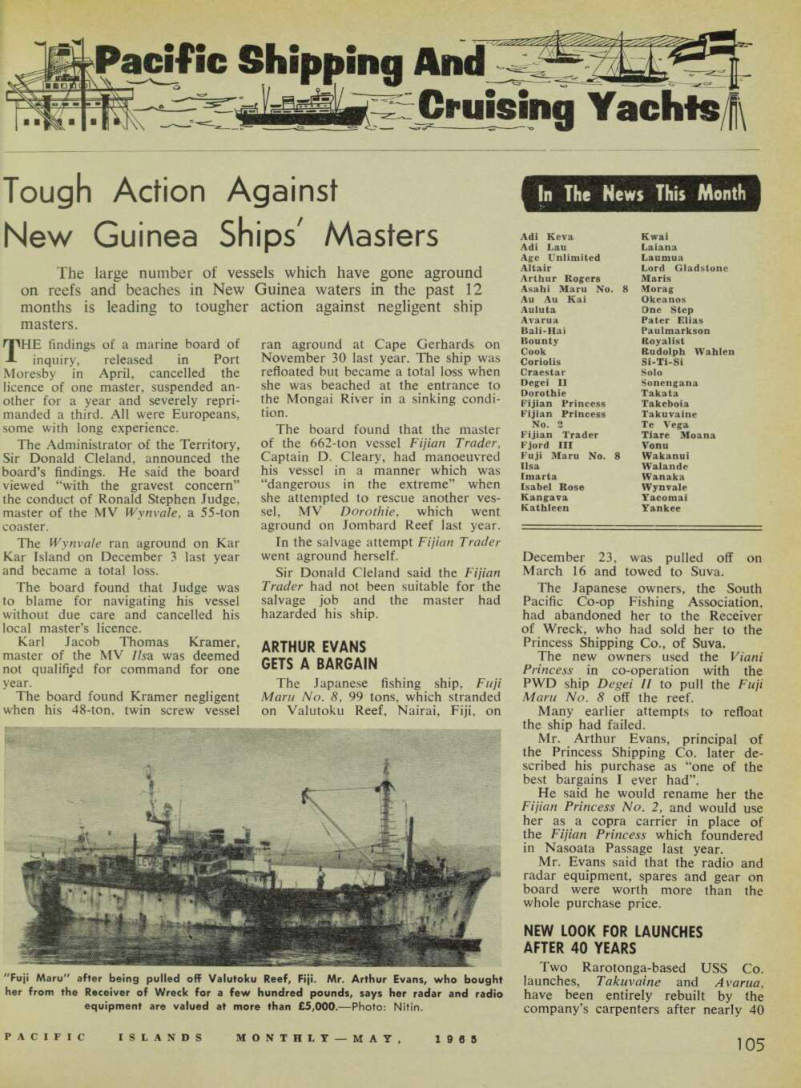
The Japanese fishing ship, Fuji Maru No. 8, 99 tons, which stranded on Valutoku Reef, Nairai, Fiji, on
December 23, was pulled off on March 16 and towed to Suva.
The Japanese owners, the South Pacific Co-op Fishing Association, had abandoned her to the Receiver of Wreck, who had sold her to the Princess Shipping Co., of Suva.
The new owners used the Viani Princess in co-operation with the PWD ship Degei II to pull the Fuji Maru No. 8 off the reef.
Many earlier attempts to refloat the ship had failed.
Mr. Arthur Evans, principal of the Princess Shipping Co. later de scribed his purchase as “one of the best bargains I ever had”.
He said he would rename her the Fijian Princess No. 2, and would use her as a copra carrier in place of the Fijian Princess which foundered in Nasoata Passage last year.
Mr. Evans said that the radio and radar equipment, spares and gear on board were worth more than the whole purchase price.
New Look For Launches
After 40 Years
Two Rarotonga-based USS Co. launches, Takuvaine and Avarua, have been entirely rebuilt by the company’s carpenters after nearly 40
"Fuji Maru" after being pulled off Valutoku Reef, Fiji. Mr. Arthur Evans, who bought her from the Receiver of Wreck for a few hundred pounds, says her radar and radio equipment are valued at more than £5,000. — Photo: Nitin.
years of service without major re pairs or overhaul.
The Takuvaine went into service in 1926 and the Avarua a year later.
The Avarua, which was the last to be rebuilt, was stripped to the keel and new stem and stern posts were hewn out of au, a Cook Islands tim ber, which is said to be one of the finest in the world for making ships’ ribs, etc.
New Ships For
Solomons Government
Two new ships for the BSIP Ad ministration arrived in Honiara re cently. They are the MV Laiana, which arrived under her own power from Halvorsen and Messier’s ship building yard in Sydney on March 15; and the Auluta, a fast launch, which came from Singapore via Hong Kong as deck cargo in the MV Chekiang on March 18.
The Laiana, a 60 ft vessel, has been renamed Laumua, which is re ported to be the name of a bird in the Lau language of North Malaita.
She reached Honiara via Noumea, and then was taken to Tulagi for checking. She will be based in Honiara for carrying cargo as and where required.
The Auluta, which was built by Thornicroft Singapore Ltd., carries up to 15 passengers at a speed of about 15 knots. She is now operat ing in the Western Solomons.
The BSIP Administration expects to take delivery of three other vessels in the near future. They are the Takata, a coastal launch for the Agri-
cultural Department; the Walande, an inner island ship built at the South Pacific Boat Building Centre in Noumea and which has been fitting out at Auki; and the Kwai, a K-class outer island vessel built in the United Kingdom.
"Ie Vega" To Visit
Vanikoro, Tikopia
Te Vega, Stanford University’s oceanographic research vessel and post-graduate training ship, was due to leave Honiara early in April to visit Rennell Island, Tikopia and Vanikoro. Tikopia is seldom visited by European ships (see p. 69).
Te Vega arrived in Honiara on March 17 from Kieta and Rabaul on the homeward leg of a three-year cruise, during which students attend classes for eight to 10 weeks and are then replaced by others. There were three scientists and 11 students on board on her arrival in Honiara, who returned from there to the United States.
Islands Ships
Change Hands
Two Islands ships have changed hands in recent weeks, and Morris Hedstrom Ltd., Suva, will take de livery soon of a new ship from Holland.
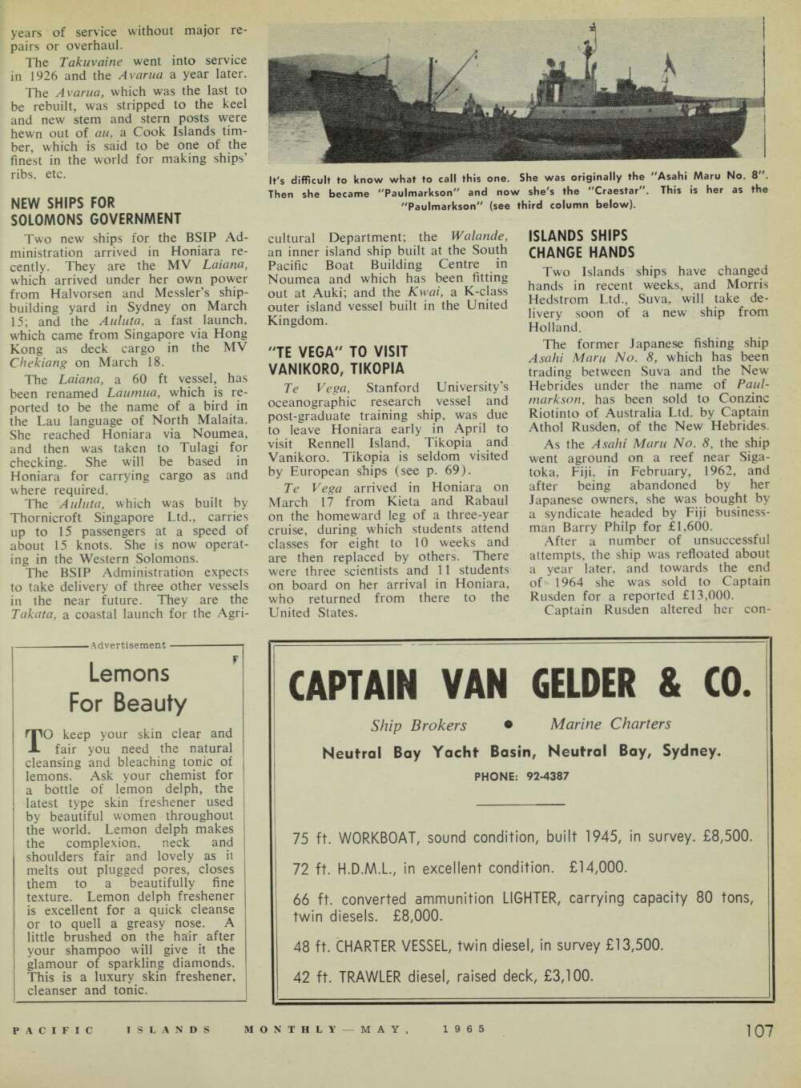
The former Japanese fishing ship Asahi Maru No. 8, which has been trading between Suva and the New Hebrides under the name of Paul markson, has been sold to Conzinc Riotinto of Australia Ltd. by Captain Athol Rusden, of the New Hebrides.
As the Asahi Maru No. 8, the ship went aground on a reef near Siga toka, Fiji, in February, 1962, and after being abandoned by her Japanese owners, she was bought by a syndicate headed by Fiji business man Barry Philp for £1,600.
After a number of unsuccessful attempts, the ship was refloated about a year later, and towards the end of 1964 she was sold to Captain Rusden for a reported £13,000.
Captain Rusden altered her con-
It's difficult to know what to call this one. She was originally the "Asahi Maru No. 8".
Then she became "Paulmarkson" and now she's the "Craestar". This is her as the "Paulmarkson" (see third column below).
siderably and renamed her Paul markson, but found her too small for the Suva-New Hebrides trade as she can only carry 120 tons of cargo. He sold her to Conzinc Rio tinto for £22,000.
Conzinc Riotinto have renamed the ship Craestar, and will use her for mining exploration work in the Solomons. A helicopter will be mounted on deck.
Captain Rusden has bought the 260-ton motorship Altair from Morris Hedstrom Ltd., Suva, and he has been negotiating to buy another, slightly smaller ship in New Guinea.
Captain Rusden will take delivery of the Altair in May after a new ship for Morris Hedstrom arrives from Holland.
The Altair, a steel ship of 260 tons gross, was built in Melbourne in 1944. She is 120 ft long, can carry 230 tons of cargo, and has passenger accommodation for eight.
Fifty-five deck passengers can also be carried.
Captain Rusden will use her be tween Vila and Santo.
Morris Hedstrom’s new ship is called Morag but will be renamed Adi Keva. This will be the fourth company ship to bear that name— the last Adi Keva having been scrapped last year after an overhaul showed that necessary repairs would have been uneconomical ( PIM . July, 1964, p. 99).
The new ship, of 351 tons gross and 148 tons net, was built in Holland in 1956.
Another Fiji Master
Fined For Overloading
Another ship’s master was fined in Fiji in April for having carried more passengers than his licence per
Captain Rusden.
mitted. This was the third such case in the past couple of months—the two earlier ones were reported in PIM last month (p. 101)—and was further proof that the authorities are making a determined effort to deter masters from carrying excess passen gers.
This action follows the Kadavulevu disaster of March 29, 1964, when 89 persons lost their lives.
In the latest prosecution, at Levuka, Misaele Tiko, master of the cutter Yacomai, 14.34 tons net, was fined £5 for having carried 22 passengers instead of the permitted 11.
The prosecution alleged that on January 22, on arrival at Levuka from Lau, the Yacomai, instead of going to the wharf, anchored about half a mile from the wharf area, and started to unload passengers.
This was seen by a Customs officer who made a check and found that the ship was carrying 22 passengers.
Earlier, in Suva, a case against Joeli Tago, master of the Adi Lau, for alleged overloading was dismissed after the Assistant Harbour Master, Captain Peter Hough, said it was common practice to reduce crew and increase passengers.
The ship is licensed to carry 19 passengers and a crew of 12, but Joeli said he had carried 21 passen gers and a crew of 10,
Action Soon On New
Nukualofa Wharf
The construction staff for Nukua lofa’s proposed wharf at Maufanga are expected to arrive in Tonga in May and June.
Mr. S. Sander, resident engineer, of Sandford Fawcett, Wilton and Bell, the consultant engineers, is expected to start on-the-spot preparations for work to begin in July. The wharf is expected to be ready by the end of 1967.
The wharf contractors are G. Drew and Co. Ltd., of Oldham, England.
Their supervisory staff for the pro
ject will be Messrs. George Batley, site agent; James Fahy, general foreman' Arthur Bond, foreman joiner; and James Barker, plan, foreman. hi Ann pi ancTrtMC"
Arrnrrc D TON
Off Reef
The British freighter, Lord Gladstone, 11,299 tons, which went aground on Tingwon Reef, about 160 miles northwest of Rabaul on March 6, was holed in several places and took in water, but was refloated 10 days later.
For three or four days before be ing refloated, she was battered by heavy seas, and a member of the crew was injured.
Journeys End For
"Arthur Rogers"
has finally Tughi
up with the well-known Islands trad ing ketch Arthur Rogers, belonging to Captain T. A. C. Hepworth and his w jf e Diana, of Reef Islands, Santa Cruz Group, BSIP. j n a note headed: “IN
Memoriam, Arthur Rogers,
1922-1965”, Captain Hepworth sent us the doleful news of the loss of the ship, which occurred on March 30.
He wrote; “The ketch was lying in her usual anchorage in Mohawk Bay, Reef
slands, when wind and sea began o get up from the west.
“The bay is unprotected from this lirection, so according to my usual iractice, I went aboard to move her ound to a more sheltered place on he other side of Lorn Lom Island.
“The cable was slipped but, as 1 lut her in gear ahead, the engine tailed. Three times I re-started it, nd each time it stalled when power yas called for. The ship drove wiftly down wind, and struck.
“We laid out an anchor and as this aok hold she gradually swung stern d wind and sea. At first she eemed to be lying easy, not making /ater unduly, and I had every hope f refloating her when the weather hould moderate. But it got worse.
“During the night, in a particularly ang and vicious squall, the anchor ailed and she drove a full ship’s mgth further up the reef. Then, on ae ebb, she fell over on her star oard side. An unlucky coral head aok the full weight amidships, and ;ove her side in for several feet.
“Despite this, and despite a arther 24 hours of pounding by eavy seas, the stout old ship at first lance seems little hurt. No planks re sprung—she hasn’t even ‘spewed er caulking’, which gives the lie to 11 the wiseacres who for years have een saying that she was full of orm and dry-rot.
“But the wound in her side is aortal, nonetheless. She is badly vracked’, that is to say distorted ut of slaape by the weight of the
bow and stern as she lies across the coral head; and wracking is some thing that can never be adequately cured.
“I have owned her now for 25 years, and it is sad to see her go.
Diana and I lived on board for 13 years, and during that time she carried us 30,000 miles about the world, before we took the sails down for the last time. And then (I’ve just counted it up), she steamed for 46,000 miles as a trader.
“She was a friendly old ship. She never butted into other ships, or charged about a crowded anchorage creating havoc and despondency. She
gave us many, many hours of happi ness, and one way or another she provided us with a living all down the years. She made us many friends, and I am sure that everyone who knew her, and especially those who sailed in her, will join us in saying:
Requiscat In Pace.”
Captain Hepworth and his wife bought the Arthur Rogers at the end of the war in England where she was then a Falmouth pilot boat.
They sailed her in easy stages from England to New Zealand via Tahiti with various crews including one of five girls.
W. I. B. Crealock, who accom
"Arthur Rogers."
anied them for part of the trip, Tote a book about the voyage en ded Towards Tahiti.
Eventually the Hepworths settled n Pigeon Island, a piece of real state 300 yards long by 100 yards ide in the Reef Islands, and they ave been in business there under the ame of Pigeon Island Traders ever nee.
Isabel Rose" Released
Y Receiver Of Wreck
The Fiji Receiver of Wreck has sleased the Isabel Rose, 89 tons, to aptain Stan Brown, agent for the wners. Pan Pacific Lines Ltd., of [onolulu.
The Receiver of Wreck took pos ;ssion of the Isabel Rose in Nov nber after the crew rowed ashore id reported that the ship was likely > sink in Suva Harbour (PIM, Dec. 99).
Captain Brown planned to slip the stch about the end of March for i examination.
Lasting Job In
He Tokelaus
A dozen New Zealand Army en neers have gone to the Tokelaus to dp complete a navigation channel irough the reef at Fakaofo to faci ;ate transport of the atoll’s copra om shore to ship.
It will be the third year the NZ rmy has been engaged on the pro ct.
A consignment of explosives was Hivered to the island recently by e cruiser Royalist.
The channel is being cut by the igineers at the request of the NZ land Territories Department.
Work by the engineers in 1963 id 1964 gave the islanders a lannel which can be used for much the tide. This year, it will be epened by three feet to make it able at all stages.
Ead Marine's
000-Mile Trip
While Hurricane Henrietta was ging over Norfolk Island in April, >64, the Single family tipped some npty bottles over the cliffs into the a, not knowing that daughter erissa had enclosed notes in a >uple of them.
Some 10 months later, and about 000 miles west, near Nambucca eads, NSW, a 16-year-old boy from [acksville High School found one : the bottles with a note inside.
His discovery made news in the cal paper, and the last we heard, erissa Bingle was eagerly looking ►rward to reading the paper’s story.
"Wanaka" Sold To
Liberian Interests
The USS Co. have sold their freighter, Wanaka, to Let Sena Navi gation Corporation of Liberia for an undisclosed sum.
The Wanaka, of 2,275 tons gross has been renamed the Pater Elias.
The Wanaka traded chiefly between Sydney and Tasmania, but made many trips to Pacific Islands ports.
Her last two voyages were on the Melbourne-Sydney-Fiji-Tonga- Western Samoa circuit.
Research Ship
Arrives In Noumea
The newly-built oceanographic re search ship Coriolis arrived in New Caledonia from France recently. The ship is about 125 ft long and 26 ft wide and carries seven officers, 11 scientists, and 12 crew members.
She will soon embark on the first stages of a two-year study of the sea from New Caledonia almost up to the North Equatorial Current.
Research will be carried out on marine life, fish population in deep water, etc.
Two Attempts Fail To
Get "Yankee" Off Reef
The famous 96 ft steel-hulled brig Yankee, which was wrecked on Raro tonga’s reef last July, is still there and seems likely to stay there.
Two recent attempts to refloat her proved unsuccessful.
The first attempt was made on February 20 when the combined strength of almost 200 men, a deck winch and a cable anchored on the ocean side of the reef, managed to move the brig seawards about three feet. Then a shackle broke, which ended the attempt.
A week later, a second attempt was made, but only 40 men and boys turned up to lend their weight. Their half-hearted efforts were abandoned when they realised that the task was utterly beyond their strength.
The Yankee's owner, Mr. Bud Sperber, of Los Angeles, California, refuses to give up hope of seeing the brig refloated, and while waiting for a firm offer to tow her off, he spends his time repairing sails, rat lines and other gear.
Once Yankee floats again, he says,
a temporary patch will be made over a hole in her hull, then she will be sailed to Samoa to be slipped, over hauled and repaired.
He would then sail her to San Pedro, California, to be completely refitted for luxurious world cruising.
Bsip Ship Aground
The BSIP vessel Vonu went up on the beach at Kira Kira, San Cristobal, broadside on March 29 after the cable to the stern anchors had parted, and she lost both rudders.
Later, while a bulldozer was push ing her stern out to sea, the engine stopped leaving the bulldozer in a dangerous position as it was well below high tide level.
In response to a call from Kira Kira, Mr. R. Davies and two Fijians left Honiara in the Megapode Air ways plane that afternoon and worked 24 hours with only about two hours sleep to refit the rudders and rescue the bulldozer.
Guns Given To Fiji
The British Admiralty has decided to make a permanent gift to Fiji of four saluting guns from the Royal Navy survey ship, HMS Cook. The ship spent many years in Pacific waters. She returned to Britain after striking a coral head in November, 1963. The captain of HMS Cook, Commander F. W. Hunt, presented the guns to Fiji on indefinite loan and they were mounted at the Queen Elizabeth Barracks near Suva.
Next, The Atlantic!
William Willis, the 71-year-old raftsman, who made a lone-handed crossing of the Pacific last year, plans to make an Atlantic crossing in five or six years time. Willis said this in New York in March when his 34 ft steel raft "Age Unlimited" was launched in the Hudson River. Willis later clambered aboard the raft to set the sails for a brief trip down the river to the Statue of Liberty.