yesterday
p. 95 · Read in the full issue
News of the surrender of Germany after 5i years of war overshadowed everything else in the issue of PIM for May, 1945. To mark the occasion, PIM published a summary of the principal events in Europe from the start of the war on September 3, 1939, to the armistice on May 8, 1945.
THE summary was taken from a day-by-day record of the war, called “Pacific News- Review”, which had been pub lished in the magazine throughout the war. Commenting on this summary, PIM said: “Those who have kept a file of the Pacific Islands Monthly now possess a complete, chronological record of World War II from beginning to end. That record is valuable.
Many people have been seeking a complete file of the journal cover ing those momentous 5i years, but because of wartime paper shortage, old files of the journal are unprocurable”. * * * A story on the possible site of a new capital for the British Solomons was one of the other items in that issue of PIM of 20 years ago. However, “deep mystery” surrounded the selection of the site, although it was said to be “Harira, or Honiara, on the Guadalcanal coast, opposite the old capital of Tulagi”. * * ♦ A new church had been com pleted on Pitcairn Island to re place one that had been in use for the previous 43 years. * * * Papua’s oldest European resi dent, Albert Charles English, died in Sydney at the age of 84.
Mr. English went to Papua when he was 22 to collect natural history specimens and native artifacts for European museums.
He was present in Port Moresby in 1883 when a Thursday Island official, H. M. Chester, annexed Papua for the British Crown, an act that was repudiated by the British Government. * ♦ ♦ An Apia correspondent signing himself “‘Old Resident” emphatic ally disagreed with a suggestion in an earlier issue of PIM that the Samoans should be given a large measure of self-government.
“I think you would too if you had lived here long enough to really know the people”, he said.
“They have more part in affairs now than they can handle success fully and comfortably”. * * * New Caledonia’s bush areas were experiencing an increase in native witch-doctoring due to a shortage of doctors. * * * Australia and New Zealand were being consulted about a project for a through air service, via Fiji, to the United States and Canada, according to Fiji’s Gov ernor, Mr. A. W. G. H. Grant ham, who was visiting New Cale donia. He said shuttle services linking Suva with the Gilbert and Ellice Groups, the Solomons and the New Hebrides were also being considered.
Although there was still a steady export of hula-skirts, shell necklaces and other souvenir articles from the Cook Islands, a Rarotonga correspondent reported that this had become a mere trickle compared with the situa tion two years previously. * * * It was announced that the last Japanese in the Admiralty Islands north of the New Guinea main land had been cleared out on February 6, 1945, thereby ending an operation which lasted almost a year. * * ♦ The 35 ft Bluenose schooner Cimba was making a holiday cruise from Suva to Auckland and return with a crew of three —G. F. Russell, owner and skipper, J. Molloy, of Suva, and F. Beddoes, of Lautoka.
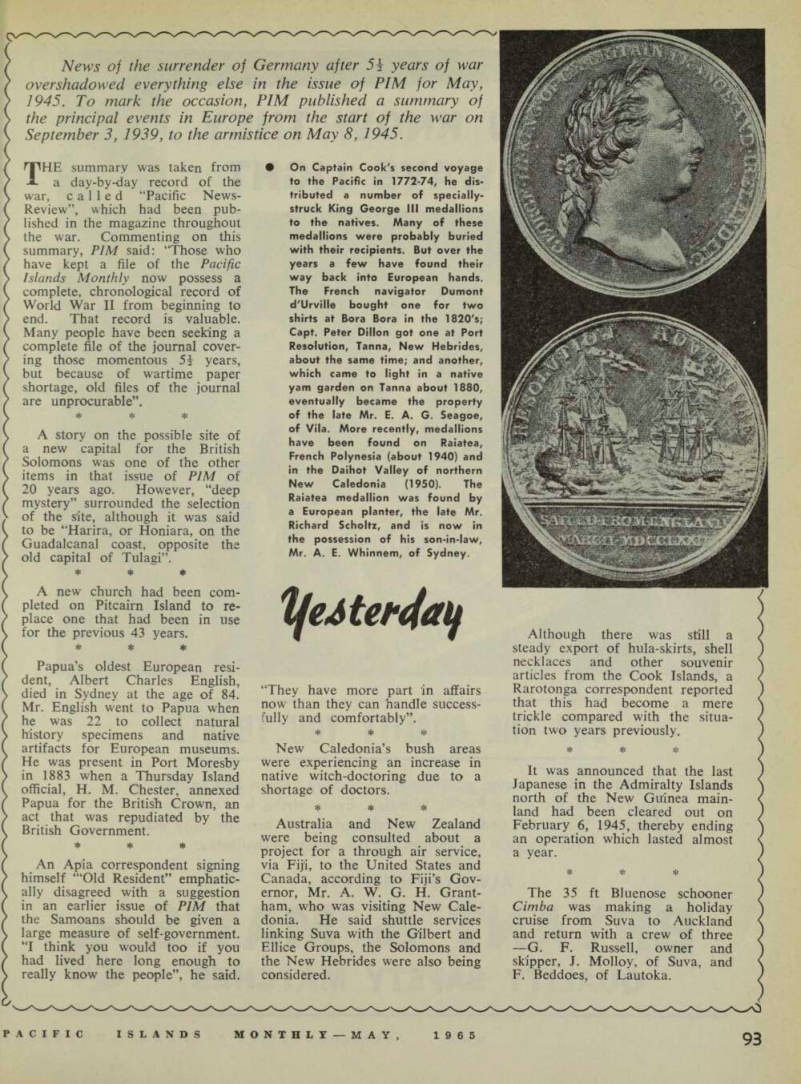
On Captain Cook's second voyage to the Pacific in 1772-74, he dis tributed a number of specially
struck King George III medallions
to the natives. Many of these medallions were probably buried with their recipients. But over the years a few have found their way back into European hands.
The French navigator Dumont d'Urville bought one for two shirts at Bora Bora in the 1820's; Capt. Peter Dillon got one at Port Resolution, Tanna, New Hebrides, about the same time; and another, which came to light in a native yam garden on Tanna about 1880, eventually became the property of the late Mr. E. A. G. Seagoe, of Vila. More recently, medallions have been found on Raiatea, French Polynesia (about 1940) and in the Daihot Valley of northern New Caledonia (1950). The Raiatea medallion was found by a European planter, the late Mr.
Richard Scholtz, and is now in the possession of his son-in-law, Mr. A. E. Whinnem, of Sydney.