New Britain’s
pp. 91-93 · Read in the full issue

Nature Man Lived On One Coconut A Day
By R. W. Robson
One of the many remarkable characters who lived in the South Pacific at the turn of the century was a highly educated German
named August Engelhardt.
HE was a naturist, or sun-worshipper and, disheartened by what he regarded as a futile struggle against the growing materialism of his native Germany, he wandered around for a while among the South Pacific Islands, seeking a place where he might make his home.
He arrived at the German settle ment of Herbertshohe, on the Gazelle Peninsula of New Britain, about 1903, and he was recommended by the famous merchant and trader, Mrs.
E. E, Forsayth—otherwise known as “Queen Emma”—to have a look at the Duke of York Islands.
The Duke of Yorks are an attractive little group lying in the narrow strait between New Britain and New Ireland. Engelhardt selected the island of Kabakon, which has a total area of about 70 hectares. The island was uninhabited but he induced a number of natives to settle there with him as labourers to plant coconut palms.
I "Kokovorismus"
Engelhardt was an ardent adherent of a small philosophic school, or sect, in the United States, which insisted that man could live and prosper on an exclusive diet of coconuts. The practice was called “Kokovorismus”.
Members of the sect had experi mented with the idea in Cuba—in fact, they founded a colony there.
Engelhardt examined the idea care fully during his wanderings in the South Sea Islands, and he insisted that he met many tribes who lived exclusively on coconuts, plus a little fish, who wore no clothes, and who apparently possessed healthy souls in healthy bodies.
On the basis of all this, Englehardt founded his own colony on Kabakon.
He wrote for magazines in various parts of the world, quoting from his own experiences and from the con siderable library which he assembled; and presently he was joined on Kabakon by at least a score of people who wanted to live like him, James Lyng, who was in New Guinea for a time during World War I, described a visit to Kabakon in 1917 in his book Island Films. Lyng v/rote.
“The hermit, or the sun-worshipper of Kabakon, as he was generally called by people in Rabaul, received his visitors at the little jetty leading out from his copra-shed into the water. We expressed surprise at his wearing a loin-cloth, to which he re plied that he yielded to convention only when receiving visitors.
“The sun-worshipper took his visitors to his library, a plain wooden structure containing a carefully
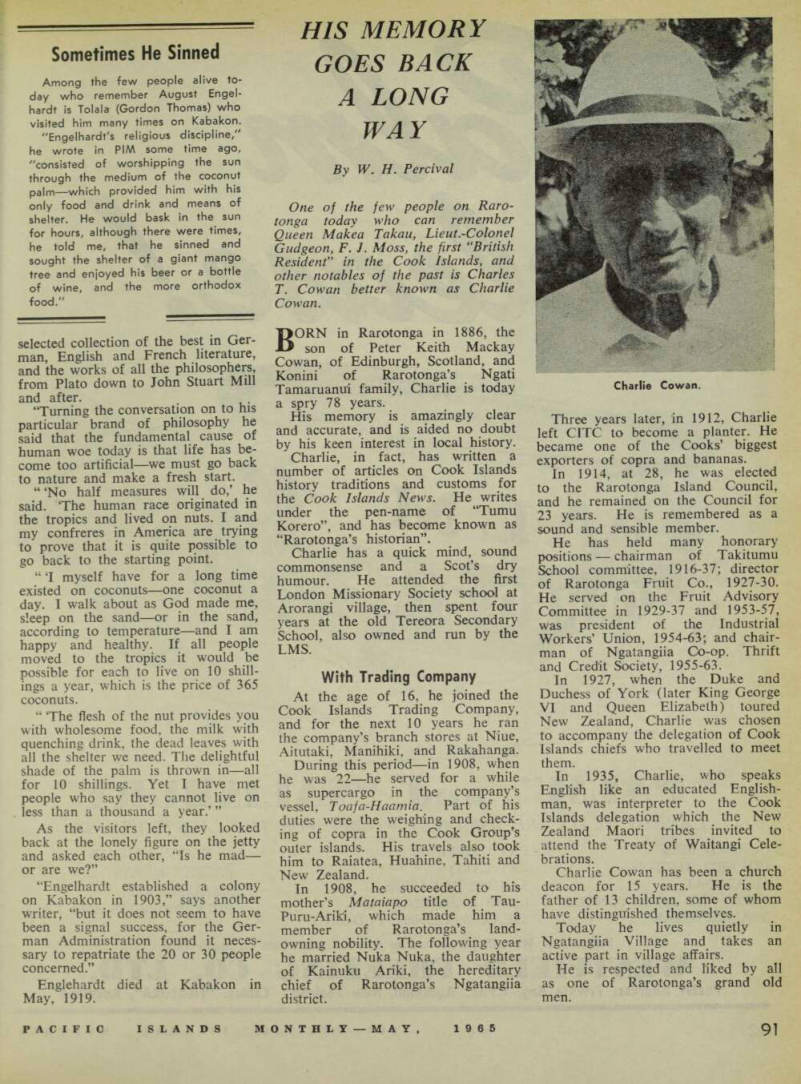
This photograph of Engelhardt was taken at Kabakon in 1911 by E. A. Hurry, and made available by courtesy of Max Hayes, of Rabaul.
selected collection of the best in Ger man, English and French literature, and the works of all the philosophers, from Plato down to John Stuart Mill and after. ‘Turning the conversation on to his particular brand of philosophy he said that the fundamental cause of human woe today is that life has be come too artificial—we must go back to nature and make a fresh start.
“ ‘No half measures will do,’ he said. ‘The human race originated in the tropics and lived on nuts. I and my confreres in America are trying to prove that it is quite possible to go back to the starting point.
“ T myself have for a long time existed on coconuts —one coconut a day. I walk about as God made me, sleep on the sand—or in the sand, according to temperature—and I am happy and healthy. If all people moved to the tropics it would be possible for each to live on 10 shill ings a year, which is the price of 365 coconuts.
“ The flesh of the nut provides you with wholesome food, the milk with quenching drink, the dead leaves with all the shelter we need. The delightful shade of the palm is thrown in—all for 10 shillings. Yet I have met people who say they cannot live on less than a thousand a year.’ ”
As the visitors left, they looked back at the lonely figure on the jetty and asked each other, “Is he mad— or are we?”
“Engelhardt established a colony on Kabakon in 1903,” says another writer, “but it does not seem to have been a signal success, for the Ger man Administration found it neces sary to repatriate the 20 or 30 people concerned.”
Englehardt died at Kabakon in May, 1919.