Savo By
pp. 87-91 · Read in the full issue


Battle Of Binisokio Predated Savo By 60 Years
By F. A. Rhoades
I first met Ingela in 1934 while I was relieving manager at Lady Lever Plantation on Kolombangara Island in the Western Solomons.
HE would then have been aged be tween 70 and 80 years; his once huge frame was shrivelled up and he was quite bald.
He did not understand Pidgin and was still a heathen despite all the efforts of the missionaries to convert him.
Ingela had once been the great war chief of the Roviana and had an in herent hatred of civilisation in gen eral and missionaries in particular.
In his prime some 50 years before I met him, he must have been a powerful man. He stood over 6 ft 2 in., and although not descended from a line of hereditary chiefs, he had, through his prowess in battle, become the greatest war chief the Roviana warriors had ever known.
The Roviana people were in those days the most war-like of all the tribes in the British Solomons.
Ingela would paddle across to Lady Lever Plantation from his village
about two miles across the lagoon.
This happened nearly every Saturday afternoon until he had just about exhausted his repertoire of stories, which he related to me with the incentive of getting a few sticks of Lord Leverhulme’s tobacco.
As he spoke only the Roviana dialect, I had to use an interpreter.
Ingela, it appears, was both “Commander-in-Chief of the Land Forces” and “Admiral of Fleet” of the Roviana people. The Roviana warriors in those days were frequent raiders of the islands to the east.
They were probably the best canoemakers in the whole of Melanesia and their huge war canoes held 40 to 60 men sitting sometimes three abreast. n . . d iii Disastrous battle In their raids, they generally attacked at dawn after having travelled during the night. The raided villages would be burnt, and all the elderly men, women and small children would be knocked on the head.
The young men and women would be kept as slaves, and the middle-
aged of both sexes who were con sidered to have enough condition were taken back to the tiny island of Bau, off Kolombangara, cooked, and eaten with cannibalistic rites, Ingela and his warriors once pene trated over 100 miles to the east, as far as Malaita. However, they were chased back to their canoes with heavy losses by the sheer weight of numbers of the smaller-statured, but extremely fierce, Malaitamen.
But Ingela’s most disastrous battle took place off the village of Bini sokio, on Santa Ysabel, after he and his warriors had raided and eaten their way eastwards along the coast of that island, which is also known as Bugutu.
The lack of population along the western part of Ysabel was due almost entirely to the efforts of Ingela and Co., and even today, if you mention the name of Ingela, the Ysabel natives will shudder with a sort of hereditary fear.
For his raid on Binisokio, Ingela assembled his fleet of four large war canoes in the Wana Wana Lagoon, The four canoes carried about 200
• The Battle of Save Island in the Solomons in 1942, when the Americans lost three heavy cruisers and the Australians the cruiser "Canberra", was one of the most disastrous battles for the Allies in World War II. But it was by no means the first such naval engagement in the Solomons.
About 60 years earlier, there were comparable casualties in the Battle of Binisokio at Santa Ysabel, when a flotilla from Meringe Lagoon routed one from Roviana, led by the noted warrior Ingela. Here F. A. RHOADES, of Rabaul, who was a lieutenant-commander with the RANVR in World War II and a coastwatcher on Guadalcanal in 1942, tells the story of Ingela and the Battle of Binisokio.
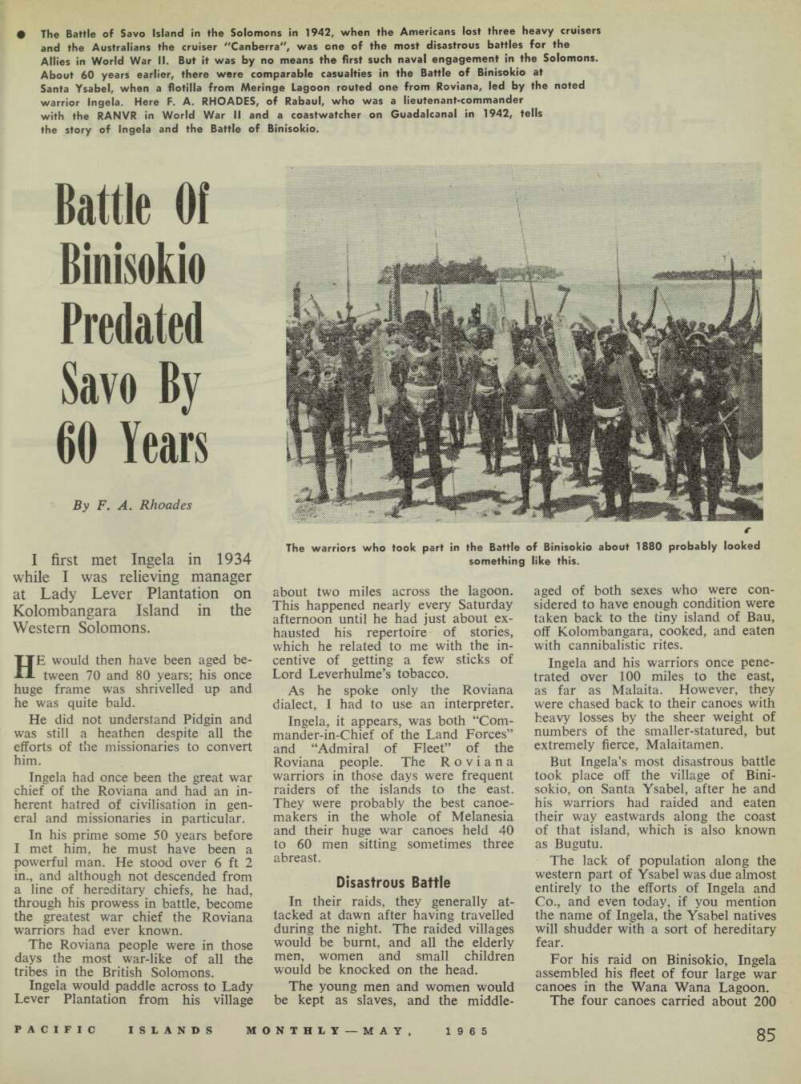
The warriors who took part in the Battle of Binisokio about 1880 probably looked something like this.
warriors armed mostly with clubs and spears, but there were also a few bowmen.
Ingela piloted the leading canoe to the entrance towards Binisokio harbour, which is very narrow and between two limestone rocks, some what like the “Beehives” in Rabaul Harbour.
But somehow he misjudged the ad verse rip up the coast, and instead of arriving off the entrance of Bini sokio before dawn he was still several miles off when daylight broke.
Alarm Raised An old man from the village, who was sitting on the hill behind Bini sokio looking for fish shoals, saw the four canoes approaching the entrance and gave the alarm.
A small canoe was sent at once to Meringe Lagoon where there was a large population.
The canoe slipped out without be ing seen by the raiders, and, mean while, the Binisokians grabbed every thing portable from their houses and retreated to the hills.
When Ingela and his warriors reached the village they found no food in the abandoned houses, and the Binisokians hurled abuse and stones down on them.
The Roviana warriors retaliated by setting all the houses on fire.
Meanwhile, the canoe from Bini sokio had reached Meringe Lagoon, where the paramount chief quickly organised a fleet of about 60 canoes, each holding from four to eight men.
Each canoe carried from 10 to 20 heavy, round, granite stones and at least one bowman.
This fleet arrived at the entrance to Binisokio unobserved by the raiders who were by this time mostly asleep, as they little feared the Bini sokians in the hills behind. But when Ingela did become aware of the situa tion, he decided to send out one canoe as a screen to draw fire.
The canoe went out through the entrance at great speed, but was soon enveloped in a hail of stones and arrows, and within minutes the whole crew was killed.
Ingela viewed the fate of the canoe crew with grave concern.
At first he thought of waiting for
darkness before making another sortie, thinking that the aim of the enemy would probably lack accuracy.
But he discarded this idea for fear that it would give the enemy time to obtain more stones and possibly arrows.
He, therefore, decided upon an im mediate sortie with the balance of his fleet. But, like the Duke of Plaza Toro, he lead his flotilla from behind, sending two canoes abreast ahead right into the enemy while his canoe hung a few lengths behind.
Similar Fate The two leading canoes soon met a similar fate to the first one, but in killing or wounding their crews, the Meringeans used up most of their ammunition.
Ingela’s canoe was thus able to shoot through the harbour entrance and through the host of small craft beyond without encountering many stones or arrows, and with few casualties.
Having got through, Ingela and his warriors—about 50-odd—sailed on to Roviana to unfold their tale of woe.
The loss of three war canoes and about 150 warriors should have lost Ingela his command, but he was, apparently, too strong a personality to be sacked by the paramount chiefs.
So he continued as “Admiral of the Fleet” at Roviana for many years, and, according to the stories he told me, he was never again beaten in battle.
In fact, the Battle of Binisokio was the only one in which he ever lost a canoe, and, curiously, he blamed himself entirely for the debacle.