Tokyo
p. 69 · Read in the full issue
Gets A Famous Hagen Axe
A Hagen ceremonial axe, which is regarded as the highest achievement in stone made by the people of New Guinea, was presented to the Governor of Tokyo at the International Trade Fair in that city which opened on April 11. The fair will continue until May 6.
THE axe was presented to Tokyo’s Governor by Zure Zurecnuoc, a member of Papua- New Guinea’s House of Assembly and Under-Secretary for the Treasury.
Mr. Zurecnuoc is representing the territory at a P-NG trade ex hibit in the Australian pavilion at the Fair.
The exhibit occupies over 1,000 square feet of space and features cocoa, coffee, timber, coconut oil and crocodile skins.
Buyers’ guides on coffee, cocoa, and timber, printed in Japanese and illustrated in colour, are being distributed from the exhibit, which is staffed by an officer of the In formation Branch of the Depart ment of Territories, an officer from the P-NG Administration’s Department of Trade and Industry, and Mr. Zurecnuoc.
Hagen ceremonial axes, such as
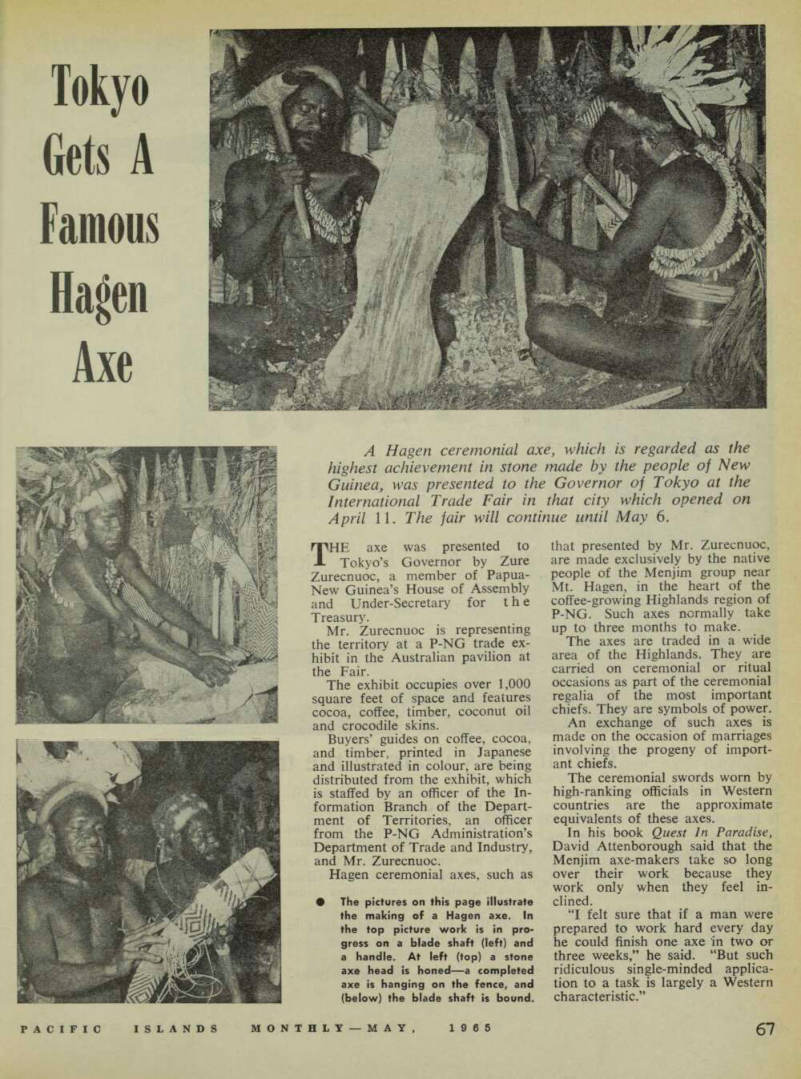
that presented by Mr. Zurecnuoc, are made exclusively by the native people of the Menjim group near Mt. Hagen, m the heart of the coffee-growing Highlands region of P-NG. Such axes normally take up to three months to make, The axes are traded in a wide area of the Highlands. They are carried on ceremonial or ritual occasions as part of the ceremonial regalia of the most important chiefs. They are symbols of power, An exchange of such axes is made on the occasion of marriages involving the progeny of import ant chiefs.
The ceremonial swords worn by high-ranking officials in Western countries are the approximate equivalents of these axes, In his book Quest In Paradise, David Attenborough said that the Menjim axe-makers take so long over their work because they work only when they feel in clined.
“I felt sure that if a man were prepared to work hard every day he could finish one axe in two or three weeks,” he said. “But such ridiculous single-minded applica tion to a task is largely a Western characteristic.”
• The pictures on this page illustrate the making of a Hagen axe. In the top picture work is in pro gress on a blade shaft (left) and a handle. At left (top) a stone axe head is honed —a completed axe is hanging on the fence, and (below) the blade shaft is bound.