Growing Problem
pp. 43-45 · Read in the full issue
Suva’S Drinkers Are A
From a Suva Correspondent There is increasing concern in Suva over the drinking habits of the Fijians. Admirers and friends of that fine race are worried about the inroads John Barleycorn is making into the lives of the people at three levels—health, standard of living and character.
RECENTLY The Fiji Times called attention to the problem, underlining the fact that there was a preponderance of Fijians among those who appear in court on drink charges.
Hardly a day passes without a Fijian appearing in the Magistrate’s Court at Suva on a charge associated with drink. Too often, reports appear of persons being assaulted and battered, and invariably the miscreant is a Fijian, who pleads “I was drunk, I didn’t know what I was doing”.
Sober, the Fijian is one of nature’s gentlemen. Drunk, he is either over-loquacious and over-friendly or the opposite. There appears to be no half-way house.
A recent example is of the Suva Chinese businessman who parked his car outside his premises. No sooner had he got out of the car than three Fijians approached and one began to play with the car’s radio aerial. Politely, the Chinese asked the Fijian to be careful or he
might damage the aerial. It took him weeks to recover from the bashing that followed.
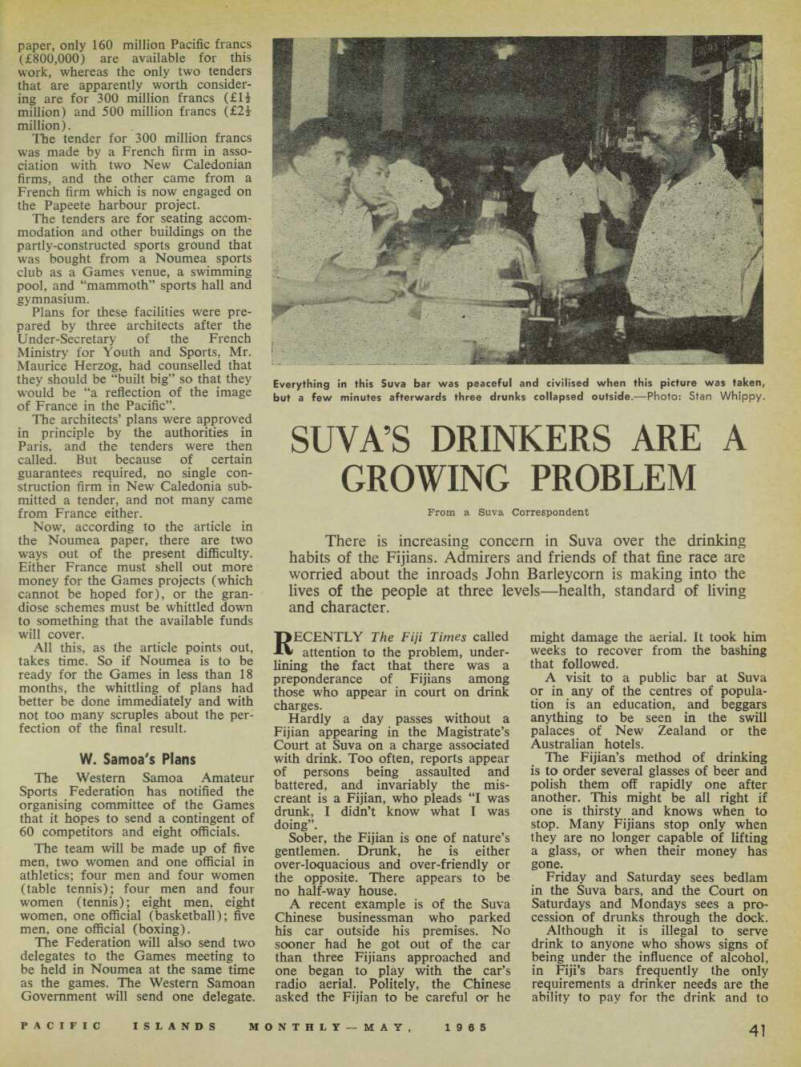
A visit to a public bar at Suva or in any of the centres of popula tion is an education, and beggars anything to be seen in the swill palaces of New Zealand or the Australian hotels, The Fijian’s method of drinking is to order several glasses of beer and polish them off rapidly one after another. This might be all right if one is thirsty and knows when to stop. Many Fijians stop only when they are no longer capable of lifting a glass, or when their money has gone.
Friday and Saturday sees bedlam in the Suva bars, and the Court on Saturdays and Mondays sees a pro cession of drunks through the dock, Although it is illegal to serve drink to anyone who shows signs of being under the influence of alcohol, in Fiji’s bars frequently the only requirements a drinker needs are the ability to pay for the drink and to
Everything in this Suva bar was peaceful and civilised when this picture was taken, but a few minutes afterwards three drunks collapsed outside.— Photo: Stan Whippy.
be standing up when the order is delivered.
It is a common sight to see a barman serve more drink to a man who is already “out” on his feet.
The history of legalised drinking in Fiji begins in 1875 when legisla tion restricting consumption of alcohol by race was introduced. It was made an offence to supply in toxicating liquor to a native or Polynesian immigrant.
In 1879 the prohibition was extended to Indian immigrants, and in 1881 to persons of mixed descent.
The permit system was introduced in 1892.
On February 3, 1958, beer was de-restricted for all males; on January 1, 1963, spirits were also de-restricted for males. The old restriction on Indian, Melanesian and Polynesian women still obtains, and they need permits to drink.
A Liquor Committee set up in I96o—its report formed the basis for changes in the Liquor Ordinance in 1962 and 1963—recommended, with only one member dissenting, that women should have the same right to drink as men, but should not be permitted to enter the public bars.
The Government agreed with the recommendation, but, faced with unanimous opposition from the Fijian and Indian members of the Legislative Council, it withdrew
from the Liquor Bill the clause permitting Indian and Fijian women to drink without permits.
Perhaps this decision was wrong.
Many a hardened drinker from European countries knows the brake on his drinking the presence of his wife can apply.
With the removal of restrictions in 1958, beer consumption in Fiji spiralled and has continued to increase every year since. When the floodgates for spirits were opened in 1963 a similar increase in the import of spirits followed.
The Fijian, in the main, sticks to beer. As the Liquor Committee observed: “An 8 oz glass of Australian or locally-brewed beer contains the same amount of alcohol as an hotel ‘tot’ of whisky or gin, and costs much less.”
There are no figures readily available for the output of locally brewed beer but excise dues on the product produced £86,055 in 1960. There was an increase of 1/6 a gallon in the excise at the end of 1961 so that the increase to a figure of £118,434 in 1963 was partly the result of the increase in dues. However, in 1964, the figure had risen to £153,498, and since there was also an increase in the amount of imported beer, two things were demonstrated. There was increased drinking and increased prosperity.
In 1959, 290,006 gallons of beer were imported. In 1960 when de restriction had got into its stride, the figure was 327,204 gallons.
That was the peak year, however, for imported beer. There were only 196,693 gallons in 1963, but the figure rose again in 1964 to 263,401.
There was no drop in overall con sumption, proving that the local brew was finding more favour, RJ«p areep Kise The import of spirits showed a steep rise after de-restriction in 19 t 6 - Figures for 1958 were 66,691 ’ 9 |?’ 153 gallons and 1964, 122,351 gallons, Fiji is not a wine-drinking country, however. Total imports in 1964 were a mere 13,330 gallons, A surprising fact arises, when one rummages through the police reports, anticipating a spectacular rise in drunkenness figures to colour the concern expressed for the Fijians future in drink. In 1957, 764 persons were convicted of drunkenness In 1958 the figure was 799, m 1962. ™3 and in 1963, 612.
Figures, it is argued, can be made to prove anything, and these might indicate that drinking habits are improving.
The Suva citizen, however, is forced to believe his eyes and his ears.
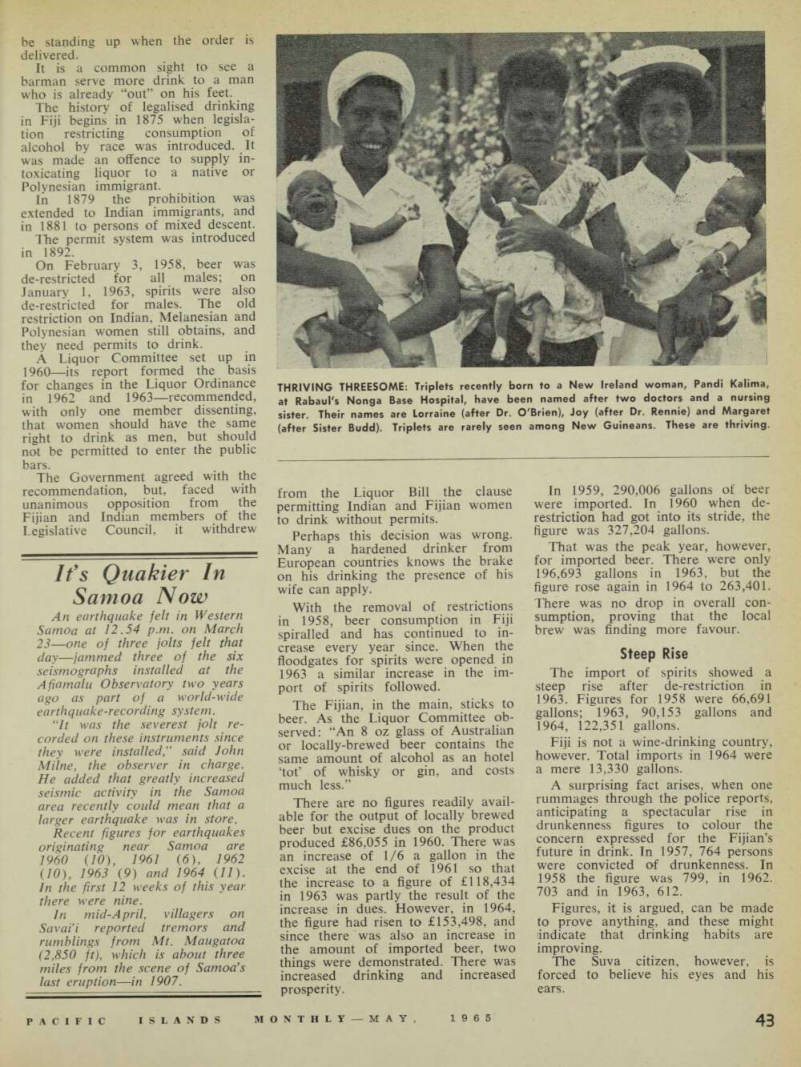
THRIVING THREESOME: Triplets recently born to a New Ireland woman, Pandi Kalima, at Rabaul's Nonga Base Hospital, have been named after two doctors and a nursing sister. Their names are Lorraine (after Dr. O'Brien), Joy (after Dr. Rennie) and Margaret (after Sister Budd). Triplets are rarely seen among New Guineans. These are thriving.