Amidst Death And Chaos, There
pp. 33-39 · Read in the full issue


Was No Rule Book To Follow
The appearance of Mary Murray’s book, Escape, which deals with the wartime escape exploits of her husband, New Ireland planter Harry Murray, and his friends, rang a bell in my mind.
THE book has been given wide publicity in some Australian newspapers —most of it summed up in the headline of the Sydney Sunday Telegraph “Army Commandos ‘Deserted Australian Civilians’
Bitter Wife’s Attack”. Criticism of that New Ireland commando unit has been made before, in Eric Feldt’s fine book. The Coast Watchers, pub lished in 1946. But Eric made a subsequent published apology.
Perhaps the ice was thin in Eric Feldt’s time, and it may have thickened in this year of 1965.
Harry, who owned Lakuramau Plantation down the east coast of New Ireland, was a most likable lad, personality-plus and efficient; a World War I digger with a DCM. He be came a Coastwatcher after his escape from New Ireland and, as Eric Feldt records in The Coast Watchers, he successfully carried out several im portant landings in the New Ireland area; for the very good reason, one assumes, of giving US naval head quarters the low-down, for it was Admiral Halsey who wanted to estab lish a base in north New Ireland, but MacArthur beat him to it with the Manus landing. Harry Murray collected an MC and a US Silver Star for his work with Coast Watchers.
But that, as I said, was after Harry’s escape from New Ireland, and after the controversial com mando incident.
Well do I remember the time when the commando crowd and the civilian passengers in Induna Star arrived in the POW camp at Rabaul.
The military were kept separate from the civilians at the time and from the Kavieng civilians I heard their tale of the departure of the commandos from Kavieng and the
Territories
Talk-Talk
With Tolala
impression I received when I first read Eric Feldt’s remarks was that it was an exceedingly charitable ac count of a regrettable incident, based on my knowledge of events as re tailed to me by Induna Star civilan passengers.
It is easy enough to dispassionately evaluate a given position and its cir cumstances after an event and voice an opinion as to what should or should not have been done. I fully realised this as I listened to the opinions expressed by these Kavieng civilians.
But I also realised that the ex periences of Kavieng had been very similar to those of Rabaul: An enemy had occupied the country; the military defending it had retired; there was no government, no law, no order; no organised plan.
One stood there alone amidst death and chaos, faced with the task of making the most momentous de cision of one’s life, well-knowing that one’s whole future depended on one’s decision.
Never were more applicable those words of poet W. E. Henley: I am the master of my fate: I am the captain of my soul.
The position was unique. There was no precedent to follow; no book of rules. You, alone, were respon sible.
Was it any wonder there were a variety of decisions made when the time to act arrived? Each different personality became evident ... To make a dash for it down the coast? . . . Stay and see it out (our own counter-attack must come soon. They —whoever “they” were, some mythical army in Australia?—would soon rescue us. Or were we really expendable?) Get aboard the last outgoing boat? (Only to be tor pedoed, or bombed at sea?) And so . . . some made a dash for it down the coast and some got away. Some did not.
Some went by sea and got away; some didn’t.
And those who stayed in Rabaul? . . . Well, it was a tragic accident that, after being embarked on Monte video Maru, the 7,267-ton vessel bound for Hainan Island, the ship should have been torpedoed at 2.30 a.m. on July 1, 1942, by US Sub marine Sturgeon in the South China Sea.
Little wonder that there were dif-
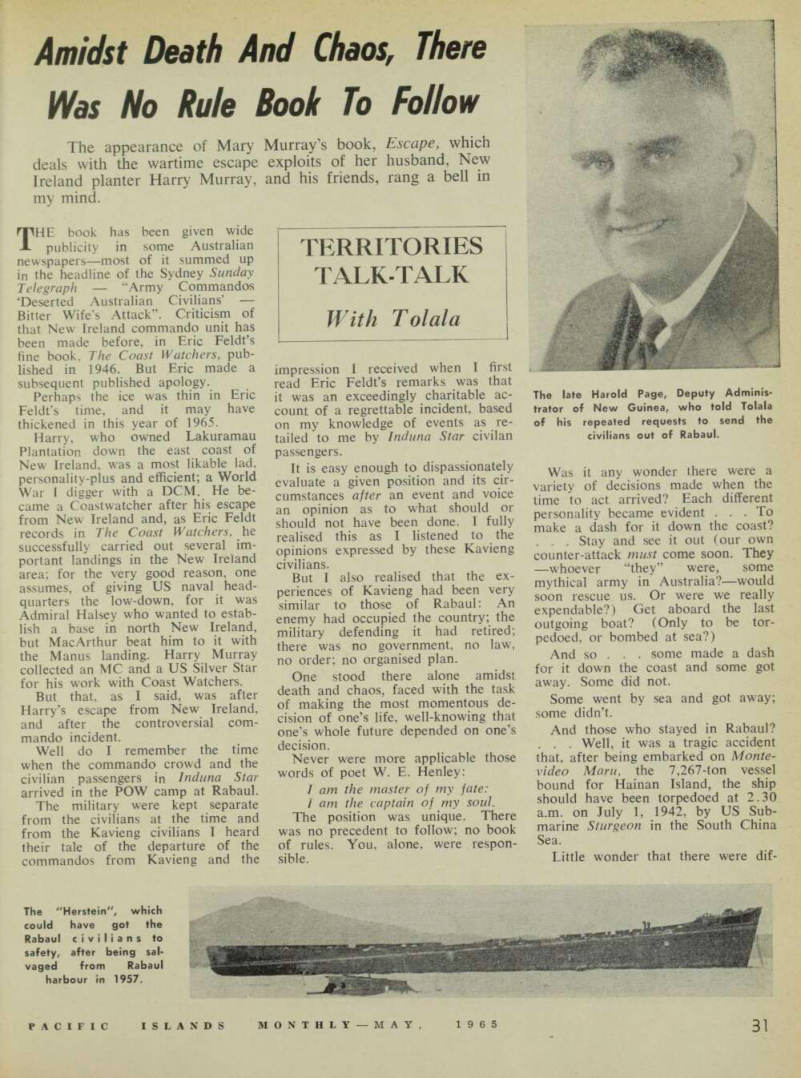
The late Harold Page, Deputy Adminis trator of New Guinea, who told Tolala of his repeated requests to send the civilians out of Rabaul.
The "Herstein", which could have got the Rabaul civilians to safety, after being sal vaged from Rabaul harbour in 1957.
ferent versions from the Kavieng crowd of what happened during and immediately after the occupation.
They also described some of the booby traps set by the commandos on the aerodrome and other strategic spots. These, unfortunately—so I learned later—were indirectly the cause of the savage treatment meted out to our men by the Japs when captured in or around Kavieng. The booby traps had accounted for a number of Japanese casualties, so I was told.
One of my informants was an in teresting Jap VIP visitor whom I met in the Rabaul freezer (where I worked) some time in 1943 (T think it was). He was Hiroshi Hamamoto and he gave me his card with his Tokyo telephone number. (“After the war you must visit me and we will look at the world from a dif ferent angle,” he had said.) He was an author-journalist of some repute, according to some Jap officers. Anyway, he made no secret of the damage done by the booby traps and the reprisals which fol lowed. He was the most neutral Jap I met during my boob days.
This is what Eric Feldt had to say about the commandos in his book (p. 45): Months later we heard the story of Kavieng ... the officer in charge of the commandos decided that it was useless to fight, and em barked his small force in a small motor vessel. He set off down the coast by night and put into a bay at dawn to hide, but found himself under the guns of a destroyer. He surrendered. It is not a bright paragraph in our history, but these men had been placed in a position where only the best of troops under inspiring leadership would have fought. Both leadership and men
were no more than ordinary, resulting in a surrender without a shot fired and without a casualty.
This somewhat innocuous reference to a “not bright paragraph in our history” nevertheless must have got into the hair of two people, judging by the apology which Eric published in the Sydney Sun of February 15, 1949, which read, in part: “Since I wrote my book The Coast Watchers, my attention has been specially drawn to the fact that I have done a grave injustice to Major Edmonds-Wilson and the Commando
Unit which was at Kavieng ... I have perused the war diary of Major Edmonds-Wilson I have read Lieut.-General Sturdee’s notes of the instructions which were issued to Major Edmonds-Wilson in his capacity of Officer Commanding First Australian Independent Company. I am now completely satisfied that the men of that company and its officers carried out the instructions in both the spirit and the letter and, in cir cumstances of great difficulty, acted with commendable courage, initiative and discretion. I regret that, in my
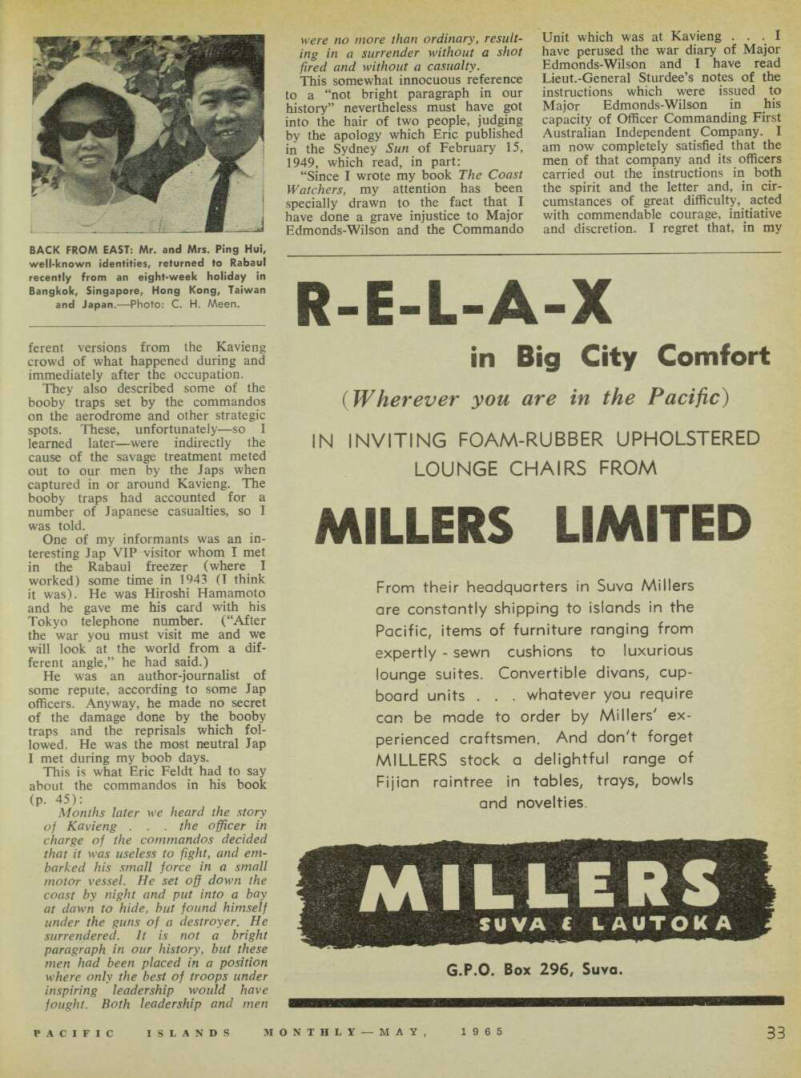
BACK FROM EAST: Mr. and Mrs. Ping Hui, well-known identities, returned to Rabaul recently from an eight-week holiday in Bangkok, Singapore, Hong Kong, Taiwan and Japan. — Photo: C. H. Meen.
book, I have unwittingly done an injustice to the officers and men of the Independent Company ...”
Both the major and the general, who was Chief of the Australian General Staff at the time, should have felt better after reading such a contrite expression from a man of Eric Feldt’s calibre.
It is unlikely, I suppose, that in reading the general’s notes Eric came across any reference to the orders issued concerning the evacu ation of Rabaul’s civilians as re peatedly requested by Deputy Ad ministrator Harold Page, when the Japs were on the door-step and Herstein in the harbour. Finally, as we know, Herstein was bombed and sank and there was no escape that way.
It was Harold Page himself who told me of his repeated requests for permission to send the European civilians out from Rabaul in Hoer sten.
Many of the captured civilians were, quite unjustly, blaming Harold for their present situation.
“Why didn’t Page commandeer the Herstein ? Why didn’t Territories De partment do something?” There were some unkind remarks made by those who did not stop to realise that neither Page nor the Territories De partment had command in a war zone. And Page lost his life like all the others.
Full Circle
IT would seem that the political leaders of the P-NG House of Assembly are not taking long to pick up the finer points of their duties and, furthermore, to implement them.
Sydney morning newspapers in the last days of March carried a story which was embarrasisng Government officials “because many NG natives are asking to be sent to Queensland”, It appears scores of natives ap proached the Government officials “demanding it lives up to its promise and send them to Queensland to cut cane”.
Eventually it was discovered that, while attending the Parliamentary Association’s conference in Hobart, an NG Parliamentary Under-Secretary, Sinake Giregire, had suggested to the conference that New Guineans be sent to Queensland canefields and allowed to work there as labourers.
When his remarks were broadcast to village listeners they were mis understood and people thought the Government would send them to Queensland.
Times change all right. There are still a few who remember the days
when Pacific Islanders were “black birded” to the Queensland canefields, and their lot was not a happy one, although a number of them re mained.
The “misunderstanding” was prob ably due to careless handling in the
translation into—presumably—pidgin.
"Ineffective Education"
HAVE you ever noticed that the popular game of Controversial Topics does, at times, over-reach it self? In Australia at present the topics consist mainly of NSW political prophecies for the State elections; when Dubbo may get a
direct air service; Christian unity; the moral rectitude or degeneracy of a certain TV programme; and, of course, that hardy annual, education and when, how and what to teach.
It would seem as though the world is rushing recklessly forward and politicians, moralists, churchmen and educationists are vainly trying to keep up Wlth the global tem P°- .
Be that as it may . ttie f ac t remains that educational planning appears to be as indeterminable as ever, while the teachers themselves appear to be anything but a happy lot.
And this brings us to Dr. M. S.
Adiseshiah, the Deputy Director- General of UNESCO, who delivered
the Camilla Wedgwood Memorial Lecture (in Port Moresby, of course) at the beginning of April.
Dr. A. hails from India and has made a study of the educational needs for “newly emerging nations”.
His comments on P-NG educational requirements are therefore well worth regarding. His yard-stick for measuring these needs is one which has had much work in other Asian, African and Latin American countries.
In short, the Deputy Director- General should have a pretty good idea of the needs of a people in that difficult “transition” period as are our New Guineans. Let us hope that the Canberra experts closely study the doctor’s comments.
I particularly favoured his re mark: “Speaking as an economist I feel that the Territory should now concentrate on quality and not quantity in education. The miracle of the last 10 years in introducing edu cation to so many now produces the problem of ‘What do you do with them’?” (He could have added: If you have such a problem over your primary and secondary graduates, what will happen to the tertiary?) In two or three years, he reckoned, it would be time enough to establish a university and then, he suggested, it should be a college of education to train teachers to a standard for local requirements. It should not try to match the standards of metro politan universities of Australian cities.
Any "Clara-Isms"?
I HAD a note the other day from Noelle Mason (Mrs. Paul Mason, of Inus, down in Bougainville) telling me she is putting together some reminiscences about Clara Scott, of the Solomons, who must be the white woman who has lived the longest in those parts. Noelle care fully refrains from calling it a biography.
It was in late 1915 that I first met Clara and experienced her wonderful hospitality at the Scott home on Orlofe Island.
Mrs. Mason is asking for any anecdotes in connection with Clara or the general locale of the Short land group, and from any Fiji readers tales of Clara’s forebears, Capt. John McDonald, Uncle Billy (Capt.
William McDonald) and of the Mc- Donald Hotel.
Get cracking now, you old-timers!
Send anything you may have direct to Mrs. Paul Mason, Inus Plantation, Bougainville, New Guinea.